Inside an Iranian "missile city". State news agency IRIB said the Revolutionary Guards unveiled the launcher and a new missile base during a visit by IRGC commander Ahmad Vahidi and aerospace chief Seyed Majid Mousavi. State TV said a launcher capable of firing two liquid-propellant missiles simultaneously was unveiled for the first time.
US/Israel-Iran war: What UAE residents need to know today (Nov. 23, 2026)
Strait of Hormuz sees surge in tanker attacks, US-Iran tensions escalate
Last updated:
4 MIN READ
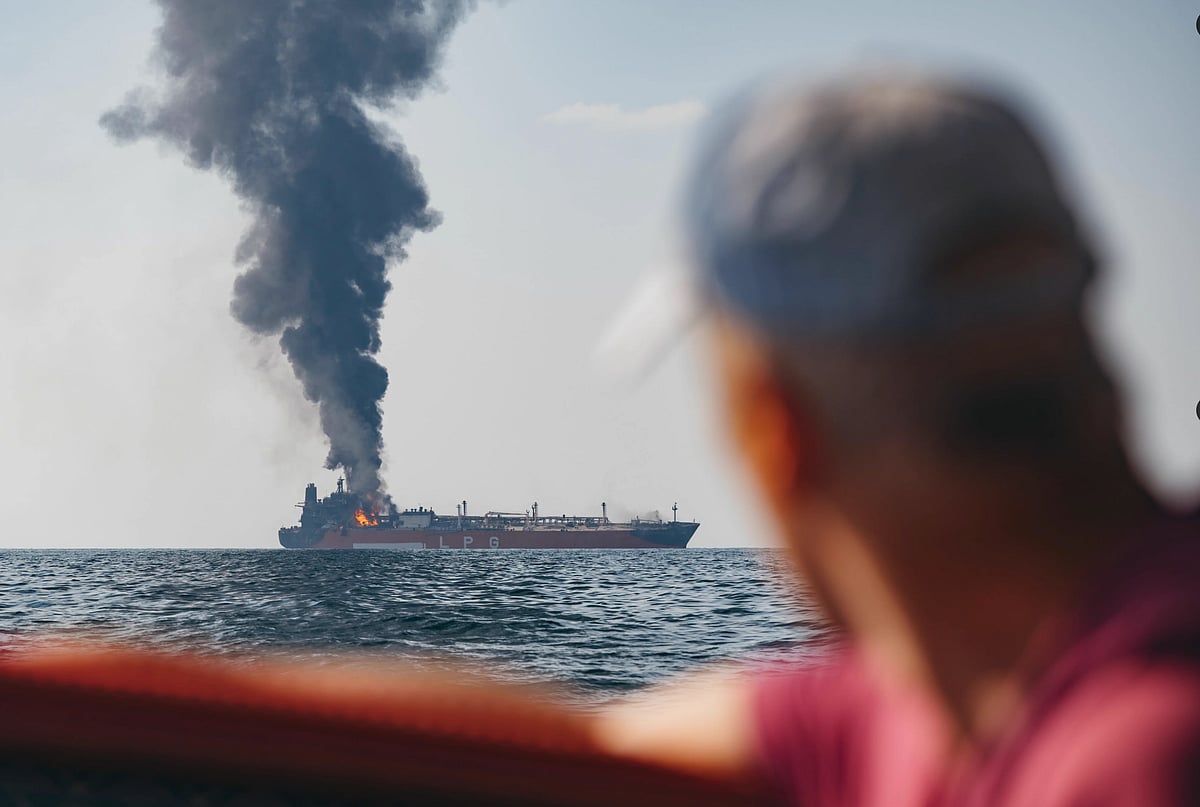
Environmental campaigner Lewis Pugh shared this photo after completing a three-day swim through the Strait of Hormuz. "I went there to bring attention to the devastating environmental cost of war." No context was given as to date, time and details of the burning ship in the background.
@LewisPugh
The US/Israel-Iran conflict continues to shape daily life across the Gulf.
Diplomacy remains stalled.
There's no deal in sight to end the war or reopen the Strait of Hormuz, while tanker fires and missile interceptions keep tensions high.
Airlines have extended cancellations on several Saudi routes, and oil prices remain elevated.
UAE residents are being urged to follow official advisories, confirm flights before travelling, and prepare for possible disruption.
Following are the latest updates:
Get it: Fast, verified news for FREE ... download the Gulf News app — simply click here
Jordanian sailor missing
JMIC said Iran's IRGC activity involving drone overflights, surveillance of commercial ships and occasional radio warnings continued.
It said Iranian claims that tankers had "struck naval mines" remain unconfirmed.
The UAE and Oman are continuing their search for a Jordanian sailor missing after an oil tanker was attacked in the Strait of Hormuz, as maritime security risks in the area remain high.
The search follows a series of attacks on commercial vessels in the strait since November 16.
7 oil tankers hit since Nov. 16, 2026
The Joint Maritime Information Centre (JMIC) said seven oil tankers have been hit, including three vessels struck near Oman’s coast between November 20 and 21. The latest attacks targeted outbound tankers between 8 and 17 nautical miles from Khasab, Oman.
Two of the vessels were hit about 50 minutes apart.
The UAE and Oman are leading the search for the missing Jordanian sailor. No further details have been released on the sailor’s identity, the tanker involved or the progress of the search.
The UK Maritime Trade Operations (UKMTO) also reported an incident involving an "oil tanker and military forces in the Gulf of Oman".
It said authorities were aware of the incident and investigations were underway.
Iran shows off dual launchers inside 'misile city'
Iran says it has a launcher that can fire two missiles at once, and showed it inside an underground base, or "missile city". The claim comes from state media, in clips shared by state controlled IRIB and PressTV, a state-funded network based in Tehran. No independent source has verified the system’s performance.
Yemen: Saudi strike on Hodeida
Houthi-affiliated media said a Saudi attack on the port city of Hodeida killed at least four people and injured 18, hitting a building belonging to Yemen’s Public Telecommunications Corporation.
Riyadh hasn’t commented, and the toll is unverified.
The Iran-backed Houthis control parts of Yemen, including Hodeida, and are fighting a Saudi-led coalition that backs the internationally-recognised government.
The never-formalised truce had held for four years, the longest lull since the coalition intervened in 2015.
It unravelled in July, and the UN says hostilities since have killed more than 1,600 people and displaced more than 300,000.
Attacks on Saudi Arabia, Bahrain
A day earlier, the Saudi-led coalition said it had intercepted a ballistic missile aimed at the kingdom’s western Red Sea coast.
The Houthis claimed two operations on Sunday, including a direct strike on the Rabigh oil refinery. The western region holds key energy sites, including the Yanbu export terminal. The Houthis’ claims are unverified.
Bahrain, meanwhile, said an Iranian attack hit a civilian industrial facility, causing a fire and damage.
Two people were injured, including a Pakistani resident in critical condition. The UAE, Qatar and Saudi Arabia condemned the attack and expressed solidarity with Bahrain.
Attacks on tankers
Attacks on tankers have reached their highest level since the war began. The US rejected Iran’s claim that it hit an American fighter jet.
Maritime monitors, however, say no Iranian tanker has so far been seen trying to break the US blockade.
Tankers waiting offshore, ship-to-ship transfers and convoy proposals are not evidence of a breakout.
The episode also shows how easily unverified tracking data can drive the narrative in a conflict where information moves faster than confirmation.
A convoy confronting the blockade, and the threats against Gulf energy facilities that come with it, would raise the stakes for regional shipping, fuel prices and security.
Diplomacy
Trump says Iran wants a deal but that its terms are unacceptable.
Ynet, citing US officials, reports a possible strike on Iran has been postponed by at least a week despite pressure from Netanyahu. The US warned Americans in Bahrain of Iranian and Houthi attack threats.
Iran's foreign minister, Abbas Araqchi, said Tehran still seeks a diplomatic settlement, with messages passing through mediators. No agreement to end the conflict or lift Hormuz restrictions has been announced.
Iran's Parliament Speaker Mohammed Ghalibaf, said Iran rejects a prolonged "neither war nor peace" situation, and that it will be settled on the battlefield or the US must accept Iran's conditions.
Flights and travel
Etihad has extended cancellations of Abu Dhabi-Riyadh and Abu Dhabi-Dammam flights through November 30.
Emirates, flydubai and Air Arabia are running varying Saudi schedules.
flydubai extended Riyadh and Abha cancellations until November 27, while Dammam services have resumed on a reduced schedule.
Iranian airlines remain suspended to and from the UAE.
The UK Foreign Office calls the regional situation "deeply unpredictable" and warns of possible flight cancellations and airspace closures.
The US State Department also warns of risks to civil aviation near the Arabian Gulf and Gulf of Oman, including the UAE.
Oil hovered above $92 on Monday (Nov. 23) as US-Iran diplomacy remained stalled.
UAE fuel rates eased in November. Lower crude prices could eventually ease transport and logistics costs; petrol prices are adjusted monthly in the UAE.
Confirm your flight with your airline before heading to the airport.
What to do
For UAE residents, the risk lies in what happens if a real blockade running attempt is made by Iran.
Residents should rely on official UAE advisories and verified sources rather than viral tracking screenshots.
Follow official UAE advisories and your airline's announcements, and keep travel plans flexible.
Network Links
GN StoreAbout Gulf NewsTerms & ConditionsReach by GNSitemapContact usPrivacy PolicyGN FocusHave your sayWork with usAdvertise with usGulf News epaperPrinting Services
Download our app
© Al Nisr Publishing LLC 2026. All rights reserved.