“We used to see so many abandoned, dumped cats when we were growing up,” recalls Abdulkarim.
Meet the Emirati in Dubai caring for 30 cats outside his home: How he rescues animals from the desert and parks
For Abdulkarim, every rescue tells a different story.
Last updated:
3 MIN READ
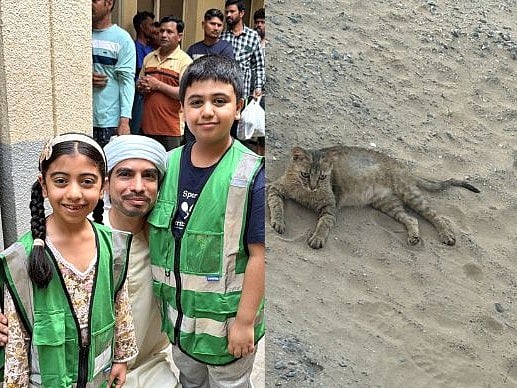
Abdulkarim Ismail Al Zarouni is the co-founder of Amal CSR, a UAE-based initiative.
Abdulkarim Ismail Al Zarouni might be a little reserved when it comes to speaking about himself. Yet, when it comes to rescuing abandoned cats from different corners of UAE, the stories begin to flow.
And due to his efforts, in one corner of the city, nearly 30 street cats know exactly where to go when hunger strikes. They gather at fixed feeding stations, padding along familiar paths and waiting patiently for Abdulkarim, who has spent much of his life caring for them. Some stay outdoors, others have found temporary refuge inside his home. Looking after them isn't something he schedules into his day. It has become part of the rhythm of family life.
“Some of them sleep in our home, and we feed them too,” he says.
It’s a family mission. His mother helps. Caring for the animals is melded into the fabric of their lives. Compassion is a shared responsibility.
An Emirati who was born and raised in Dubai, Abdulkarim had often noticed a problem that often went unseen: abandoned animals struggling to survive.“We used to see so many abandoned, dumped cats when we were growing up,” he recalls.
He couldn’t just walk past the sights of animals in distress. So, for years, he independently rescued cats and helped animals in distress whenever he could. But as the number of cases grew, so did the realisation that lasting change would require something bigger than individual efforts.
In 2024, he and his partner launched Amal CSR, a UAE-based initiative focused on animal welfare and sustainability. Initially run by volunteers, the initiative has since secured its own funding, allowing it to broathen its efforts in animal welfare and sustainability.
In 2024, he and his partner launched Amal CSR, a UAE-based initiative focused on animal welfare and sustainability
Those efforts often begin in places many people would never think to look.
For Abdulkarim, every rescue tells a different story. Some cats are found wandering in the desert, dehydrated and exhausted. Others are discovered on construction sites or in industrial areas where survival chances are strained. Then there are the animals left behind in parks after their owners move away, forced to fend for themselves. Each situation presents its own challenges, but the objective remains the same: Give the animals a new lease of life.
Few of these rescues happen in isolation. There are well-connected groups of volunteers relentlessly looking out for vulnerable animals in the UAE. When a cat or dog in distress is spotted, messages and photos are quickly shared among rescue groups. Often, help is mobilised within hours, with volunteers coordinating transport, arranging veterinary care and ensuring the animal receives the treatment it needs.
"We try to save the cats in the best way that we can," he says. "By taking them to the vets, or doing TNR."
TNR, or Trap-Neuter-Return, is one of the key methods used to humanely manage stray cat populations. Cats are trapped, sterilised and returned to their territories, helping reduce suffering and prevent uncontrolled population growth.
But compassion comes with a cost. "Some are left behind in parks. People just dump them and leave them behind when they leave the country," Abdulkarim says. "We take them to the vets, and pay for them, though it costs a lot."
Veterinary bills, food, transportation and ongoing care quickly add up. Yet for Abdulkarim, the financial burden is secondary to the welfare of the animals. Every cat treated, every rescue completed and every life saved reinforces a belief that has guided much of his work: Communities thrive when compassion becomes a collective responsibility.
That belief doesn't stop with animals. Through this initiative, Abdulkarim is also helping create a healthier and more sustainable environment. The organisation plants trees and supports environmental initiatives aimed at strengthening urban ecosystems and improving community wellbeing.
To him, the connection is straightforward. Caring for animals and caring for the environment are just two sides of the same coin. Just making the world a better place.
Network Links
GN StoreAbout Gulf NewsTerms & ConditionsReach by GNSitemapContact usPrivacy PolicyGN FocusHave your sayWork with usAdvertise with usGulf News epaperPrinting Services
Download our app
© Al Nisr Publishing LLC 2026. All rights reserved.