Nikita Neogy's painting
'I kept drawing eyes': How Dubai teen’s pandemic hobby became award-winning art in the GCC and beyond
Dubai-based Nikita Neogy shares her art journey that began at the age of nine
Last updated:
5 MIN READ
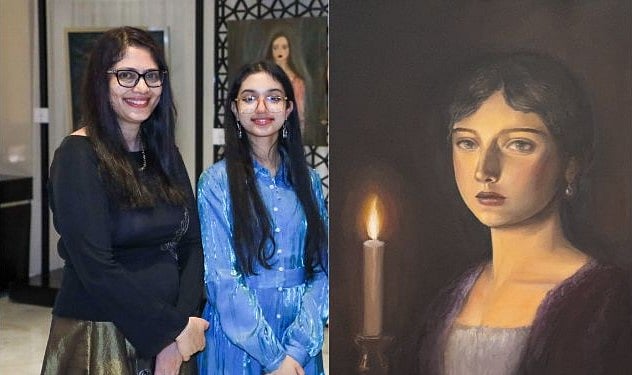
Left: Nikita Neogy with her mother, Lisa Chatterjee. Right: Her artwork, The Last Spark
Paper is more patient than man, as the saying often goes.
The world slowed down during the pandemic, and nine-year-old Dubai-based Nikita Neogy turned to paper and a pencil. With time no longer in question, she began sketching in her room. She wasn’t harbouring lofty, idealised dreams: She just drew.
Little did she know that this habit would grow into international recognition, with major competition triumphs. She would go on to build a portfolio that includes first-place finishes in some of the region’s largest student art competitions, a prestigious art scholarship along with a stream of accolades.
But at the time, she was just drawing. Faces.
A passion born in lockdown
Nikita, who is 15 now, shares her story with us. “I had always enjoyed drawing, but the pandemic gave me something I didn’t really have before, which was uninterrupted time to practise after online classes.” During the lockdown, instead of treating drawing as something to do occasionally, she started spending hours on it.
One idea leads to another, and those days were filled to the brim by curiosity. There was a new thrill: Capture the human face. And so, that's what she sought to do, instead of experimenting with too many subjects.
As she explains, “Very early on, I became interested in portraits. Faces felt like the most challenging subject, because even a small mistake could change an expression,” she says. Nikita recalls the days when she repeatedly sketched eyes, trying to understand how light, shadows and proportions worked together. The illustrations began to gradually shift from a hobby to a long-term passion.
She didn’t have an art teacher; she relied on online tutorials, and studied the work of established artists and just kept experimenting with art. Through trial and error, she kept trying to figure things out, as she says. “I could tell that something looked wrong in a painting, but I didn't always know why. I learned by watching tutorials, studying the work of other artists and, most importantly, making mistakes and trying again."
The progress was gradual, but so was the transformation. Nikita adds that there wasn’t a specific moment when something changed. It was just a series of changes, little by little, all piecing together her journey as she began sharing her work more widely. “Opportunities began to appear that I hadn't expected, especially receiving an art scholarship from my school, UAS (Universal American School),” she says.
She received feedback from established artists, and was asked to exhibit her work. A realisation dawned: Her paintings were making an impact.“This encouraged me to take the work more seriously and think about what I wanted to convey through it."
The determination behind the talent
Lisa Chatterjee, Nikita’s mother is emotional and proud, as she looks back at her daughter’s journey. It began with pencils, moved to paints, oils, painting a picture of success. The admirable aspect of it all for her, was just the consistency. "At first, we saw drawing as one of many interests that children often explore,” she says. But, Nikita didn’t let the pencil go, and weeks turned into months, as her enthusiasm only grew. “She continued dedicating more and more time to developing her skills."
Perhaps another ingredient to this little success story: Nikita was determined to take on challenges. She wanted to push herself, as Chatterjee adds. She would spend hours working on difficult subjects, researching techniques and starting over when something wasn't working. Over time, it became clear that this wasn't simply a hobby she enjoyed, it was something she was genuinely committed to pursuing and improving,” she says.
Support, love and a caring environment: Perhaps that’s all a person needs to chart their own path, sometimes. “Our role as parents was mainly to create an environment where Nikita could continue exploring her interests. We made sure she had the materials she needed and a space where she could work comfortably,” explains Chatterjee.
Opportunities began to emerge, and they supported her with the practical side of things like applications, exhibition logistics and communication. “We wanted to make sure she could focus on her studies and her artwork without feeling overwhelmed by everything happening around it."
Art, academics and balance
How was she able to juggle international exhibitions, competitions and commissions that demanded hours of work as well as her own art?
But Nikita was learning the art of time management, and discipline. "For me, it's about making time for the things that are important. I take my academics seriously, but I also enjoy painting and spending time with friends and family. Good time management helps me do all these without feeling like one has to come at the expense of another."
Ironically, it’s her own artwork that taught her lessons. “Painting has actually helped me become more organised,” she says frankly. “Many pieces take a long time to complete, so I've learned to work steadily over time rather than leave everything until the last minute. That approach has been useful not just in art, but in school and everyday life as well."
Her parents have encouraged the same philosophy. "Most of our conversations are really about time management rather than choosing one path over another. Like many teenagers, she’s balancing different responsibilities, and our role has been to help her keep perspective and make sure she isn’t taking on too much at once,” explains Chatterjee.
Telling stories through realism
Art tells stories, and that’s what Nikita intends to do. She is drawn to stories that dwell on introspection and raw emotion. “Before starting a portrait, I often spend time researching the historical context and heritage that I am exploring in the specific piece,” she says.
One example is her work The Last Spark, a portrait that invites viewers to look beyond physical likeness.
"With artworks like 'The Last Spark', I wasn't trying to create a realistic resemblance. I wanted viewers to engage with the meaning behind the portrait and reflect on the experiences that shaped them."
It’s a language that she has learnt to tell different stories. “Realism is important to me, but it’s a tool for communication. If someone spends a little longer looking at my painting because they're curious about the story behind it, then I believe I have achieved something meaningful."
A journey still unfolding
The milestones have come quickly. In recent years, Nikita has been named Realistic Artist of the Year by Media Waves, won first place in the GCC's largest annual student art show featuring more than 1,200 students, topped the Voices of the UAE Student Competition, won the COP28 Toyota Dream Car Sustainability Art Contest, and contributed to a Guinness World Record live painting achievement alongside 50 international artists.
Her work has also been selected for international showcases including We Are the World in Florence and the International Art Museum of America in San Francisco.
For her family, however, the awards tell only part of the story. "There have been many special moments along the way. Seeing Nikita win the largest GCC Annual Student Art competition in her category, hearing that world renowned portrait artist, Robert Shetterly, had taken the time to look at her work and offer feedback, and watching her story being published, were deep meaningful milestones for us,” adds Chatterjee.
But the achievement that matters most isn't hanging on a wall or listed on a certificate. Chatterjee is just proud of Nikita’s own willpower and focus as she grows as an artist and a person, as she says.
For a girl who began by sketching eyes during lockdown, it is a remarkable journey already. And judging by the stories she is determined to tell through her art, it may only be the beginning.
Network Links
GN StoreAbout Gulf NewsTerms & ConditionsReach by GNSitemapContact usPrivacy PolicyGN FocusHave your sayWork with usAdvertise with usGulf News epaperPrinting Services
Download our app
© Al Nisr Publishing LLC 2026. All rights reserved.