Positioned in one of India’s fastest-growing industrial and transportation hubs, Galgotias University surges in global and national rankings
Galgotias University on most frameworks assessing higher education institutions in India
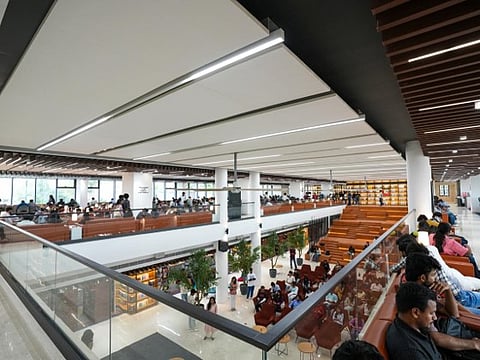
The twin cities of Noida and Greater Noida illustrate India’s economic transformation particularly vividly. Over the past two decades, the region has emerged as one of the country’s fastest-growing industrial, manufacturing and technology centres, supported by modern expressways, expanding urban infrastructure and increasing global connectivity. The newly inaugurated Noida International Airport at Jewar, expected to become one of Asia’s largest aviation hubs, is accelerating that momentum further, drawing investment into logistics, advanced manufacturing, data centres, electronics, mobility and aviation services.
Galgotias University has grown alongside this transformation. Its campus is located within an economic corridor where industries are expanding rapidly and where demand for engineers, technologists, researchers, managers and entrepreneurs continues to rise. Industry partnerships, research priorities and academic programmes have increasingly evolved in response to these shifts in the regional economy.
The latest cycle of national and international rankings suggests that this alignment is beginning to translate into measurable institutional outcomes. From the Times Higher Education World University Rankings and the QS World University Rankings to the THE Impact Rankings, the India Today-MDRA survey and NAAC accreditation, Galgotias University now features across nearly every major framework used to assess higher education institutions in India.
Each ranking measures something different. THE focuses heavily on teaching, research and citations. QS places greater emphasis on reputation and internationalisation. THE Impact Rankings assess contributions towards the United Nations Sustainable Development Goals. India Today-MDRA captures domestic academic standing and perception, while NAAC examines institutional processes and governance. Strong performance across all of them is relatively uncommon, particularly for a university established in 2011.
Times Higher Education World University Rankings 2026
One of the university’s most significant recent milestones came with the publication of the Times Higher Education World University Rankings 2026. Galgotias University was placed in the 1201-1500 global band and ranked 27th among private universities in India.
THE evaluates institutions across five broad pillars: Teaching, Research Environment, Research Quality, International Outlook and Industry Engagement. Research Quality emerged as one of Galgotias University’s strongest areas of performance, reflecting sustained growth in scholarly output and citation impact.
The university’s Scopus profile now includes more than 8,500 indexed publications, over 65,500 citations and an h-index of 94. Seven faculty members feature among the world’s top 2 percent scientists, while researchers across disciplines have secured competitive funding from agencies including ICSSR, ANRF, CSIR, SERB, DHR, IUAC and the IIT Bombay TIH Foundation.
QS World University Rankings 2027
Galgotias University’s progress is equally visible in the QS World University Rankings 2027, where it was placed in the 1201-1400 global band. The university was ranked among the top 16 private universities in India, 46th among all universities in the country and third among private universities in Uttar Pradesh.
For an institution established in 2011, entry into the global rankings ecosystem within little more than a decade marks a relatively rapid rise.
Subject-level rankings provide additional context. In the QS World University Rankings by Subject, Galgotias secured a place in the global rankings for Computer Science and Information Systems, reflecting the growing scale and maturity of its engineering and computing ecosystem.
QS indicator-level data also highlights the university’s performance in internationalisation. Galgotias ranks sixth in India for international students and international diversity, ninth for international faculty, 13th for faculty-student ratio and 20th for academic reputation.
The international indicators are particularly notable for an Indian private university and reflect a sustained effort to build a globally connected campus environment.
Times Higher Education Impact Rankings 2026
While the world rankings focus primarily on research and academic reputation, the Times Higher Education Impact Rankings assess universities against the United Nations Sustainable Development Goals.
Among the 1,603 universities assessed globally in the 2026 edition of the rankings, Galgotias University was one of only five institutions from Uttar Pradesh to be included.
The university recorded its strongest performances in SDG 1 (No Poverty), SDG 2 (Zero Hunger), SDG 6 (Clean Water and Sanitation) and SDG 15 (Life on Land), where it was placed in the global 101-200 band.
Further strong performances were recorded in SDG 4 (Quality Education), SDG 9 (Industry, Innovation and Infrastructure), SDG 10 (Reduced Inequalities), SDG 12 (Responsible Consumption and Production) and SDG 14 (Life Below Water), where the university was placed in the 201-300 band globally.
These outcomes reflect sustained institutional investment in sustainability, community engagement and socially relevant research.
India Today-MDRA Rankings 2026
Within India, the India Today-MDRA survey remains one of the most closely watched indicators of institutional standing.
In the 2026 edition, Galgotias University secured top-tier rankings for Academic Excellence in Law, Business and Media among private universities. The university also recorded strong performances across engineering, computing and hospitality disciplines.
The alignment between domestic and international rankings is notable because these assessments rely on very different methodologies. International rankings draw heavily on research metrics and reputation surveys, while domestic rankings place greater emphasis on teaching quality, infrastructure, employability and student outcomes.
Increasingly, both sets of rankings are arriving at similar conclusions.
NAAC accreditation
Alongside these rankings sits the university’s accreditation by the National Assessment and Accreditation Council.
Galgotias University holds an A+ grade from NAAC, achieved during its first accreditation cycle. At the time, this represented one of the strongest first-cycle performances by any university in Uttar Pradesh and placed Galgotias among a relatively small group of institutions nationally to secure an A+ grade at the first attempt.
The assessment covered curriculum design, teaching and learning processes, research and innovation, governance, infrastructure, student support and institutional leadership.
Unlike rankings, which can fluctuate annually, accreditation evaluates institutional systems and academic processes over longer periods. Strong accreditation outcomes therefore provide an important indicator of consistency and organisational maturity.
Viewed together
For CEO Dr Dhruv Galgotia, rankings have always been a consequence of sustained focus on academic excellence, close industry alignment and creating opportunities that allow students to realise their potential on a global stage.
That philosophy has shaped much of the University's direction over the past decade. As industries evolve and new sectors emerge, Galgotias has sought to continuously adapt its academic programmes, research priorities and industry partnerships to remain closely connected to the changing world of work. The objective has been straightforward: to equip students with the knowledge, skills and exposure needed to succeed in industries that are themselves being reshaped by technology, artificial intelligence and globalisation.
At the same time, the University has invested heavily in creating an environment where students are encouraged to spread their wings, pursue ambitious goals and explore opportunities well beyond the classroom. International immersion programmes, entrepreneurship support, industry-led learning, active learning pedagogies and global collaborations all form part of that broader effort.
Viewed through this lens, the rankings tell a larger story than institutional recognition alone. The Times Higher Education rankings capture research quality and citation impact. QS places greater emphasis on reputation and international engagement. THE Impact Rankings focus on contributions to society and sustainable development. India Today-MDRA reflects domestic academic standing, while NAAC evaluates institutional quality and governance.


