Terra's Hundred Hives reaches its first Dubai school
Deira International School joins Dubai's Hundred Hives with on-campus beehives
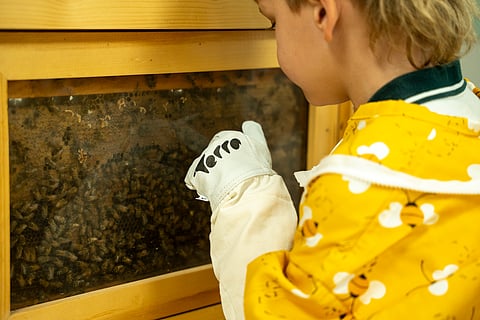
There's a new buzz around campus as the UAE's first native swarm of bees has found a home at Deira International School (DIS).
DIS has become the first school in Dubai to join Terra Expo City Dubai's Hundred Hives initiative, bringing a working beehive onto campus and giving thousands of students a front-row seat to biodiversity in action.
The programme aims to establish 100 pollinator hives across Dubai, and is designed to move environmental education beyond textbooks and into real-world experiences. Rather than simply learning about pollination, students will observe and engage with a living ecosystem while discovering the crucial role bees play in sustaining food systems and biodiversity.
The partnership was formally launched with the signing of an agreement between Marjan Faraidooni, Chief of Education and Culture at Expo City Dubai, and Mira Al Futtaim, Chief Future Education Officer at Al-Futtaim Education Foundation.
The real stars of the day, though, were the bee-autiful bees. Students met their new buzzing neighbours and named the colony's queen, ‘Beyoncé’. The newly minted hive then celebrated its launch with a beeswax candle-making workshop for little kids.
A living classroom for 2,500 students
With around 2,500 students and staff on campus, DIS will gradually integrate the hive into its curriculum through guided educational sessions.
Speaking to Gulf News, Ms. Ammie Thomas, Sustainability Lead, faculty member, and beekeeper at DIS, said the initiative is designed to help children understand just how much bees contribute to everyday life.
"We want students to realise how much bees do for our planet, our food and our ecosystems," she said. “There’s just so much to learn about bees; their teamwork, their skills, their roles, their goals. And as they learn more, I’m sure this knowledge will have a huge impact on the children's learning.”
Rather than opening the hive constantly, the school will carefully balance educational activities with the health and wellbeing of the colony.
"We'll begin with a small number of year groups before gradually expanding. It's important that students get meaningful experiences while ensuring the bees aren't disturbed unnecessarily," Ms. Thomas explains.
Terra specialists will inspect the hive every two weeks to monitor its health and support the school.
Lessons from the hive
Beyond pollination, the colony offers lessons in teamwork, organisation and responsibility.
Ms. Thomas said students are often fascinated to discover that almost all worker bees are female. "Every bee has a specific role, depending on their age," she explained. "Some are nurse bees looking after young larvae, others clean the hive, while others protect it. They move from one role to another. If the queen is no longer performing her role effectively, the colony can even replace her."
These natural behaviours offer opportunities to teach collaboration, leadership and the interconnectedness of living systems.
A project years in the making
Instead of removing them, Terra's environmental team began studying the colony, eventually building a wider pollinator conservation programme around the discovery.
Dr. Meriem Hammal, who leads Terra's pollinator programme, said the experience revealed the resilience of native UAE bees, their scientific name being Apis mellifera jemenitica.
"Every season, the UAE imports around one million bee colonies because many commercial bees cannot survive our climate," she explained. "Native bees are different. They're naturally adapted to the UAE, they're self-sufficient and much more resilient."
The original colony has since expanded significantly, with one hive successfully reproducing into two thriving colonies.
In 2024, they created a bee-autiful garden for them at Terra and the renowned ethologist and conservationist Jane Goodall inaugurated the garden.
Why this school?
According to Terra, Deira International School was selected because its campus provides a safe environment for pollinators while also demonstrating a strong commitment to sustainability education. The organisation plans to introduce the programme to five schools during its first year before expanding further across Dubai.
Although bees are the most visible element of the project, Dr. Hammal stressed that the initiative is about much more than beekeeping. "It's really about understanding entire ecosystems," she said.
Healthy pollinators support native plants, which in turn provide food and habitats for wildlife. Beneath them, healthy soils, fungi and microorganisms keep these systems functioning. The hive is simply the entry point into understanding how nature works as a connected system.
Facing global threats
The initiative also introduces students to the environmental challenges affecting pollinators worldwide.
Among the biggest concerns are colony collapse disorder, caused by habitat loss, pesticide use and genetic pollution.
By introducing children to bees at an early age, Terra hopes to build long-term environmental awareness. "We want children to care," Dr Hammal said. "If they develop empathy for nature now, they'll become adults who protect it."
That message already appears to be taking root at DIS. Reflecting on the experience, one student said, "If we don't hurt the bees, they won't hurt us. So I'm not scared of the bees."
More than honey
According to Terra, pollinators contribute to around 75% of global crop species, making them essential to food production and biodiversity. The beekeeping industry is one of the few rare sectors that contributes to 11 of the 17 United Nations Sustainable Development Goals (SDGs).
Through the Hundred Hives initiative, Terra is supporting several of these goals:
SDG 1 (No Poverty): Supports sustainable livelihoods through beekeeping.
SDG 2 (Zero Hunger): Boosts food security through pollination.
SDG 3 (Good Health and Well-being): Promotes healthy ecosystems and natural honey.
SDG 4 (Quality Education): Inspires hands-on environmental learning.
SDG 5 (Gender Equality): Expands opportunities for women in beekeeping.
SDG 8 (Decent Work and Economic Growth): Creates jobs in the beekeeping sector.
SDG 10 (Reduced Inequalities): Makes green initiatives more inclusive.
SDG 11 (Sustainable Cities and Communities): Supports biodiversity in urban areas.
SDG 12 (Responsible Consumption and Production): Encourages sustainable farming.
SDG 13 (Climate Action): Strengthens climate resilience with native bees.
SDG 15 (Life on Land): Protects biodiversity through pollinators.
The wider beekeeping sector also contributes to responsible production, economic growth and community development.
Building Dubai's pollinator network
Hundred Hives forms part of Terra's wider pollinator programme, which also includes Bee Kind, an initiative encouraging businesses, hotels and other organisations to host hives.
Together, the programmes aim to establish 100 hives across Dubai, creating a citywide network of pollinator habitats while generating valuable data on urban biodiversity.
For Terra, the goal is simple: transform sustainability from something people learn about into something they experience every day.
And for the students at Deira International School, that journey now begins with one small hive, and a queen bee named Beyoncé.


