How a paralysed man controls computers with his mind using Elon Musk’s Neuralink chip
Noland Arbaugh revealed he hopes the brain chip could one day help him walk again
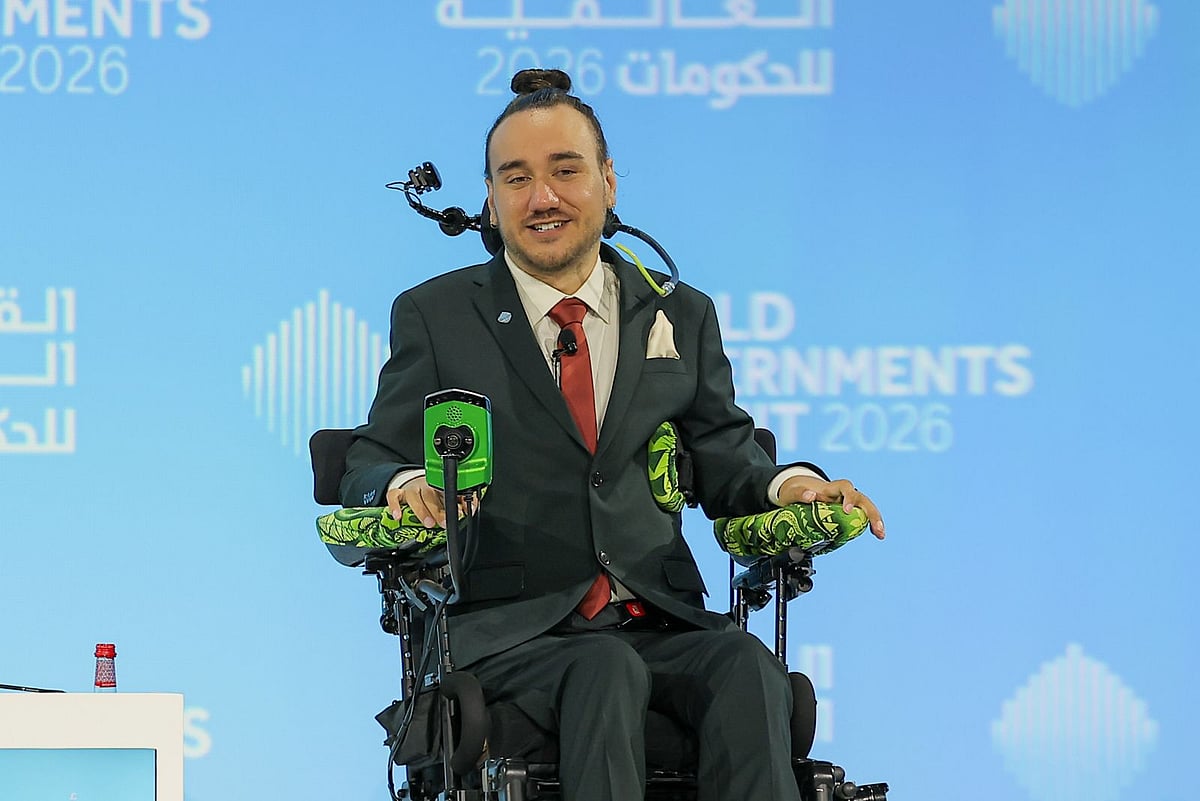
Dubai: “Now I can control a computer with my thoughts,” says Noland Arbaugh, the first human on Earth to have the Neuralink chip. It might sound like telekinesis but this once science-fiction concept is now becoming reality and it could soon be available to more people.
In January 2024, eight years after a 2016 accident left him paralysed below the shoulders, Arbaugh became the first person to receive the implant from US neurotechnology firm Neuralink, founded by Elon Musk.
How does Neuralink work?
Arbaugh, 30, shared his experience at a panel during the World Government Summit in Dubai, explaining the science behind the device. “I have the chip implanted onto my skull. There are 64 threads and 16 electrodes on each thread, implanted in my motor cortex. It is specifically correlated to my right hand,” he said.
The Neuralink device is a wireless, implantable Brain-Computer Interface (BCI) that uses Bluetooth technology to allow users to control digital devices – from smartphones to computers, directly with their thoughts. Arbaugh explained that he could play video games, use social media, and perform nearly any task on a computer simply by thinking about it.
From paralysis to a perfect GPA
The chip has not only given Arbaugh digital independence; it has also enabled him to return to college. “I got my injury a few months after my senior year in college and never completed my degree,” he said.
Since receiving the implant, Arbaugh has completed 22 credit hours in his last semester, finishing with a perfect 4.0 GPA. “I found out I was more capable than I thought I was due to the chip. Now I’m pursuing neuroscience and maybe someday I will get a PhD,” he said.
Could thought-controlled chips restore movement?
While Arbaugh can currently control devices with his mind, he said full physical restoration remains a possibility for the future. “I’m not sure it will happen in my lifetime, but maybe 10 to 20 years down the line, it is possible. Implanting a chip in the brain and one below the spinal cord injury, so they communicate, could eventually restore movement. I believe one day people could walk after a spinal cord injury in a hospital setting,” he said.
Arbaugh emphasised that while this vision requires more research, it is no longer pure science fiction.
Beyond computers, Arbaugh believes Neuralink could allow him to interact with the wider environment. “With Bluetooth, you can control anything with a Bluetooth connection. Devices that are ‘Alexa compatible’ could one day be ‘Neuralink compatible.’ As long as the app is uploaded, you could control your wheelchair, lights, or even appliances,” he explained.
Neuralink’s promise and its perils
Despite its promise, Neuralink raises ethical and technical concerns. The use of Bluetooth, data privacy, and animal testing are all under scrutiny. Shortly after his surgery, 85 per cent of the threads in Arbaugh’s brain retracted, limiting his control. Software updates eventually restored some functionality, but additional procedures were avoided.
Arbaugh stresses that technology must prioritise people, not just enhancements. “We are helping people with disabilities first. Humans must retain control and consent. It’s easy for governments, companies, or organisations to exploit the technology, but people must come first,” he said.
For Arbaugh, Neuralink has already transformed his life and restored independence and opening doors that seemed permanently closed. The future may hold even more - a world where thoughts can move machines, control environments, and perhaps even restore mobility.
“Science fiction is becoming science fact, and we are just at the beginning,” he said.
Network Links
GN StoreDownload our app
© Al Nisr Publishing LLC 2026. All rights reserved.