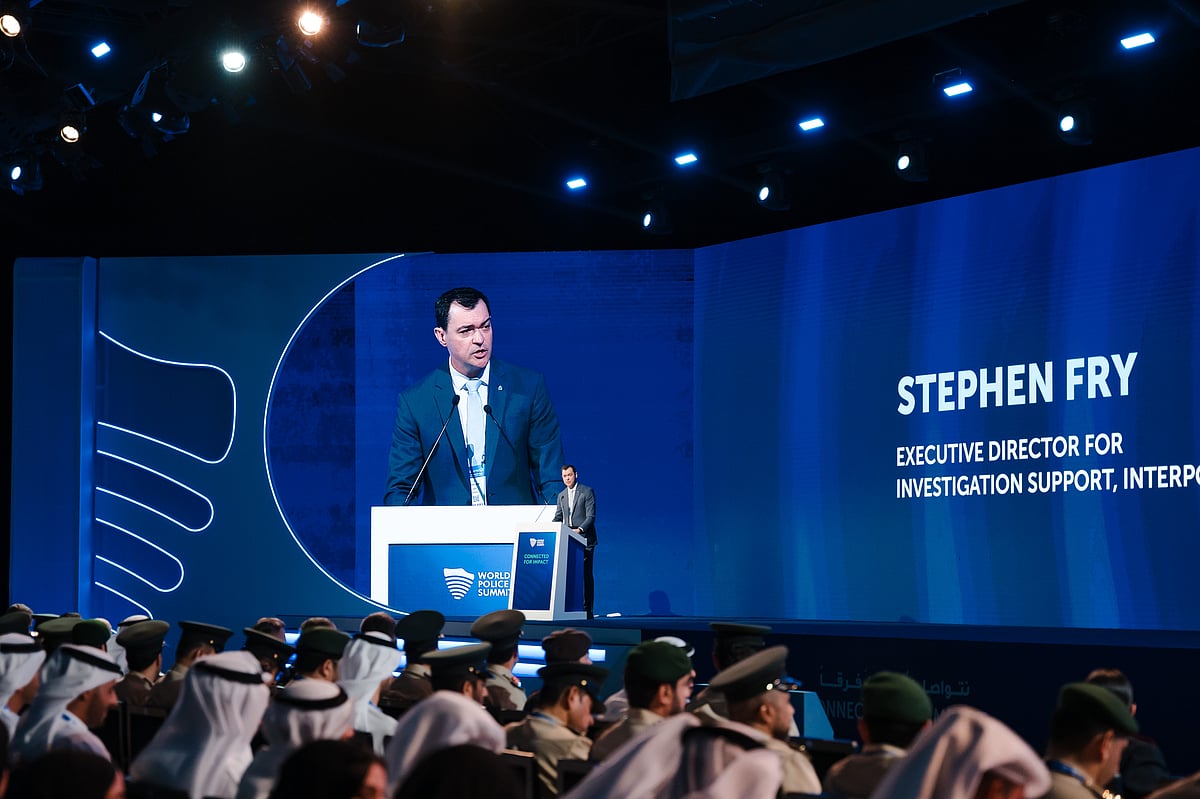
Interpol urges police to target drug networks’ finances and supply chains, not just traffickers.
Dubai: A plastic package labelled as green tea, found on a South Korean beach, helped Interpol uncover a drug trafficking network linked to 24 tonnes of ketamine seized across nine countries.
The case was highlighted at the World Police Summit in Dubai, where international officials warned of evolving drug trafficking networks, the spread of methamphetamine in the Middle East and the need for stronger cross-border cooperation.
Tea packaging exposes 24-tonne ketamine network
Stephen Fry, Interpol's Executive Director for Investigation Support, said a beach cleaner on South Korea's Jeju Island discovered a plastic package labelled as green tea containing ketamine.
Get updated faster and for FREE: Download the Gulf News app now - simply click here.
South Korean authorities sought Interpol's assistance. Investigators compared photographs of the packaging with intelligence from previous seizures, identifying matching shipments across nine countries and linking 24 tonnes of ketamine to one criminal network.
“And then a match. And then another, and then another,” Fry said.
“For these networks, a seized shipment is simply the cost of doing business,” he added.
Fry urged police to use every seizure to trace trafficking routes, financial flows, intermediaries and suppliers, rather than treating it as an isolated incident.
Methamphetamine fills Captagon gap
Siri Bjune, chief of the UN Office on Drugs and Crime's (UNODC) border management branch, warned that methamphetamine was becoming increasingly established in the Middle East following the disruption of Syria's Captagon trade.
“The end of the conflict in Syria has disrupted Captagon production and weakened the networks that sustained the market, while methamphetamine is increasingly becoming entrenched in the Near and Middle East,” she said.
Syria was the world's biggest Captagon source under Bashar Al Assad, whose regime fell in December 2024. Much of the trade supplied Gulf markets.
Bjune said criminal groups had quickly shifted to other drugs following the disruption of Captagon production and smuggling networks.
Methamphetamine remains the world's largest synthetic drug market, with North America, East Asia and South-East Asia its main markets. Traffickers are increasingly targeting the Middle East, exploiting smaller ports, new transit corridors and advanced technologies.
Global drug use reaches record levels
Presenting the UN's World Drug Report 2026, Bjune said 331 million people used drugs worldwide in 2024, a 34 per cent increase over a decade.
“Drug use has reached historically high levels,” she told delegates.
She also highlighted fentanyl in North America, tramadol misuse in parts of Africa and the spread of nitazenes, highly potent synthetic opioids.
Bjune said Afghanistan's opium cultivation had increased more than four times despite the Taliban's ban, rising from about 10,000 hectares in 2025 to more than 43,000 hectares in 2026. The crop generated an estimated $525 million for Afghan traffickers so far this year.
Ketamine and fentanyl threats grow
Fry said ketamine was the fastest-growing substance on Interpol's radar, driven by pharmaceutical diversion and industrial-scale production in clandestine laboratories.
During Operation Lionfish-Mayag, ketamine seizures exceeded methamphetamine seizures for the first time. Authorities also seized fentanyl quantities equivalent to an estimated 63 million potentially fatal doses.
Fry warned that traffickers were concealing drugs in leather, paprika and paint, using lead shielding to evade X-ray screening and forging shipping documents. Artificial intelligence was making convincing counterfeit paperwork easier to produce.
He said drug trafficking increasingly overlapped with firearms smuggling, endangered wildlife trafficking and human trafficking, as criminal groups exploited shared routes and financial channels.
“Global drug networks thrive on the gaps between jurisdictions and the differences in our systems. Every weakness in our cooperation is an opening for them,” he said.
Interpol targets criminal profits
Fry highlighted Interpol’s Silver Notice, a mechanism that enables member countries to trace and identify criminal assets, including money and property linked to drug trafficking. Member countries are expected to vote on making it a permanent Interpol capability at the organisation’s General Assembly in Hong Kong, China.
He said Interpol’s secure global police communications system facilitates intelligence-sharing among its 196 member countries and gives investigators access to more than 155 million criminal records, as well as specialised drug databases.
Fry also announced plans to establish Interpol’s first dedicated drug task force in South America, based in Buenos Aires. Investigators from 12 countries will exchange intelligence, coordinate cross-border investigations and identify high-value targets.
Interpol also supports national investigations through forensic analysis, data extraction and evidence collection.
Fry pointed to the recent relaunch of Interpol’s drugs conference in Prague, which brought together nearly 250 participants from more than 100 countries and organisations and facilitated more than 70 case coordination meetings.
He called for greater involvement of the private sector, particularly shipping companies, port operators, cargo handlers, chemical and pharmaceutical businesses, and banks, in identifying suspicious activities and exposing criminal supply chains.
Target the business behind drug trafficking
Gabor Sztankovics, a regional adviser at the United Nations Office on Drugs and Crime (UNODC), urged law enforcement agencies to focus on dismantling the business structures behind drug trafficking rather than concentrating solely on arrests and seizures.
“A middleman, a driver, a transporter or a smuggler can easily be replaced. We have to target the business, the market and the supply chain,” he said.
Drawing on his experience with Europol, Sztankovics said criminal networks relied on specialists in encrypted communications, cryptocurrency and money laundering. Targeting these key operators could cause greater damage than disrupting smuggling routes or arresting low-level traffickers.
Fry stressed that timely intelligence-sharing could make the difference between a single arrest and dismantling an entire criminal network. “One piece of information shared at the right moment can be the difference between a closed case and a dismantled organised criminal drug network,” he said.
UAE outlines three-pronged anti-drug strategy
Fahad Abdullah Haikal, official spokesperson for the National Drug Enforcement Authority, said the UAE's anti-drug strategy focused on pursuing traffickers, preventing drug abuse and rehabilitating users.
“We are moving along three interconnected paths: firmness in pursuing the merchants of death, prevention that protects minds, and rehabilitation that takes people by the hand to return to life,” he said.
Haikal said protecting families and communities was central to building a drug-free future.
Network Links
GN StoreAbout Gulf NewsTerms & ConditionsReach by GNSitemapContact usPrivacy PolicyGN FocusHave your sayWork with usAdvertise with usGulf News epaperPrinting Services
Download our app
© Al Nisr Publishing LLC 2026. All rights reserved.