US flight shutdown: FAA halts router installations after nationwide disruption
Agency suspends upgrades as senators demand answers over air traffic control failure
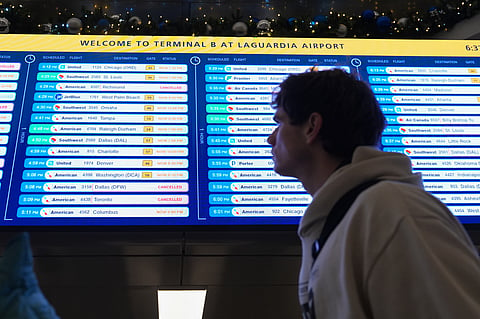
Dubai: The US Federal Aviation Administration (FAA) has suspended the installation of new routers and disabled broadcasting functions on equipment already installed following last week's nationwide ground stop that disrupted thousands of flights.
The decision comes as investigators examine how a network failure involving equipment at two facilities in Arkansas and Texas overwhelmed air traffic control systems on Friday, November 13.
Get updated faster and for FREE: Download the Gulf News app now - simply click here.
According to the FAA, the disruption involved approximately 1,000 connection attempts every four to five seconds, destabilising communications and radar data feeds at 17 of the agency's 22 en route air traffic control centres.
The nationwide ground stop lasted more than four hours, forcing airlines to cancel thousands of flights and leaving passengers stranded across the United States.
FAA suspends router installations
The FAA said it had stopped installing Juniper routers and disabled their broadcasting functions as a precaution while investigators work to establish the cause of the failure.
The agency has turned off the same functionality on more than 60 other Juniper routers already operating within its network.
The FAA is relying on older Cisco routers while the affected equipment undergoes testing.
The investigation centres on a communications facility in El Dorado, Arkansas, where contractor L3Harris Technologies had been replacing ageing networking equipment, and a radar facility in Amarillo, Texas.
A router at the Texas facility had been replaced approximately three weeks before the disruption.
The network stabilised after L3Harris blocked traffic from the two locations.
Senators demand pause in upgrades
A group of 13 Democratic senators has called on the FAA to suspend further router replacements until investigators determine what caused the nationwide disruption.
The lawmakers warned that continuing the programme without addressing outstanding safety and reliability concerns could expose the air traffic control network to further failures.
According to the lawmakers, approximately 400 of more than 3,600 planned router installations have been completed.
The incident has raised questions about the risks of introducing new equipment into ageing aviation infrastructure while keeping critical systems operational.
Cause remains under investigation
US Transportation Secretary Sean Duffy said investigators were examining whether the disruption resulted from faulty equipment, installation problems or incorrect configuration.
The affected routers are undergoing testing at an L3Harris laboratory in Florida under FAA supervision. The FBI has also been invited to participate.
Hewlett Packard Enterprise, which owns router manufacturer Juniper Networks, said its equipment appeared to have operated as configured, based on the information available to the company.
The FAA said there was no indication that a cyberattack caused the incident.
Officials have not reached a final determination on the technical failure.
More than 18,000 flights cancelled
Reuters reported on Monday that airlines had cancelled more than 18,000 flights following the disruption, forcing carriers to reposition aircraft and crews.
The FAA lifted the nationwide ground stop on Friday evening after confirming that its communications network had stabilised.
The agency said approximately 3,500 aircraft that were airborne when the ground stop was imposed landed safely.
$50 billion funding request
The incident has intensified debate over funding to modernise the US air traffic control system.
The Trump administration is seeking approximately $50 billion for air traffic control and airport infrastructure improvements, following the nationwide disruption.
Congress approved $12.5 billion for aviation modernisation last year, although some of that funding is allocated to airport construction and runway projects.
Duffy has argued that additional investment is needed to replace ageing communications infrastructure and improve the reliability of the national airspace system.
The FAA has distinguished the router replacement work involved in Friday's incident from its broader air traffic control modernisation programme.
Investigators are continuing to examine the equipment and network configuration to determine how the failure occurred and prevent a recurrence.


