Dubai to host global anti-drugs conference on November 17
UN agencies and police experts will discuss trafficking, synthetic drugs and prevention.
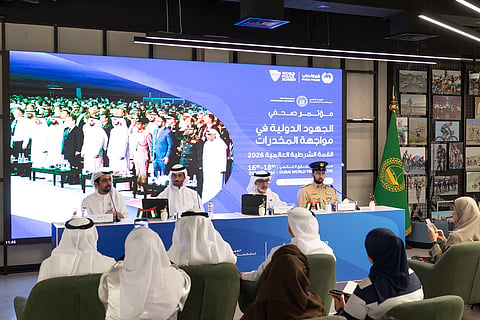
Dubai: The growing use of social media, encrypted messaging applications and digital payments by drug trafficking networks will be among the key issues discussed at an international anti-narcotics conference in Dubai on November 17, as the UAE steps up efforts to strengthen global cooperation against drugs and protect young people.
The Anti-Narcotics Conference, organised by the National Drug Enforcement Authority (NDEA) and Dubai Police General Headquarters, represented by its General Department of Anti-Narcotics, in cooperation with the World Police Summit (WPS), will take place at Dubai World Trade Centre as part of the three-day summit running from November 16 to 18.
Get updated faster and for FREE: Download the Gulf News app now - simply click here.
The conference will bring together international and regional law enforcement officials, health professionals, researchers and specialists to examine the growing drug threat from security, legislative, preventive, therapeutic and public health perspectives.
The united nations office on drugs and crime (UNODC) and the European union drugs agency (EUDA) are among the international organisations taking part.
Drug networks exploit digital platforms
Dr Abdullah Al Khayat, awareness and prevention adviser at the NDEA, warned that drug trafficking and promotion networks are increasingly abandoning traditional methods and exploiting digital channels to reach young people.
These networks are using social media platforms, encrypted applications and electronic payment systems, while synthetic psychoactive substances are increasingly being marketed in misleading forms that conceal their risks.
He stressed that prevention must be treated as the first line of defence rather than an additional measure in combating drugs.
Key priorities include improving digital awareness among children and young people, encouraging parents to communicate with and monitor their children's activities, and integrating prevention programmes into schools, sports organisations and community institutions.
He also highlighted the importance of encouraging early reporting through approved channels and using artificial intelligence, modern technology and data analysis to identify emerging drug promotion methods before they spread.
Al Khayat said combating drugs was a shared national responsibility involving security, health, education, social and media institutions, as well as families.
He expressed hope that the conference would deliver practical recommendations to support the UAE's efforts to build a safe, drug-free society.
UAE strengthens international anti-drug cooperation
Major Fahad Abdullah Haikal, official spokesperson for the NDEA, said the Authority's participation followed the directives and direct support of Sheikh Zayed bin Hamad bin Hamdan Al Nahyan, Chairman of the Authority.
He said Sheikh Zayed emphasised the importance of representing the UAE at specialised international forums and strengthening partnerships to confront drug-related threats that extend beyond national borders.
Haikal said international cooperation, the exchange of expertise and the adoption of proven practices were essential to tackling the growing challenge.
Established under a Federal Decree-Law issued by President His Highness Sheikh Mohamed bin Zayed Al Nahyan on August 3, 2025, the NDEA is an independent federal entity reporting to the UAE Cabinet and serves as the country's principal authority for combating drugs.
Its establishment supports the implementation of the National Strategy for Combating Drugs 2024-2031.
The Authority is responsible for developing drug-related policies and legislation, tracking and dismantling smuggling and trafficking networks, overseeing addiction treatment and rehabilitation, regulating chemical precursors and strengthening cooperation with countries and international organisations.
Haikal described the partnership with Dubai Police as a distinguished example of institutional cooperation, reflecting a shared commitment to protecting society and future generations from drugs.
He also highlighted the media's role in supporting the Authority's strategy, particularly in communicating prevention messages and raising awareness among families.
Five key issues on the agenda
Brigadier Ahmed Al Suwaidi, deputy director of the General Department of Anti-Narcotics at Dubai Police, said the conference programme would focus on five major themes covering the scale of the global drug problem, treatment, international cooperation, health impacts and artificial intelligence.
The first theme, "The Scale and Spread of the Global Drug Problem", will be presented by UNODC and examine the worldwide rise in drug use, drawing on the organisation's latest reports and statistics despite continuing awareness and law enforcement efforts.
The second, "Moving from Criminalisation to Therapeutic Approaches", will explore international trends in shifting from criminalisation towards treatment and rehabilitation programmes in cases involving drug use.
The third theme, "Cross-Border Interdiction: Dismantling Global Drug Networks", will focus on international efforts to pursue trafficking networks from countries of origin to destination markets.
The fourth, "How Global Bodies Are Addressing the Health Impact of Drugs", will feature EUDA experts examining the physical and mental health consequences of drug use.
The fifth, "The Future Role of AI in Combating Criminal Networks", will examine how artificial intelligence and smart technologies can help authorities detect, investigate and disrupt drug-related criminal activity.
Synthetic drugs and international trafficking under spotlight
The conference will feature two panel discussions addressing the challenges facing law enforcement agencies worldwide.
The first, "dismantling global drug networks: tracking illicit flows across regional corridors", will examine how authorities can trace illicit drug movements and disrupt trafficking routes across regions.
The second, "The rising threat of synthetic drugs: global impact, law enforcement efforts and regulatory challenges", will focus on the growing circulation of chemical precursors and the need for effective regulation to prevent their misuse in manufacturing illegal drugs.
A fireside session, "disrupting drug trafficking: lessons from Australia and Colombia", will also examine experiences and lessons from the two countries in tackling drug trafficking.
Two workshops will be held alongside the conference, covering manufactured substitutes for natural drugs and the use of artificial intelligence in analysing drug cases.
Participants will also take part in two brainstorming sessions: "towards an integrated model for drug case risk management" and "institutional practices and their role in developing training curricula across operational entities and the criminal investigation sector".
Anti-Narcotics Excellence Award attracts global entries
The World Police Summit's Anti-Narcotics Excellence Award has attracted more than 39 entries from around the world this year, highlighting international interest in efforts to combat drug-related crime.
Brigadier Al Suwaidi said the award was launched to recognise specialised institutions, researchers and other stakeholders working in the field.
Submissions cover field operations and intelligence-led work, chemical precursor control, addiction treatment and rehabilitation, and awareness and prevention.
The winners will be announced during the World Police Summit.
Government bodies and international agencies to participate
The conference will bring together UAE government entities and professional organisations involved in drug prevention, law enforcement, healthcare, rehabilitation and judicial affairs.
National participants include the ministries of Health and Prevention, Justice, Education, Community Empowerment, Culture and Family, as well as the Federal Authority for Identity, Citizenship, Customs and Port Security and local anti-narcotics authorities.
Treatment and rehabilitation partners include Erada Center, the National Rehabilitation Centre and Al Amal Hospital.
Other participating entities include the Public Prosecution, Dubai Courts, the Knowledge and Human Development Authority, Dubai Health Authority, Community Development Authority and Dubai Sports Council.
International partners include the UNODC Regional Office, the International Narcotics Control Board, the United Kingdom's National Crime Agency, Egypt's Fund for Combating and Treating Addiction, Qatar's Criminal Information Centre for Combating Drugs, Jordan's Arab Bureau for Narcotics Affairs and the United States' National Association of School Resource Officers.
Dr Mohammed Jamal Al Tamimi, head of programming at the World Police Summit, said drug trafficking networks did not recognise borders and could not be confronted by individual countries acting alone.
He said the conference would provide a platform for security, health, legislative and academic institutions, alongside international organisations, to exchange expertise and turn discussions into practical partnerships.
Al Tamimi praised the cooperation between the World Police Summit, the NDEA and Dubai Police's General Department of Anti-Narcotics, stressing that protecting future generations was a shared national responsibility requiring the combined efforts of institutions and society.
He added that the more than 39 entries received for the Anti-Narcotics Excellence Award reflected the level of international interest in addressing the challenge.
The Anti-Narcotics Conference will be held on November 17 at Dubai World Trade Centre during the World Police Summit, which runs from November 16 to 18.