UAE used AI to track misleading online posts during recent attacks
Official says AI helped authorities monitor posts targeting the UAE's reputation.
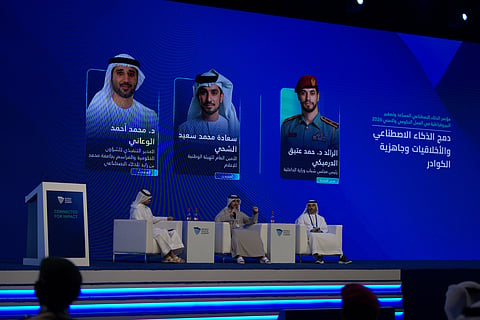
Dubai: The UAE used artificial intelligence (AI) to identify misleading social media posts targeting the country's reputation before, during and after the recent attacks, Mohammed Saeed Al Shehhi, Secretary-General of the National Media Authority, said at the fifth World Police Summit in Dubai on Wenesday.
Al Shehhi said the Authority worked with relevant government entities and social media platforms to tackle misleading content, while federal and local media teams issued verified updates in several languages within minutes of incidents. The updates were disseminated through social media platforms and mainstream media outlets to ensure accurate information reached the public quickly.
Get updated faster and for FREE: Download the Gulf News app now - simply click here.
He warned that delays in releasing verified information could allow false claims to take hold. When official sources are slow to respond, people tend to speculate and share their own versions of events, giving misleading claims more time to spread rapidly. AI-powered monitoring helped authorities analyse large volumes of online content, track false claims and identify patterns linked to coordinated disinformation campaigns.
Speaking during a summit panel on AI-powered policing and digital transformation, Al Shehhi highlighted how the technology can help detect misleading information early, speed up responses and limit its impact, particularly during sensitive situations.
The panel was organised by the Ministry of Interior in partnership with the UAE Cyber Security Council, National Media Authority, Ministry of Human Resources and Emiratisation, Prime Minister's Office at the Ministry of Cabinet Affairs, and Mohamed bin Zayed University of Artificial Intelligence. Discussions focused on how AI governance can streamline government and security procedures, improve services and support decision-making.
AI helps track online disinformation
Al Shehhi said AI enables authorities to analyse vast amounts of digital content, identify misleading posts and recognise patterns that could indicate coordinated campaigns.
Early detection helps authorities respond faster and limit the spread and impact of false information.
However, he stressed that AI must support, not replace, human judgement, with people retaining responsibility for verification and decision-making.
Disinformation poses growing global threat
Misinformation and disinformation rank as the world's second most severe global risk over the next two years, Al Shehhi said, warning of their potential impact on national security, social stability and economic prosperity.
He described disinformation as an organised industry backed by specialised tools, networks and actors, capable of spreading false claims and influencing public opinion before verified information reaches audiences.
Countering the threat requires cooperation between governments, media institutions, organisations and digital platforms. He also highlighted institutional credibility and public trust as essential to limiting the influence of misleading information.
UAE develops unified monitoring platform
The National Media Authority is strengthening its technological capabilities and training teams to use AI tools to monitor digital content, analyse patterns and identify emerging threats.
The Authority has established a dedicated National Narrative Department to promote a clear and credible account of the UAE's values, positions and achievements.
It is also developing a unified platform to monitor and analyse information, with early-warning capabilities to identify disinformation campaigns and support timely responses.
Speed, accuracy and public awareness
Al Shehhi said the challenge in today's digital environment was no longer a lack of information, but the speed and volume at which it circulates.
He identified accuracy, speed and clarity as essential to effective communication, stressing that verified information must reach the public promptly to maintain its impact and credibility.
While AI has made it easier to create sophisticated deceptive content, it also offers tools to detect misleading material and track false claims. Closer coordination between media institutions and government entities is increasingly important in addressing these threats.
He also stressed that technology must be complemented by public awareness and media literacy. People should recognise reliable sources, question suspicious claims and verify information before sharing it.
The panel also featured Dr Mohammed Ahmed Al Loghani, Chief Executive Officer for Government Affairs and Protocol at Mohamed bin Zayed University of Artificial Intelligence, who discussed AI agent governance and the ethical considerations surrounding their use in government and security institutions.