Dubai-based Anisha Lakhani, a sales executive with her daughter.
Distance learning in the UAE: How parents are helping kids stay focused in online classes
A calm space and a checklist go a long way, say parents
Last updated:
6 MIN READ
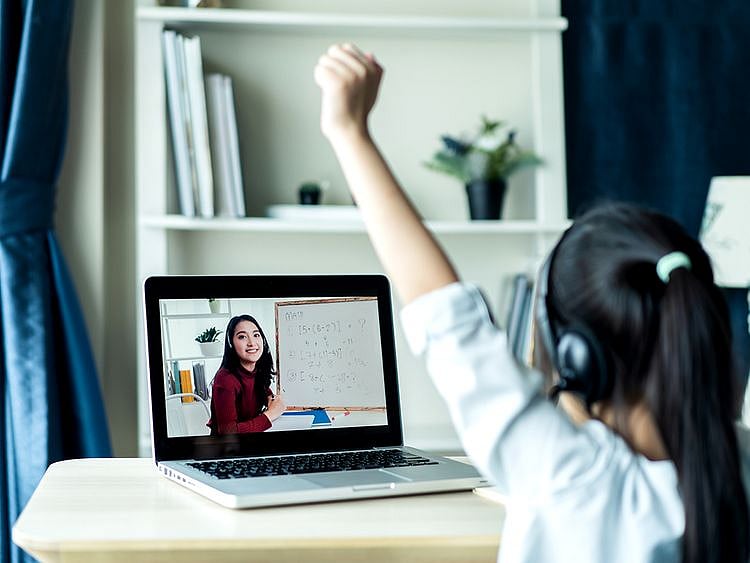
Representational image of distance learning used for illustrative purpose only
Shutterstock
In the beginning, her seven-year-old daughter would feel a little sleepy after switching on the laptop. This sleepiness only set in for academics; she could game for hours if she had the opportunity.
Yet her mother, Dubai-based Diya Mathur, says that she slowly found a way to make her daughter concentrate in her online classes. It was a lot of trial and error, she admits. “But, I was persistent. I cleaned up her table, made it like an academic space, and put her in uniform, so that she felt that she was in school. And every few breaks, I would ask questions, ‘What did you learn?’ I think that kept her awake and a little more focused, because she started thinking, ‘Okay mom’s going to ask me questions, I better pay attentions,” adds Diya. “There’s no foolproof method, I think. Every child is different and responds differently.”
It has been a challenging time for parents and children in the UAE, but they are determined to make the best of it. In homes across emirates, dining spaces are now makeshift classrooms, and parents are also co-teachers. Uncertainty does shape routines, but with the occasional frustration of distractions, there are moments of triumph.
It's not about replicating school, as families say. It's about reimagining it.
Screens are the new classroom
For parents like Dubai-based Anisha Lakhani, a sales executive, the challenge begins with a contradiction many can relate to. “In the era where parents are trying to reduce screen exposure for their children, we are unfortunately placed in a situation where distance learning has become necessary,” she says.
As she observes, attention spans are short and distractions are plenty. Yet, structure has become her anchor. Sitting alongside her daughter during sessions, she builds a rhythm with short lessons, frequent breaks, and small incentives to stay engaged. A silent space and a simple checklist go a long way. Moreover, what makes a difference, is the effort from teachers.
They open classes with a morning song, and bring in sensory activities with a touch of humour. This helps in gaining the attention of young children. I believe together, parents and teachers can make distance learning enjoyable and effective for children at this age,” Lakhani adds.
Structure and routine
A little organisation doesn't hurt at all.
Dubai-based Mona Dhanjal maps out the day: “Every evening I have a look through the timetable and I make a very small list of the areas that my son Ryan is going to be focussing on,” she explains
Her approach is meticulous and flexible, as she breaks subjects into manageable chunks, building in breaks. She makes sure that her nearly eight-year-old stays engaged beyond the screen. “I make sure that there’s lots of breaks in between as well, he can have a bit of water, a bit of food, a bit of just interacting with something that’s not his laptop.”
One of her most effective strategies is surprisingly simple: Routine, dressed up in uniform, “I put my son in school uniform, because I strongly believe that even if he’s like seven, eight, nine, if they’re wearing their uniform then they know that they’re going to be doing something and expected to do something.”
And, she makes it fun. Dhanjal turns everyday moments into lessons, such as using water-filled jugs to explain fractions, or keeping plenty of paper and pens within reach to encourage hands-on engagement.
Her younger child, however, requires a completely different approach. “Nursery is like a whole kettle of fish,” she says, describing days filled with tracing, soft play, and imaginative activities. The structured lessons are less, and there is more movement, which is guided by the child herself.
Mona Dhanjal, with her son, Ryan.
The problem of screens
Undoubtedly, it is difficult for a child to sit for eight hours, glued to a screen, as Dr Sneha John, a clinical psychologist in Dubai's Medcare Camali Clinic, Jumeirah, notes. The enthusiasm wavers, as half the fun of school comes from being around friends and teachers. It is challenging, for sure, to overcome, but not impossible.
Like the parents navigating this shift, Dr John suggests a firm routine, just as you would do for school. Go to sleep on time, wake up on time, put on your uniform. Do some light stretches, have breakfast and then log in. She advises parents to make sure that the child gets breaks periodically and in those breaks, to go outside the house, get some form of fresh air.
After class, she adds, keep their minds engaged by asking them, “So what did you learn today?”—a strategy that mirrors what many parents, like Diya, have already begun practising. Parents also need to supervise that unnecessary tabs are not open, and that children are actively engaging with what is being taught.
And after class, no more screens. As they have already spent the day in front of a screen studying, they need to do something else that keeps them busy, like a fun hobby or playing outside.
For Shaheera Anwar, the biggest hurdle is not the lesson itself, but the medium. “The screen’s the biggest distraction honestly,” she says.
Young children, especially those aged five to six, find it difficult to navigate virtual classrooms. Between emojis, mute buttons, and the temptation to watch classmates, focus quickly slips. “It’s a lot for them to manage already, apart from just the focus on the lesson element.”
Dubai-based Shaheera Anwar
Like many working parents, her day doesn’t end when work does. Evenings become a second school shift. “I have to separately sit with him, away from the screen, and reiterate what’s taught in class, after 6pm, take about an hour or two to explain and get his school days tasks completed before the next day begins.”
Nevertheless, she has some advice for parents: "Don’t feel guilty about the young ones not getting the kind of education they should be, this situation is beyond our control and their mental health and safety is more important."
Parents also need to supervise that unnecessary tabs are not kept open, and that children are actively engaging with what is being taught. And after classes, no more screens....
Sneha John clinical psychologist in Dubai
Tips to navigate distance learning
Create a simple routine: Follow a school-like structure, sleep on time, wake up on time, get dressed (even in uniform) to set the tone for the day.
Break the day into chunks: Short lessons with frequent breaks help children stay focused and avoid screen fatigue.
Stay involved: Sit in on sessions when possible, or revisit lessons later by asking, 'What did you learn today?' to reinforce understanding.
Limit distractions on screens: Keep an eye on unnecessary tabs and ensure children are actively engaged during lessons.
Make learning hands-on: Use everyday activities, like measuring, drawing, or play, to explain concepts beyond the screen.
Prioritise movement and fresh air: Encourage children to step away from devices during breaks and spend time outdoors where possible.
Adapt by age: Younger children may need more play-based learning, while older ones benefit from structure and independence.
Cut back on screens after school: Once classes are done, shift to offline activities like hobbies, reading, or playtime.
Be flexible and kind to yourself: Not every day will go as planned. Focus on consistency over perfection.
Don’t carry guilt: This is an unusual situation, your child’s mental health and well-being matter just as much as academic progress.
Network Links
GN StoreAbout Gulf NewsTerms & ConditionsReach by GNSitemapContact usPrivacy PolicyGN FocusHave your sayWork with usAdvertise with usGulf News epaperPrinting Services
Download our app
© Al Nisr Publishing LLC 2026. All rights reserved.