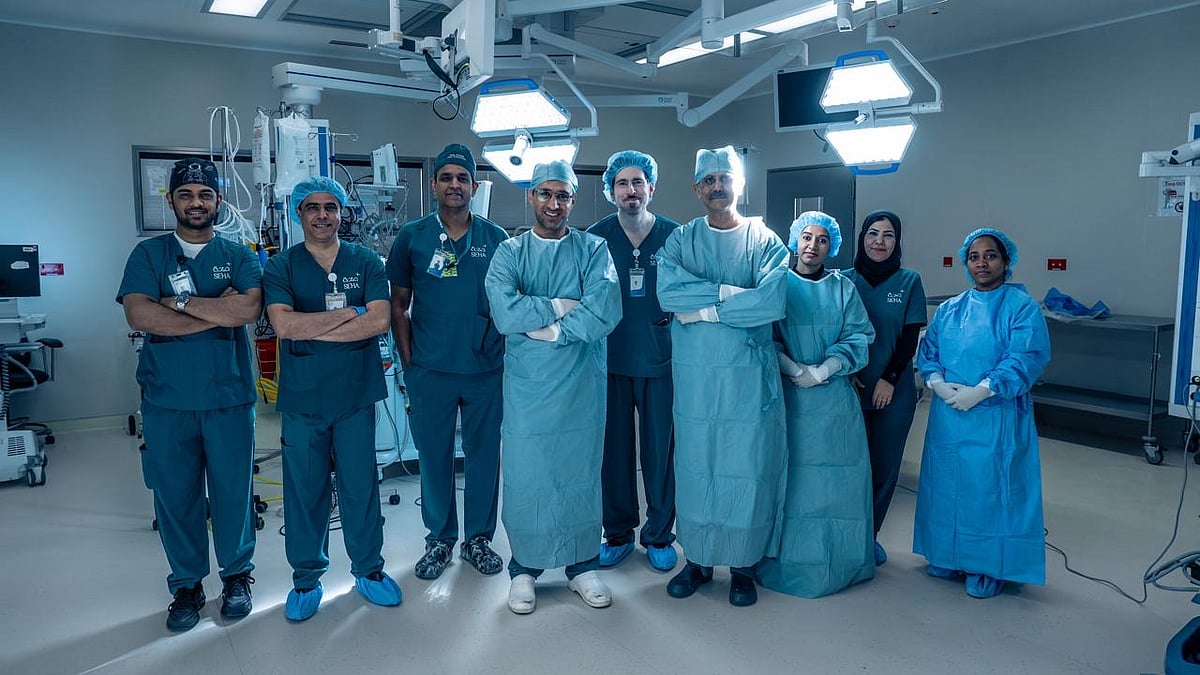
An 81-year-old colorectal cancer patient with several medical risk factors has successfully undergone advanced minimally invasive surgery in Abu Dhabi, avoiding the need for a temporary or permanent stoma.
Doctors at SEHA Tawam Hospital performed laparoscopic surgery on the patient, who had distal rectal cancer as well as obesity, heart disease and a history of having a pacemaker.
Get updated faster and for FREE: Download the Gulf News app now - simply click here.
Despite his age and medical condition, doctors were able to remove the tumour through small incisions without creating a stoma.
The patient recovered well after the operation, was able to return to a normal diet and was discharged from hospital after three days.
What is a stoma?
Distal rectal cancer affects the lower part of the rectum and can be challenging to operate on because of the tumour’s location deep within the pelvis and its proximity to surrounding structures.
In some complex cases, patients may require a temporary or permanent stoma.
A stoma is an opening created in the abdomen that allows waste to leave the body and be collected in a bag.
Dr Mahdi Al Taher, Consultant Gastrointestinal and Oncologic Surgeon at SEHA’s Tawam Hospital, said avoiding a stoma can have an important impact on a patient’s recovery and quality of life.
“Distal rectal cancer can be one of the most technically demanding conditions in colorectal surgery, particularly in elderly patients with multiple medical risk factors,” he said.
“In this case, a minimally invasive approach allowed us to remove the tumour safely while avoiding the need for a temporary or permanent stoma.”
Faster recovery
Laparoscopic surgery is performed through several small incisions rather than a larger surgical opening.
According to Al Taher, the approach can result in smaller incisions, less surgical trauma and faster recovery for suitable patients.
He said treating complex cancer cases also requires coordination between colorectal surgeons and other medical teams, as well as treatment decisions based on each patient’s individual condition.
SEHA said the operation involved coordination between surgical, anaesthesia, operating room nursing and other teams at Tawam Hospital.
Network Links
GN StoreDownload our app
© Al Nisr Publishing LLC 2026. All rights reserved.