How doctors at Medcare remove massive colon tumour without open surgery
The complex condition affected 75 per cent of intestine, requiring major tumour removal
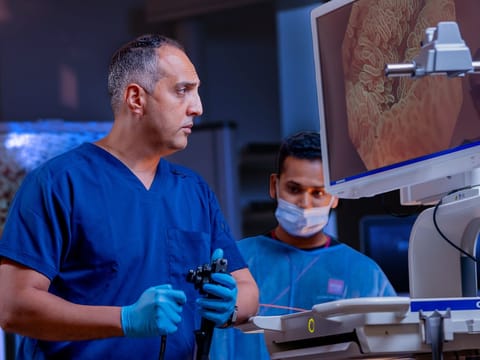
Dubai: In an extraordinary advancement in medicine that has the potential to transform colon cancer treatments in the future, a group of experts at Medcare Royal Hospital in Al Qusais has successfully prevented a man from having his colon removed due to a large tumour, all without making any external cuts.
The patient, who was originally recommended to have an extensive open surgery that would have resulted in a permanent loss of part of his bowel, left the hospital just days later with his organ completely intact, thanks to an innovative minimally invasive endoscopic procedure carried out by Dr. Mohamed Abdelhafez, Consultant Gastroenterologist at Medcare Royal Speciality Hospital.
For several weeks, the patient, J.N. from Dubai had dismissed his cramps and bloating as merely a result of stress and his hectic schedule. However, when he eventually consulted a doctor, a tumor had stealthily encased three-quarters of his colon, and he was informed that it was highly likely he would need to undergo life-altering bowel removal surgery.
“I was shocked when I was told that such a big part of my colon, and possibly other organs, might need to be removed,” the patient remarked. “I was worried about how my life would change after such a major surgery.” Unwilling to proceed with a life-altering operation, the patient sought a second opinion at Medcare Royal Speciality Hospital.
The complex condition affected over 75% of the patient’s intestine and required the removal of a massive lateral tumour measuring 9 x 6 cm. This size usually forces patients into open surgery and a permanent loss of part of the colon. However, the specialists at Medcare were able to remove the tumour from within the colon using the Endoscopic Submucosal Dissection (ESD) technique.
Speaking about his initial assessment of the patient’s condition, Dr. Abdelhafez said, “This was an unusually large lesion, and most patients with tumours of this size are directed straight for colectomy. But after reviewing his scans and performing a detailed endoscopic evaluation, it was clear that the tumour showed features suggesting superficial invasion only. That opened the possibility of removing it endoscopically while keeping the colon intact.”
Dr. Abdelfaez added that the next step was to determine the safest, most effective treatment path. “The challenge was not only the size, but also the risks of perforation, delayed bleeding, and the patient’s pre-existing hypertension. After careful planning, we decided that an advanced Endoscopic Submucosal Dissection (ESD), a minimally invasive technique that removes large tumours from inside the colon without open surgery, performed under general anaesthesia with full physiological control, was the best organ-preserving option,” he further said.
The procedure involved carefully dissecting the tumour from the colon wall and removing it in one piece. Following the resection, the team fully closed the large internal wound using endoscopic hand-suturing, a technique performed entirely from inside the colon without external incisions. This method significantly reduced the risk of bleeding or perforation and eliminated the need for an open surgery.
Reflecting on the patient’s recovery, the doctor said, “The closure of such a large defect using hand-suturing played a major role in his smooth recovery. He had no post-procedural bleeding, no perforation, and was able to return home far sooner in two days than patients who undergo major colon surgery which is more than one or two weeks for recovery.”
The patient expressed relief and gratitude for the outcome by saying, “After the procedure, I couldn’t believe how quickly I felt normal again. I didn’t have the pain or long recovery they warned me about after the procedure. I’m back to my regular life, and I’m so grateful that this approach was possible.”
Commenting on the broader significance of the case, Dr. Abdelfaez advised, “Cases like this show how far therapeutic endoscopy has come. Many patients who are told they need major colon surgery may actually be candidates for organ-preserving procedures if evaluated by an advanced endoscopist. With modern techniques like ESD and endoscopic suturing, we can treat large, early-stage tumours effectively while avoiding the risks and long-term consequences of open surgery.”
Dr. Abdelfaez concluded, “The patient is now recovering well. He has resumed normal activities, and requires only routine follow-up, with the next colonoscopy scheduled in 12 months. Histopathology confirmed no invasive malignancy, meaning the tumour was removed completely, and the long-term outlook is excellent.”


