Countries air grievances in search of COP31 climate deal
Ministers clash over science and funding in final push for climate accord
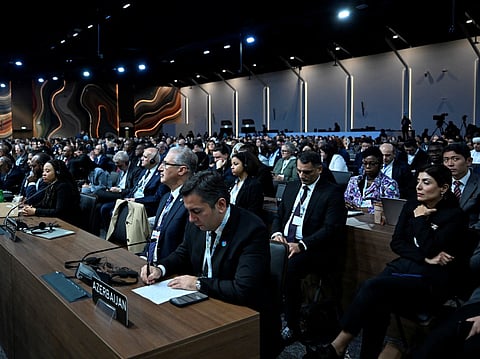
Nations bargained over a sprawling climate deal on Wednesday but deepening divisions left compromise elusive even as the COP31 summit in Turkey enters its final days.
In conference rooms and bustling corridors, government ministers have been drawing red lines as they negotiate the terms of a contentious draft accord in Antalya.
Get updated faster and for FREE: Download the Gulf News app now - simply click here.
'Divan' drama
Nearly 200 nations are under pressure to find common ground before the UN climate talks wrap up on Friday.
As the clock ticked down, ministers aired their views in a "divan" — a "council" in Turkish — on a proposed deal that has faced widespread criticism.
That first draft, published Monday, ran to 18 pages and laid bare opposing priorities on flashpoint issues from fossil fuels to finance, science and trade.
After the divan, COP31 President Murat Kurum, who is also Turkey's environment minister, told reporters that ministers spoke "openly and frankly in the room" but "significant gains" were made.
French Ecological Transition Minister Monique Barbut said that while the meeting may not have helped make progress in the negotiations, it allowed countries to understand each other's positions.
"We really heard people speak from the heart," Barbut told reporters.
Australia's delegation, which is steering the negotiations, is expected to unveil a new version of the text early Thursday.
"Countries have different ideas on different items, but I think negotiators and ministers made great efforts to try to bring us to reach the agreement," the head of China's COP31 delegation, Li Gao, told reporters.
"It's hard to say what the biggest obstacle is, because every country has different concerns," Li said.
Science battle
A fight over the timing of the next Intergovernmental Panel on Climate Change (IPCC) reports has flared at COP31, exposing tensions over the place of science in the negotiations.
Danish climate minister Samira Nawa said a political deal at COP31 must reflect the crucial role of the IPCC: "There is no compromise when it comes to science," she told AFP.
Dozens of countries want the IPCC's next assessments available before a global review of carbon-cutting efforts in 2028.
A smaller number of nations, including Saudi Arabia and India, want the findings postponed to 2029.
"We hope to reach some sort of compromise on this issue. I said a compromise, I didn't say we would necessarily get everything we want," Barbut said.
On Tuesday, Saudi Arabia defended its position, saying developing countries in particular needed more time to meaningfully participate in the review process.
Finance friction
Climate finance remains a major fault line, with developing nations arguing that wealthy countries, historically the biggest emitters, must provide funding to tackle global warming.
"To now expect the Global South to bear the burden of addressing the consequences of their past actions, in the name of higher ambition, is unjustified," India's Environment Minister Bhupender Yadav told ministers.
Rich nations are also under pressure to step up support for countries struggling to adapt to rising seas, extreme weather and other climate impacts.
"Our countries are sinking and it's a matter of survival for our people," Fiji's Climate Minister Lynda Tabuya told AFP.
'Petroleum mafia'
Panama's Climate Minister Juan Carlos Navarro accused the "petroleum mafia" of holding the world hostage while countries suffer from Stockholm syndrome.
"You love your kidnapper: the petroleum industry. Oh, and those lovely petroleum-producing countries. They are so generous. Except they don't give one dime for adaptation or for facing the climate crisis or for saving biodiversity," he said.
Navarro later told AFP that China and oil-producing nations should join developed countries in providing funds to help the developing world cope with climate change.
Fossil feud
Portugal and Ireland unveiled "roadmaps" for phasing out fossil fuels, the main driver of global warming.
They join France, Germany, Finland, Denmark and the Netherlands in setting out national plans to exit coal, oil and gas.
"We don't need another roadmap... we need countries to travel the road together" and move from planning to delivery, said Tuvalu Environment Minister Maina Talia, whose low-lying nation is threatened by rising seas.
COP33
South Korea said it was "deeply thinking" about bidding for COP33 after India and China dropped their interest, the country's energy and environment minister Kim Sung-whan said.
In the absence of another bidder, Kim said South Korea would "seriously consider how we can fulfil our responsibility in tackling the climate crisis, and make a decision".


