Photo of an airplane cruising across the sky. Up to 100 shooting stars an hour lit up the UAE skies during the Perseids peak, as seen from Mleiha National Park.
100 shooting stars an hour? Perseids peak lights up UAE skies — best watch night at Mleiha National Park
Families swap screens for sky as Perseid meteors light up Sharjah desert
Last updated:
4 MIN READ
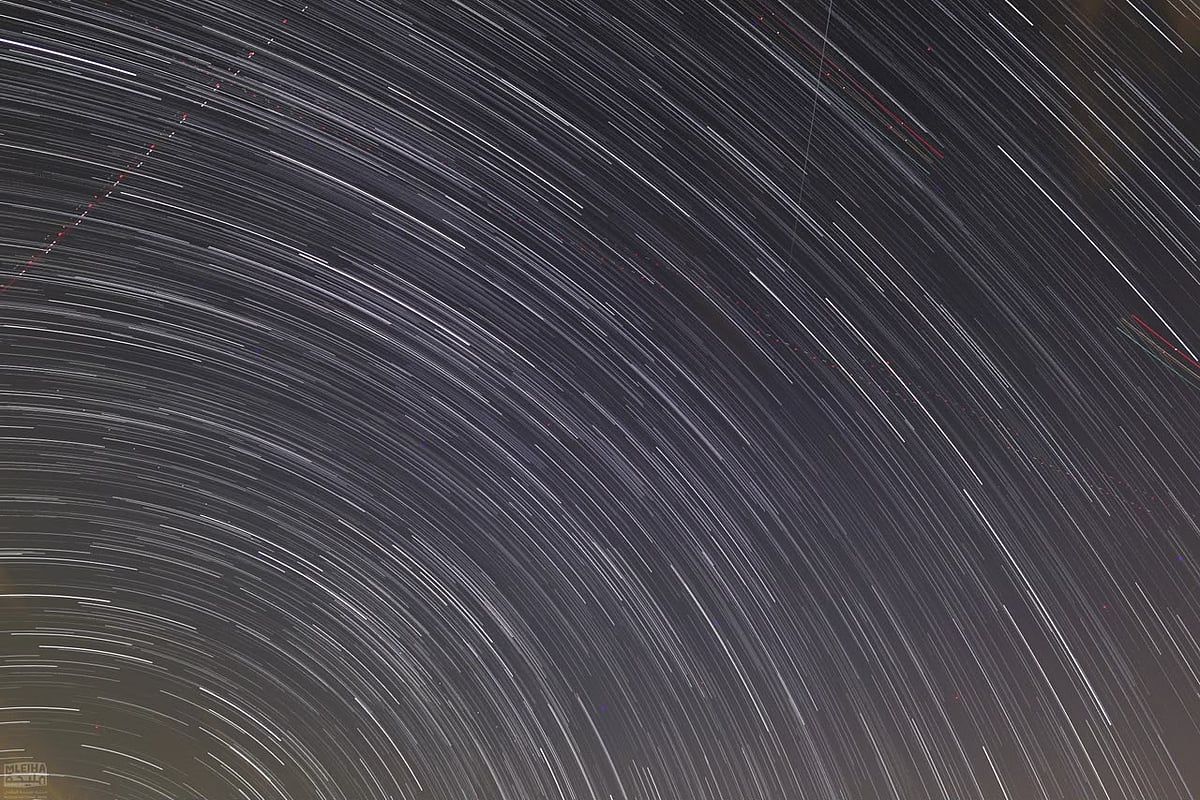
Star‑trail composition from the event, featuring meteors within the frame.
Prabhakaran Andiappan, Mleiha National Park
Sharjah: The buffet plates were cleared just before 9pm on Thursday, the lights at the Mleiha Eye Lounge dimmed, and a few hundred people settled onto carpets with their necks tilted back.
For the next four hours, until 1am, everyone was waiting for the same thing: a streak of light.
This was Mleiha National Park's annual Perseids night, timed to the shower's peak, which fell overnight on 13 August.
Gulf News spent the evening with Nirmal Rajah, head of tours at the park, who guided the session.
Get it: Fast, verified news for FREE ... download the Gulf News app — simply click here
What you are watching
"The Perseid meteor shower is quite an interesting astronomical event, and it's quite prominent in the year," says Rajah.
"This is when we actually see hundreds of meteors in a single evening. All of these are dust particles left behind in a trail by a comet called Swift-Tuttle."
A streak of the annual Perseid meteor shower, which peaked overnight on August 12–13, 2026, observed in an event hosted by Dubai Astronomy Group.
Earth crosses that trail every August. "When the earth ploughs through this cloud of dust, all of it enters the earth's atmosphere," he explains.
"Through a process called ablation, it enters at great speed, and it leaves a light trail. That is what we see as shooting stars."
The particles hit the upper atmosphere at roughly 59 kilometres per second, which is why they burn so brightly and so briefly.
Residents observed and took photos of Saturn from telescopes at the event.
One or two on any night, 100 on this one
"We do see shooting stars on a daily basis. Any random day, you just go outside and you will see one or two," says Rajah.
"But on a day like the Perseid meteor shower, when it peaks, you can expect to see at least 100 meteors per hour."
There is one more headline shower before the year ends. "Another meteor shower that is happening later this year is the Geminid meteor shower, which is happening on the 14th of December," he says.
A Perseids meteor streaking across the sky with Mleiha’s mountain in the backdrop.
A guided session
"This is a curated experience where we actually give people an idea about why the event is happening, the science behind meteor showers and meteors and comets and asteroids," Rajah says.
The observation hours ran as a conversation rather than a talk. "It's a fully guided session where we talk people through the event, and try to get the number of meteors that they've seen, the colours. It's more like an interactive session where we keep talking to each other." Quizzes ran through the night for the children.
Nine inches, 11 inches, 150 times magnification
"We use Cassegrain telescopes, so all the telescopes are nine inches and 11 inches big," says Rajah.
"These are all computerised, high-definition telescopes. That means these telescopes can actually point at thousands of objects in the night sky, with just a computer push away."
Guests at the Mleiha National Park's annual Perseids night.
Alignment happens before guests arrive.
"We programme the computers, we've aligned them to this area, and if you want to see one object or the other, you just have to tell the computer where it has to look at. It automatically moves," he says.
The instruments magnify between 100 and 150 times.
The queue paid off.
"Today we actually saw several stars, for example Vega, and another double star called Albireo," Rajah says.
"We also saw Venus earlier this evening, and we also saw the planet Saturn and its moons."
Everyone stayed past midnight
August in the UAE is not a comfortable month to sit outdoors for six hours. It emptied nothing.
"This time we actually had a lot of people, and the number of children who turned up, they were quite active despite the challenging weather conditions," says Rajah.
"What's more interesting to see is people were so engrossed. The weather is not a limiting factor here. They were here for knowledge, they were here for astronomy, and they got it."
"It's not just something beautiful, it's also very encouraging. In uncertain times, when we actually see people getting distracted by everything that the internet has to offer, this is the time that we actually deliberately took them off the internet," Rajah says.
"They stayed disconnected, but connected to the universe."
Network Links
GN StoreAbout Gulf NewsTerms & ConditionsReach by GNSitemapContact usPrivacy PolicyGN FocusHave your sayWork with usAdvertise with usGulf News epaperPrinting Services
Download our app
© Al Nisr Publishing LLC 2026. All rights reserved.