SpaceX's massive Starship rocket soared into its latest test flight Monday (11th test), as the US company vies to defy critics who say its technology might not be on track to deliver NASA's lunar projects and fulfill Elon Musk's Mars ambitions.
What would Elon Musk do with 100,000 satellites?
SpaceX eyes massive Starlink expansion to 100,000+ V3 satellites amid blockbuster IPO
Last updated:
3 MIN READ
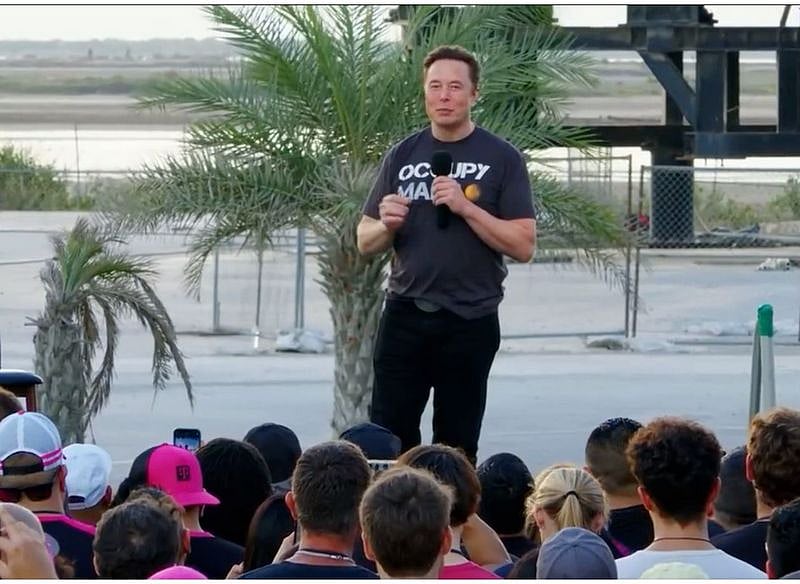
Elon Musk explains the direct-to-cell (D2C) service to users. Starlink's V3 satellites, the size of a Boeing 737 when deployed, promise up to 10-20 times the capability of prior generations, with roughly 1,024 Gbps of downlink capacity per satellite — more than 10 times that of V2 models — along with lower "latency", and expanding D2C service to the world's remotest areas.
X
Elon Musk’s SpaceX is planning a dramatic expansion of its Starlink constellation to more than 100,000 next-generation Version 3 and later satellites.
That scale-up, the company says, is essential to meet exploding demand for bandwidth from artificial intelligence (AI) systems and to position orbital data centers as the future of high-performance computing.
The ambitious target, outlined by Musk in recent remarks to investors, comes as SpaceX pulled off the largest initial public offering (IPO) in history, with shares now trading under ticker SPCX.
The IPO raised around $75 billions at a valuation around $1.75 trillion. That would provide capital to scale satellite manufacturing, Starship launches and space-based AI infrastructure.
Also In This Package
Mega IPO: SpaceX valuation seen skyrocketing to $1.77T
SpaceX IPO: Public scramble to get on bandwagon
SpaceX IPO could make Musk world’s first trillionaire
SpaceX’s $75b IPO may crown Musk and shake markets
SpaceX inks pre-IPO deal to supply AI compute to Google
SpaceX IPO: Can Elon Musk justify a $1.75tr valuation?
Starlink V3 satellites represent a significant leap over current versions.
Roughly the size of a Boeing 737 when deployed, they are designed exclusively for launch aboard SpaceX’s Starship vehicle and promise up to 10-20 times the capability of prior generations, with roughly 1,024 Gbps of downlink capacity per satellite — more than 10 times that of V2 models — along with lower latency.
Scaling to 100,000 satellites would require unprecedented industrial output and massive capital.
SpaceX aims to manufacture thousands of V3 satellites annually, potentially ramping to 5,000-10,000 per year, while relying on Starship’s full reusability to slash launch costs to levels competitive with international air freight.
The company has been cash-flow positive for years, but Musk described to Jamie Dimon of JP Morgan the IPO as key step to raise the massive sums private markets cannot readily provide for the next phase of growth.
Why so many satellites?
Musk has emphasized that AI and robotics will demand bandwidth and compute at scales incomprehensible for human users.
While a person might consume a few hundred bits per second, AI systems operate at trillions (at terrabyte-scale usage).
V3 satellites are engineered for this AI-centric future, supporting not only global broadband and direct-to-cell service but also massive inter-satellite laser links for orbital data centers.
Direct-to-Cell (DTC) is a satellite-based technology that connects standard, unmodified smartphones directly to satellites in space. Acting like "cell towers in space," these satellites use standard mobile frequencies (like LTE or 5G) to provide coverage in remote areas without needing bulky satellite phones or additional hardware.
Space-based compute offers compelling advantages: continuous solar power without atmospheric interference, radiative cooling in the vacuum of space, and freedom from terrestrial constraints such as NIMBY opposition to power (especially nuclear) plants.
Musk has spoken of scaling to terawatts of compute from the moon and beyond, tapping a minuscule fraction of the sun’s energy output.
1 million data centres in space?
SpaceX has filed plans for up to 1 million satellites that could function as AI data centres, each potentially delivering 120-150 kW of power using technology derived from Starlink V3.
Analysts and competitors have raised concerns about orbital "congestion", increased space junk risks and impacts on astronomy, though Musk has downplayed crowding in low Earth orbit.
Regulatory approvals from the FCC and international coordination will be critical.
IPO's timing
The IPO timing aligns with SpaceX’s push to fund this vision.
The company, which has maintained a relatively stable senior leadership team, views the public offering as a liquidity event and capital raise to accelerate its multi-planetary and AI ambitions rather than a sign of distress.
Starlink remains the financial crown jewel, generating the majority of revenue and profit as launch services and newer AI efforts continue to scale.
Musk has positioned the effort as essential for humanity’s long-term "multiplanetary" future, arguing that moving compute and energy infrastructure off-planet removes Earth’s bottlenecks and unlocks exponential economic growth.
Shares in the newly public SpaceX debuted on Friday.
Sign up for the Daily Briefing
Get the latest news and updates straight to your inbox
Network Links
GN StoreAbout Gulf NewsTerms & ConditionsReach by GNSitemapContact usPrivacy PolicyGN FocusHave your sayWork with usAdvertise with usGulf News epaperPrinting Services
Download our app
© Al Nisr Publishing LLC 2026. All rights reserved.