The Low-Cost Uncrewed Combat Attack System (LUCAS) drone, has been mass produced in the US after reengineering the "Shahed" drone captured from Iran. The Pentagon has reported deploying it against Iran.
300,000 drones ordered: Pentagon hits hard wall as '98% of the magnets come from China'
Race to mass-produce attack drones hinges on non-Chinese magnet supply
Last updated:
4 MIN READ
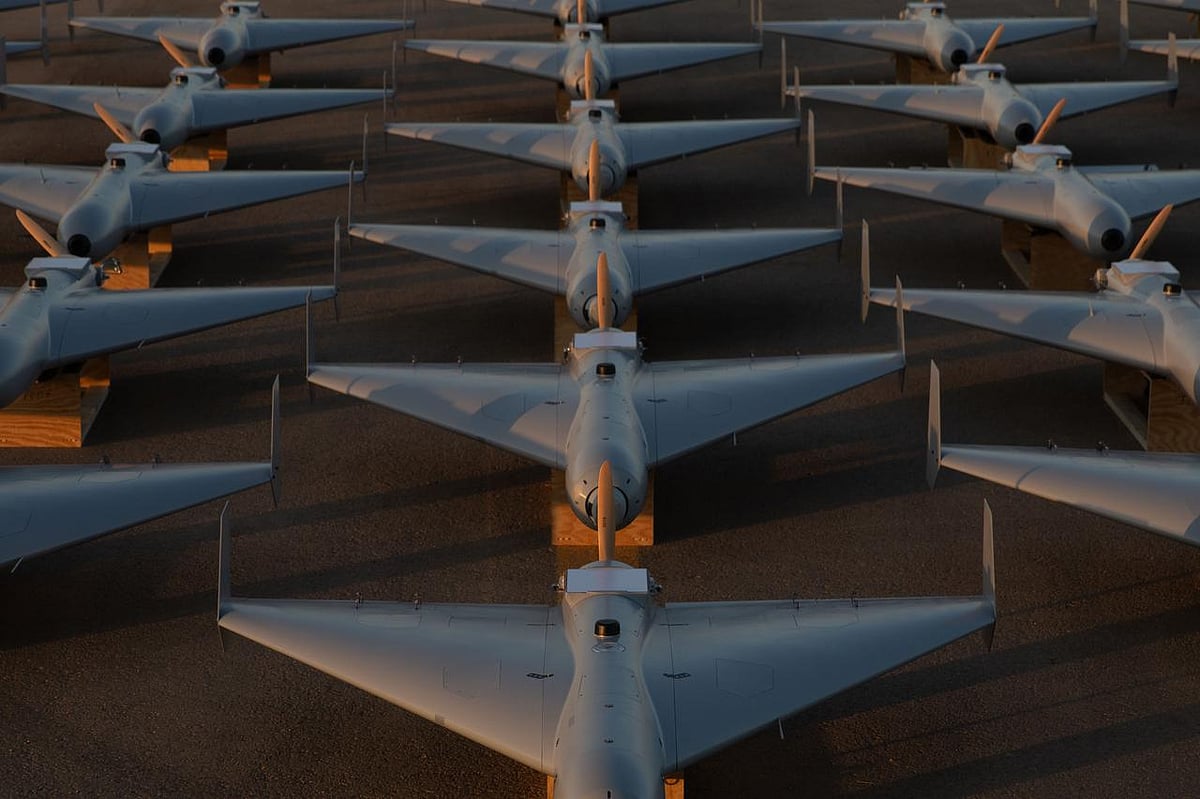
DRONE WARFARE: Low-cost Unmanned Combat Attack System (LUCAS) drones are positioned on the tarmac at a base in the US Central Command (CentCom) operating area. LUCAS is a clone of Iran's inexpensive Shahed-136 kamikaze drone. Photo published on Nov. 23, 2025.
X | @DeptWar
The US Department of Defence (also known as the Department of War) has quietly launched the largest drone buildup in American history — ordering 30,000 one-way attack drones with plans to scale beyond 300,000 units by 2028.
But inside that surge lies a vulnerability.
Few outside US defence circles talk about it: every one of those drones runs on rare-earth minerals (magnets) — and, by industry estimates, about 98% of the world’s supply is manufactured in China, according to an industry report.
Now, the US is working hard to create a supply chain for rare earths to replenish its military arsenal, AFP reported.
FROM RARE EARTHS TO MAGNETS: Rare earth minerals are transformed into powerful permanent magnets (like Neodymium-Iron-Boron) through a complex, multi-step process, currently dominated by China.
That’s the strategic choke point companies like REalloys say they were built to address.
The firm claims to operate the only fully non-Chinese “mine-to-magnet” heavy rare earth supply chain in North America, producing processed metals and alloys that feed directly into magnet manufacturing for defense use.
Why Pentagon needs to move fast
To understand the urgency, analysts point to Ukraine. Over the past two years, drones have transformed the battlefield at a pace not seen since the machine gun.
Ukraine reportedly produced over 1.2 million drones in 2024 alone — and the magnets powering nearly all of them traced back to Chinese supply chains.
That lesson was not lost on Washington.
In June, President Donald Trump signed an executive order titled “Unleashing American Drone Dominance” aimed at accelerating both military and commercial drone production.
A month later, Defence Secretary Pete Hegseth issued guidance to ramp up procurement of American-made systems.
The 2026 defence budget now earmarks $13.6 billion for autonomous systems, underscoring how central drones and AI-enabled platforms have become to U.S. war planning.
The supply chain money can’t fix
Despite the funding, a structural problem remains: rare earth dependence.
By Pentagon estimates, 80,000 components across 1,900 US weapons systems rely on Chinese-sourced rare earth materials — from drone motors to missile guidance, sensors and aircraft systems.
Unmanned Combat Attack System (LUCAS) drones are positioned on the tarmac at an undisclosed base in the US Central Command operating area, on November 23, 2025. The LUCAS platforms are part of a one-way attack drone squadron that CENTCOM recently deployed to the Middle East.
The drone surge is also reshaping the broader defense tech sector. Companies such as AeroVironment, Kratos Defense & Security Solutions, and Palantir Technologies are expanding deeper into autonomous warfare and AI-driven targeting.
Yet nearly all of these platforms ultimately depend on the same magnet supply chain.
The equation is simple: If Beijing tightens the valve, there’s no backup supplier to call.
A US military MQ-9 Reaper drone sits on a tarmac at Rafael Hernandez Airport in Aguadilla, Puerto Rico, on December 29, 2025.
Still, venture capital is flooding into rare earths.
For example, Vulcan is now building the largest rare earth magnet factory outside of China, as the Trump governments drives the move to lessen or altogether stop reliance on China, which controls 90% of global rare earth processing.
An industry report states that securing mining permits in the US typically takes seven to 10 years. However, bringing a new mine online, including development and planning, can take an average of 29 years, making it one of the longest lead times globally.
The rare earth gap few talk about
The US government has begun responding.
The Pentagon took a $400 million equity stake in MP Materials, now its largest shareholder, and has extended loans to other domestic producers.
But most of that effort focuses on light rare earths — neodymium and praseodymium — used in consumer magnets for EVs and electronics.
What military systems require are heavy rare earths such as dysprosium and terbium.
These elements keep magnets stable under the extreme heat inside a jet engine or a high-stress drone motor.
Without them, magnets degrade quickly. That’s the difference between a consumer-grade component and a military-grade one.
And this is where REalloys says it operates: in the heavy rare earth segment that few others in North America currently cover at scale.
America's strategic vulnerability exposed
While Europe has moved slowly, Washington is now spending aggressively to close the gap in 2026. The Pentagon’s drone ambitions, combined with lessons from Ukraine, have turned what was once a niche mining issue into a frontline national security concern.
The central question is no longer whether the US can build hundreds of thousands of drones.
It’s whether it can build the magnets inside them — without relying on China.
Sign up for the Daily Briefing
Get the latest news and updates straight to your inbox
Network Links
GN StoreAbout Gulf NewsTerms & ConditionsReach by GNSitemapContact usPrivacy PolicyGN FocusHave your sayWork with usAdvertise with usGulf News epaperPrinting Services
Download our app
© Al Nisr Publishing LLC 2026. All rights reserved.