Trump says US may strike Iran again; Drones that targeted UAE's Barakah nuclear power plant came from Iraq
JD Vance says Iran talks making 'good progress' but US remains 'locked and loaded'
Highlights
We are closing this coverage now. For latest updates, click here.
US Senate approves curbs on Trump’s war powers in Iran — what's next
The US Senate has advanced a measure seeking to limit President Donald Trump’s authority to launch future military action against Iran without congressional approval, passing the procedural vote 50–47.
UN Security Council condemns attack on UAE's Barakah nuclear plant
The UN Security Council members strongly condemned the terrorist attacks that targeted the Barakah Nuclear Power Plant, and emphasised the grave risks associated with targeting nuclear facilities.
The UAE also joined the Council members in calling for ensuring full accountability.
VP Vance: Iran’s negotiating position is 'unclear', cites 'fractures' within Tehran's leadership, deal prospects 'not certain’
JD Vance told reporters he is “not certain” a deal with Iran will materialise, as cited "fractures" within Iran’s leadership, adding that Tehran’s negotiating position remains "unclear" amid mixed signals from different power centres in the country.
Vance, however, said he remains sufficiently optimistic to keep working toward an agreement as diplomatic efforts continue alongside military pressure.
'Limited period of time’: Trump says he’s delaying new Iran strike amid talks — but threat still looms
US President Donald Trump stated that he has paused a planned military attack on Iran, saying he would "hold off" for a “limited period of time” to allow for ongoing negotiations — even as he warns a new strike could happen soon if talks fail.
Trump said he was reportedly “an hour away” from ordering a fresh assault before postponing it, and suggested the delay could last “two or three days, maybe Friday, Saturday, Sunday, something, maybe early next week — a limited period of time.” He stressed the pause is temporary because “we can’t let them have a new nuclear weapon.”
UAE air defences intercept 6 drones over past 48 hours
The UAE Ministry of Defence announced that over the past 48 hours, UAE air defence systems successfully detected and intercepted six hostile drones that attempted to target civilian and vital areas in the country.
US says 89 vessels redirected under Iran blockade enforcement
US Central Command said its forces continue 'total enforcement' of the U. blockade targeting Iranian maritime activity, reporting that 89 commercial vessels have now been redirected to ensure compliance.
In a post on X, CENTCOM said the operation aims to stop the flow of commercial traffic into and out of Iranian ports, as part of ongoing enforcement measures in the region.
The command added that vessels are being diverted in coordination with maritime operations designed to restrict sanctioned shipping routes linked to Iran.
Airbus seeks to cut peripheral expenses due to Mideast war
European aviation giant Airbus has asked its teams to cut "non-essential expenses" by 10 percent due to turbulence following the Middle East war, according to a document seen by AFP.
"We are asking for your support in adopting several cost containment measures to help our company navigate this unstable situation," it said.
"Our specific focus is on significantly pausing all activities and costs that are not strictly essential to our industrial activities and operations ... We aim to reduce these costs by -10% compared to the 2025 baseline."
Airbus, contacted by AFP, declined to comment.
The memo asked teams not to "engage in any new expenses or any subcontracting activities that are not strictly essential", singling out "team events, team boosters, corporate events, events for other stakeholders, and participation in conferences and events".
It also asked teams not to enter into new agreements or activities, and to cut travel costs.
The economic uncertainty caused by the Middle East war is weighing on the entire aviation sector, as well as on global supply chains in the industry.
At the end of April, Airbus was still planning to deliver a record 870 commercial planes in 2026.
Get updated faster and for FREE: Download the Gulf News app now - simply click here.
US VP Vance says Poland troop deployment delayed
US Vice President JD Vance said Tuesday that a deployment of 4,000 troops to Poland had been delayed rather than canceled, but said Europe had to stand on its "own two feet."
Last week US officials said that the deployment had been scrapped, the latest move by President Donald Trump's administration to slash troop numbers stationed in European NATO allies.
Trump has appeared determined to punish allies who have failed to back the Middle East war or contribute to a peacekeeping force in the crucial Strait of Hormuz waterway, which Iran has effectively closed.
The Pentagon announced at the beginning of May that Washington would pull 5,000 troops from Germany.
Iran talks making 'good progress': US VP Vance
US Vice President JD Vance said Tuesday that Iran talks are making good progress but Washington was "locked and loaded" to restart military operations if there is no deal.
Vance's comments came hours after President Donald Trump said he had come within an hour of ordering fresh strikes and gave Tehran "two or three days" to reach an agreement.
"A lot of good progress is being made, but we're just going to keep on working at it, and eventually we'll either hit a deal or we won't," Vance told a briefing at the White House.
Vance - an Iran war-skeptic who led a US delegation to Pakistan in April for talks that failed to produce a deal - said Iran had to accept that it could not have a nuclear weapon.
We're in a pretty good spot here - but there's an option B, and the option B is that we could restart the military campaignJD Vance, US vice president
"We're locked and loaded. We don't want to go down that pathway, but the president is willing and able to go down that pathway if we have to."
US seizes Iran-linked oil tanker in Indian Ocean
The United States seized an Iran-linked oil tanker in the Indian Ocean overnight, according to three US officials cited by The Wall Street Journal, in a move that comes as President Donald Trump threatens to resume military strikes against Iran amid escalating tensions.
The tanker, identified as the Skywave, had been sanctioned by Washington in March over its alleged role in transporting Iranian oil. Ship-tracking data showed the vessel sailing west of Malaysia on Tuesday after passing through the Strait of Malacca. According to brokers and data from Lloyd's List Intelligence cited by the newspaper, the tanker was likely carrying more than one million barrels of crude oil loaded at Iran’s Kharg Island in February.
Erdogan calls for immediate reopening of Hormuz
Turkish President Recep Tayyip Erdogan held a phone call with European Commission President Ursula von der Leyen to discuss Turkey–EU relations alongside regional and global developments.
Erdogan stressed the need to preserve ceasefires in regional conflicts and said the Strait of Hormuz should be reopened immediately. He also accused Israel of seeking to prolong regional conflicts and violating international law, calling for increased global pressure.
The leaders also discussed strengthening Turkey–EU cooperation, with Erdogan highlighting economic integration, updates to the Customs Union, and deeper collaboration in security initiatives.
Israel says soldier killed in south Lebanon
An Israeli soldier "fell in combat" in southern Lebanon on Tuesday, the military said, bringing to 21 the number killed since the start of their latest operation against Hezbollah.
The military identified the latest casualty as Major Itamar Sapir, a 27-year-old deputy company commander in the reservist 551st Brigade.
Israel launched a ground and air operation into Lebanon after the Iran-backed armed group Hezbollah launched rockets in response to US and Israeli strikes on its ally.
Israeli strikes on Lebanon have killed more than 3,000 people since March 2, according to Lebanese authorities.
Sapir's death brings the Israeli military toll to 21. One civilian contractor has also been killed.
Love and war: Supreme leader urges Iran to procreate
In a break from his recent warlike rhetoric, the latest message from Iran's shadowy supreme leader on Tuesday set his people a more productive mission: get out and make babies.
Ayatollah Mojtaba Khamenei was reportedly wounded in the US-Israeli bombardment that killed his father and predecessor and ignited the Middle East war on February 28, and he has not been seen in public since.
But several written messages have been attributed to him and in the latest - a letter in response to well-wishes from pronatalists - he urged Iranians to secure great power status by growing their population.
"By earnestly pursuing the correct, necessary policy of population growth, the great Iranian nation will be able to play a major role and experience strategic leaps in the future," he posted on social media platform X.
In a longer version of his remarks carried by state broadcaster IRIB, Khamenei told activists: "It is hoped that your sincere efforts... will lead to fruitful results, God willing."
Iran has a population of around 92 million - less than half that of neighbouring Pakistan and smaller than Middle East rival Egypt - but official figures show it is still the 17th most populous nation in the world.
Vance says Iran must agree to never have a nuclear weapon
US Vice President JD Vance said Iran must agree never to obtain a nuclear weapon or risk the United States remaining “locked and loaded” to restart military operations.
Providing an update on Iran, Vance said Washington has a “simple proposition” and described “two paths to go down,” reiterating that “Iran cannot have a nuclear weapon.”
He warned that if Iran were to acquire one, other countries would “scramble” to develop their own arsenals, triggering what he called a global “nuclear arms race.”
“Iran would really be the first domino in what would set off a nuclear arms race all over the world,” he said, adding it would make global security “much less safe.”
Read more here.
UAE urges UN action after Barakah attack
The UAE is participating today in the emergency session of the United Nations Security Council following the treacherous terrorist attack that targeted an electricity generator located outside the inner perimeter of the Barakah peaceful nuclear power plant in the Al Dhafra region of the UAE.
The UAE called on the Security Council to condemn this dangerous escalation in the strongest terms, stressing that targeting nuclear facilities designated for peaceful purposes constitutes a flagrant violation of international law and the United Nations Charter, while also posing a direct threat to regional and international peace and security.
The UAE affirmed that it will not tolerate any threat to its security and sovereignty under any circumstances, underscoring its firm commitment to confronting any attack targeting its vital facilities and civilian infrastructure.
US again avoids taking responsibility for Iran school attack
A top commander of US forces in the Middle East avoided taking responsibility Tuesday for an attack on a school in Iran that left 155 people dead on day one of the war, insisting a "complex" probe continues.
Admiral Brad Cooper, the commander of US Central Command (CENTCOM), told a congressional oversight panel that "the school itself is located on an active IRGC cruise missile base," making the investigation "more complex than the average strike." IRGC stands for Iran's Islamic Revolutionary Guard Corps.
The attack killed 73 boys, 47 girls, 26 teachers, seven parents, a school bus driver, and another adult in the southern city of Minab on February 28, according to Iranian state media. The United States has repeated avoided assuming responsibility for the tragedy.
Cooper was responding to questioning by House Armed Services Committee Ranking Member Adam Smith, a Democrat, who said that, "in the past, when we've had these types of mistakes, they have been quickly acknowledged, even if a further investigation is necessary."
Cooper promised to share the results of the investigation when it was complete. Smith responded by saying, "So that's a 'no.' We will not take responsibility for something we very obviously did."
The New York Times has previously reported that the school was hit by a US Tomahawk cruise missile, a weapon which Iran does not possess. CNN has also reported that the US was responsible for the attack.
Trump initially claimed that Iran itself might be behind the attack because "they have no accuracy whatsoever" with their munitions.
House Democrats filed impeachment proceedings against Defence Secretary Pete Hegseth in the wake of the attack, although this was largely seen as symbolic given Republican control of the chamber.
Hamas, Hezbollah, Houthis cut off from Iran support: CENTCOM
Iran’s ability to threaten regional partners and US interests has been significantly reduced, according to a senior US military official.
Admiral Brad Cooper, head of US Central Command, told a Senate committee that Iran’s operational threat has been “dramatically degraded” across all domains.
“Iran has a significantly degraded threat, and they no longer threaten regional partners or the United States in ways that they were able to do before,” Cooper said. “They’ve been significantly degraded.”
He added that Hamas, Hezbollah and the Houthis are now “cut off” from Iran’s weapons supply and support, describing it as a significant shift in the regional security landscape.
EU denounces new US waiver of Russian oil sanctions
The European Union criticised the latest US waiver of sanctions on Russian oil, announced while G7 finance ministers were meeting to reach a common response to multiple economic challenges.
"From the EU point of view, we do not think that this is a time to ease pressure on Russia," Dombrovskis told journalists while arriving for a second day of G7 talks in Paris.
"In fact, Russia is the one which is gaining from the war in Iran and the increase in fossil fuel prices," he said. "If anything, we would need to strengthen the pressure."
Dombrovskis later added that "the G7 is a forum for cooperation, it's a forum for discussion" among like-minded allies, "but we are not always 100 percent aligned on everything and this is unfortunately one of those topics."
The final communique of the G7 ministers and central bank governors reaffirmed "our commitment to multilateral cooperation in addressing risks to the global economy".
Against the backdrop of the Middle East war, the statement highlighted "multiple and complex global challenges requiring coordinated responses".
Dombrovskis called "it a good statement and a successful outcome" of the meeting, adding it "provides a good basis to work towards a summit next month".
US targets Iranian exchange house over sanctions evasion
The US Treasury Department said it has imposed sanctions on a prominent Iranian foreign currency exchange house and a network of associated front companies accused of handling hundreds of millions of dollars in transactions for sanctioned Iranian banks.
In a post on X, the Treasury’s Office of Foreign Assets Control said the entities collectively manage billions of dollars in foreign currency transactions annually, facilitating what it described as efforts by the Iranian regime and its armed forces to bypass sanctions.
The department added that the network enables access to the international financial system and the movement of funds linked to oil and petrochemical sales.
Modi vows to support end to war in Mideast, Ukraine
Indian Prime Minister Narendra Modi on Tuesday vowed to work with Nordic allies to end conflicts in Ukraine and the Middle East and defend the "rules-based global order".
Speaking at a summit in Oslo, Modi - a close ally of US President Donald Trump - said his and the Nordic leaders' commitment to democracy and multilateralism made them "natural partners".
Trump has spoken of efforts to end the wars but has also sown uneasiness among European allies by challenging pillars of the post-war order, notably the NATO military alliance.
"In these times of global tensions and conflict, India and Nordic countries will together continue to focus on a rules-based global order," Modi told reporters.
"Whether it is Ukraine or West Asia (Middle East), we will continue to support an early end to the conflict and efforts for peace."
Standing alongside him, Denmark's outgoing prime minister Mette Frederiksen warned the "rules-based world order" was under pressure.
"Unfortunately the old world order is changing rapidly and it's not going in the right direction," she said.
Putin lands in Beijing for talks with Xi: Chinese state media
Russian President Vladimir Putin landed on Tuesday night in Beijing, where he will meet his Chinese counterpart Xi Jinping as they aim to showcase ironclad relations just days after a visit by geopolitical rival Donald Trump.
Putin touched down in Beijing Capital International Airport shortly after 11:15 pm (0315 GMT), where a military band waited to greet him, state broadcaster CCTV showed.
US troop withdrawals from Europe don't harm NATO defences
NATO's top commander said Tuesday that US President Donald Trump's decision to withdraw 5,000 troops from Germany does not hurt the alliance's defences.
"I'd like to emphasise this decision does not impact the executability of our regional plans," US General Alexus Grynkewich, NATO's Supreme Allied Commander Europe, told journalists.
"As allies build up their capability, the United States is able to pull capability back and use it for other global priorities, so I'm very comfortable with where we are," he added.
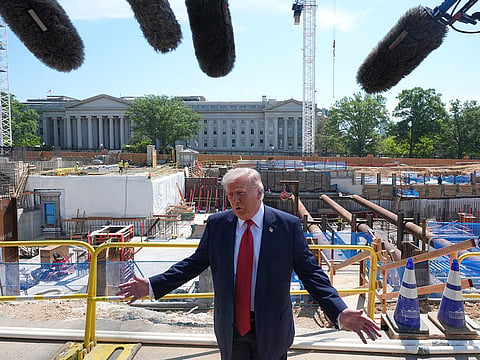
'We may have to hit Iran again', says Trump
US President Donald Trump said on Tuesday that Washington may still carry out another strike on Iran, revealing he had come close to approving military action earlier in the day.
Speaking to reporters at the White House, Trump said he was “an hour away” from making the decision to launch a strike before ultimately postponing it.
I was an hour away from making the decision to go todayDonald Trump, US President
He also claimed that Iran’s leadership is seeking to negotiate, saying they are “begging” to reach a deal.
UAE intercepts six hostile drones over 48 hours
The UAE’s Ministry of Defense said its air defence systems intercepted six hostile drones over the past 48 hours that were targeting civilian and vital facilities across the country.
In a statement, the ministry said the drones were detected, engaged and neutralised with a high level of readiness and efficiency, adding that no casualties were reported and there was no impact on critical infrastructure.
The announcement came as authorities concluded investigations into the May 17 attack on the Barakah Nuclear Energy Plant. Technical tracking and monitoring confirmed that three drones involved in the incident — two of which were intercepted — originated from Iraqi territory. The third drone struck an electrical generator located outside the plant’s internal perimeter.
The ministry said the drones involved in the Barakah incident, along with those intercepted in subsequent operations, were all launched from Iraq.
It stressed that the UAE reserves the right to take all necessary measures to safeguard its sovereignty and national security, in line with international law.
The Ministry of Defense also reaffirmed the armed forces’ full readiness to respond to any threats targeting the country’s security and strategic capabilities.
US stocks dip as markets fret over inflation
Wall Street stocks retreated early Tuesday as analysts pointed to angst over inflation pressures as the prolonged Middle East war kept oil prices high.
Equities had until recently "shrugged off the effects of higher yields," Interactive Brokers' Steve Sosnick said of increases in bond yields.
"After pretending this was not a problem, I think (the market) has now decided that higher yields are in fact a problem," Sosnick said. "But we aren't seeing panic or anything like that."
About 10 minutes into trading, the Dow Jones Industrial Average was down 0.8 percent at 49,289.53.
The broad-based S&P 500 dropped 0.4 percent to 7,372.49, while the tech-rich Nasdaq Composite Index shed 0.3 percent to 26,024.82.
Iran's army warned on Tuesday it would "open new fronts" against the United States if it resumes attacks, after President Donald Trump said he had held off launching a new offensive in hopes of striking a deal.
Major US indices were also under pressure Monday as semiconductor equities sold off a fraction of recent gains. Sosnick described the dynamic as profit-taking ahead of Wednesday's release of Nvidia's earnings.
Iran stock exchange reopens after war forced shutdown
Iran reopened its stock exchange on Tuesday after the longest shutdown in its history, caused by the war with the United States and Israel, local media reported.
"After nearly 80 days ... the Tehran Stock Exchange reopened this morning," the economic daily Donya-e-Eqtesad reported.
Trading had been suspended since the start of the war on February 28, when Israeli and US strikes on Iran triggered retaliatory missile and drone attacks by Tehran across the region.
The market remained closed even after a fragile ceasefire took effect on April 8.
Rosatom sees return of staff to Bushehr nuclear plant
Russian state nuclear corporation Rosatom expects to be able to redeploy personnel to Iran’s Bushehr nuclear power plant in the coming weeks, according to RIA state news agency.
Kuwait, Pakistan discuss strengthening military cooperation
The Chief of the General Staff of the Kuwaiti Army, Lieutenant General Khaled Al-Shuraian, held talks on Tuesday with the Director General of Military Operations of the Pakistani Army, Brigadier Naveed Abbas, focusing on ways to further develop joint military defence cooperation in support of mutual interests.
In a statement, the Kuwaiti Army General Staff said the discussions took place during Al Shuraian’s reception of Brigadier Abbas and his accompanying delegation during their visit to Kuwait.
The statement added that the meeting reviewed bilateral relations between Kuwait and Pakistan.
Qatar says US-Iran negotiations need 'more time'
Qatar said on Tuesday that US-Iran negotiations, mediated by Pakistan, required more time to reach a deal, a day after President Donald Trump said he had postponed planned attacks to give the process a chance.
"We are supportive of the diplomatic effort by Pakistan that has shown seriousness in bringing parties together and finding a solution, and we do believe it needs more time," Qatari foreign ministry spokesman Majed Al Ansari said at a press conference.
Trump, who had indefinitely extended the truce and made clear he wanted to exit a war that has proved to be politically damaging, said on Monday he had prepared a new military attack for the following day after Iran rejected his outlines of a deal.
But on Monday, Trump said on social media that he had suspended the attack after the leaders of Qatar, Saudi Arabia and the United Arab Emirates asked him to give negotiations a chance.
"We want to protect the people of the region from being basically the main losers of any escalation in the region," al-Ansari said.
He would not say whether Qatar was optimistic or not about a deal and would not comment further on Trump's social media post.
Explosions heard in Iran's Qeshm Island
Explosions have been heard on Iran’s Qeshm Island on Tuesday, although the cause was not immediately clear and Iranian authorities had yet to issue an official statement, according to Iran’s semi-official Mehr News Agency.
Meanwhile, Iran’s Tasnim news agency later cited an official as saying the blasts were linked to operations to neutralise unexploded munitions on the island.
Qeshm Island, located near the Strait of Hormuz, has witnessed heightened military activity in recent months amid regional tensions and security incidents involving Iran and GCC countries.
Israel military issues fresh evacuation warnings for south Lebanon
The Israeli military on Tuesday warned residents of 12 towns and villages in southern Lebanon to immediately evacuate ahead of expected attacks against Hezbollah, the latest despite a ceasefire.
"Hezbollah's continued violations of the ceasefire compel the IDF to operate against it. The IDF does not intend to harm you. For your safety, we urge you to distance yourself from the area and immediately move at least 1,000 metres away," the military's Arabic-language spokesman Avichay Adraee posted on X.
Lebanon's state-run National News Agency reported a new series of Israeli strikes targeting several locations in southern Lebanon on Tuesday.
Meanwhile, Hezbollah said in a statement that it had targeted a gathering of soldiers and vehicles in northern Israel with "a swarm of attack drones."
The Iran-backed militant group also claimed responsibility for new attacks against Israeli forces operating inside Lebanese territory.
Iran army warns will 'open new fronts' against US if attacks resume
Iran's army warned on Tuesday it would "open new fronts" against the United States if it resumes attacks, after President Donald Trump said he had held off launching a new offensive in hopes of striking a deal.
"If the enemy is foolish enough to fall into the Zionist trap again and launches new aggression against our beloved Iran, we will open new fronts against it, with new equipment and new methods," said army spokesman Mohammad Akraminia, according to Iran's ISNA news agency.
Gargash: Gray positions more dangerous than inaction
Anwar Gargash, the UAE's Diplomatic Adviser to the President, posted on X warning that the confusion of roles during what he described as Iran's treacherous aggression is deeply alarming, noting that victim states have been cast as mediators, friends have stepped back from being steadfast allies, and that in this most dangerous phase of modern Gulf history, taking a gray or ambiguous position is more perilous than doing nothing at all.
G7 calls on IMF to help countries hit by Iran war
France's Finance Minister Roland Lescure has called on the IMF and World Bank to do more to support countries most vulnerable to the economic fallout from the Middle East conflict, as G7 finance ministers and central bank governors gathered in Paris for a second day of talks.
Ministers were joined by representatives from Gulf states, Brazil and Kenya, as the world's most advanced economies sought to build new partnerships amid the Iran war and mounting pressure on Russia over Ukraine.
"We agree on the fact that the IMF and the World Bank have to step up their game for those countries and make sure we help them," Lescure told reporters, adding that a shortage of fertiliser would have a particular impact on the most vulnerable nations.
The talks also touched on volatility in global bond markets and broader economic strains stemming from the ongoing conflict. Meanwhile, US President Donald Trump said he had paused a planned attack against Iran after Tehran sent a peace proposal to Washington, adding there was now a "very good chance" of reaching a deal limiting Iran's nuclear programme, according to Reuters.
UAE denounces Iran over sea mines
The United Arab Emirates has renewed its condemnation of the illegal and unjustified attacks launched by Iran against the State and neighbouring countries, including the disruption of navigation in the Strait of Hormuz and the targeting of oil and gas infrastructure, during the high-level meeting on protecting energy flows and supply chains. The United Arab Emirates, alongside its partners, affirmed the importance of respecting navigation rights and the freedoms of commercial vessels, in line with international law and Security Council Resolution 2817. The State stressed the necessity of Iran's immediate cessation of all its attempts to obstruct transit traffic in the Strait through the planting of sea mines and the imposition of illegal fees.
UK employers cut hiring
Britain's employers reined in their hiring in April, adding to growing signs of the Iran war's impact on the economy. Early payroll data from the tax office showed a heavy fall of 100,000 jobs in the month from March — the biggest drop since May 2020, at the height of the COVID-19 pandemic, though officials stressed the figures were likely to be revised.
Vacancies fell to 705,000 in the three months to April, down from 712,000 in the first quarter of 2026 and the lowest since February 2021. Wage growth, excluding bonuses, stood at 3.4% in the first three months of 2026 compared with the same period last year, in line with economist expectations.
The Bank of England has been closely monitoring wage growth as it assesses inflation pressure in the economy.
300,000 drones ordered
The US Department of Defence (also known as the Department of War) has quietly launched the largest drone buildup in American history — ordering 30,000 one-way attack drones with plans to scale beyond 300,000 units by 2028.
But inside that surge lies a vulnerability.
Few outside US defence circles talk about it: every one of those drones runs on rare-earth minerals (magnets) — and, by industry estimates, about 98% of the world’s supply is manufactured in China, according to an industry report.
Now, the US is working hard to create a supply chain for rare earths to replenish its military arsenal, AFP reported.
Under Trump pressure, EU eyes deal to end trade standoff
The EU hopes Tuesday to strike a deal towards implementing its nearly year-old trade pact with the United States - with an increasingly impatient Donald Trump threatening steep new tariffs unless it is done by July 4.
The 27-nation bloc struck an accord with Washington last July setting levies on most European goods at 15 percent, but to the US president's frustration a final version of the text still needs nailing down on the EU side.
"A deal is a deal," the US mission to the EU posted on X Monday, saying the bloc "must live up" to the agreement sealed in Turnberry, Scotland, between Trump and EU chief Ursula von der Leyen.
Negotiators from the EU's parliament and capitals will meet Tuesday night in Strasbourg to push for a compromise that would allow the bloc to meet Trump's deadline and hopefully turn the page on more than a year of transatlantic trade battles.
Short of that, Trump has warned the EU should expect "much higher" tariffs - and has already vowed to raise duties on European cars and trucks from 15 to 25 percent.
India raises fuel prices
India raised prices of petrol and diesel by nearly a rupee a litre on Tuesday, as the government moves to recover losses incurred from high global crude prices. After the hike of roughly 0.9 rupees ($0.0093), petrol will cost 98.64 rupees a litre in Delhi while diesel will be at 91.58 rupees a litre. The world's third-largest importer and consumer of oil is one of the last major economies to raise retail fuel prices after the US-Israeli war on Iran triggered the effective closure of the Strait of Hormuz, according to Reuters.
US crude futures fall, Brent down nearly 3%
Oil prices fell sharply in early Asian trade, extending losses after recent volatility tied to disruptions around the Strait of Hormuz began to ease and tanker traffic showed tentative signs of recovery.
Market data at 9:27 am Tokyo time showed:
WTI crude at $102.5, down $1.87 (-1.79%)
Brent crude at $109.3, down $2.75 (-2.45%)
Murban crude at $106.7, down $1.28 (-1.19%)
The declines reflect a cooling of the risk premium that had built up over weeks of near-paralysis in shipping through Hormuz, the narrow waterway that handles roughly a fifth of global oil flows.
Iran’s latest counterproposal 'does not appear to meet US demands': report
Iran’s latest counterproposal does not appear to meet US demands, as per the Institute for the Study of War (ISW), a Washington think-tank. A senior US official and source briefed on the matter told Axios on May 18 that Iran’s counterproposal does not contain a commitment “about suspending uranium enrichment or handing over its existing stockpile of highly enriched uranium (HEU).” US demands have been and continue to be that Iran must give its HEU to the US.
Get updated faster and for FREE: Download the Gulf News app now - simply click here.
Trump cites 'very positive development', deal is 'near' on Iran nuclear enrichment
Speaking later at a White House event, Trump said there had been a 'very positive development' and that Arab allies said a deal was near that would leave Iran without nuclear weapons, which Tehran denies pursuing.
"There seems to be a very good chance that they can work something out. If we can do that without bombing the hell out of them, I'd be very happy," Trump said.
Iran has repeatedly rebuffed Trump's offers and has exerted control over the Strait of Hormuz, the vital waterway into the Gulf, sending global oil prices spiraling.
He was quoted as saying: "We were getting ready to do a very major attack tomorrow, and I put it off for a little while—hopefully maybe forever... because we've had very big discussions with Iran, and we'll see what they amount to."
Muslim Council of Elders condemns targeting of Barakah Nuclear Power Plant
The Muslim Council of Elders, under the chairmanship of His Eminence Dr. Ahmed Al-Tayeb, Grand Imam of Al-Azhar, strongly condemned the targeting of the vicinity of the Barakah Nuclear Power Plant in the Al Dhafra region of the United Arab Emirates by drones. The Council also affirmed solidarity with the UAE. No casualties were reported in the attacks.
Get updated faster and for FREE: Download the Gulf News app now - simply click here.
US Treasury eases purchase of Russian oil in move to stabilise markets
The US Treasury Department issued a temporary 30-day general licence allowing the most energy-vulnerable nations to access Russian oil stranded at sea, aiming to stabilise global crude markets and redirect supply to "countries in need". Treasury Secretary Scott Bessent, in announcing the move, said the extension provides flexibility for specific licenses as needed.
The action is intended to help reroute existing supply away from China, which has been stockpiling discounted Russian oil, while ensuring oil reaches nations facing energy shortages.
Extending by 30 days US sanctions waiver for Russian oil cargoes already at sea, is expected to ease global energy prices amid Iran war risks.
The latest "temporary 30-day general license" will "provide the most vulnerable nations with the ability to temporarily access Russian oil currently stranded at sea," Treasury Secretary Scott Bessent said in a social media post.
IAEA monitoring developments at Barakah Plant
The International Atomic Energy Agency (IAEA), affiliated with the United Nations, is closely monitoring the situation at the Barakah Nuclear Energy Plant in Abu Dhabi through continuous coordination with the relevant UAE authorities, while expressing its full readiness to provide assistance if needed.
The remarks were made this evening by Farhan Haq, Deputy Spokesman for the UN Secretary-General, who renewed the Secretary-General’s deep concern over reports received by the United Nations indicating that drone attacks yesterday caused a fire in an electricity generator within the vicinity of the Barakah plant.
Trump says 'holding off on attack on Iran tomorrow'
In a lengthy post on his Truth Social platform, US President Donald Trump said: "I have been asked by the Emir of Qatar, Tamim bin Hamad Al Thani, the Crown Prince of Saudi Arabia, Mohammed bin Salman Al Saud, and the President of the United Arab Emirates, Mohamed bin Zayed Al Nahyan, to hold off on our planned Military attack of the Islamic Republic of Iran, which was scheduled for tomorrow, in that serious negotiations are now taking place, and that, in their opinion, as Great Leaders and Allies, a Deal will be made, which will be very acceptable to the United States of America, as well as all Countries in the Middle East, and beyond."
He added: "This Deal will include, importantly, NO NUCLEAR WEAPONS FOR IRAN! Based on my respect for the above mentioned Leaders, I have instructed Secretary of War, Pete Hegseth, The Chairman of The Joint Chiefs of Staff, General Daniel Caine, and The United States Military, that we will NOT be doing the scheduled attack of Iran tomorrow, but have further instructed them to be prepared to go forward with a full, large scale assault of Iran, on a moment’s notice, in the event that an acceptable Deal is not reached. Thank you for your attention to this matter! President DONALD J. TRUMP."
US‑Israel war on Iran: Recent developments
Day 80: Trump says 'holding off on attack on Iran tomorrow'
Day 79: Trump says 'clock is ticking' for Iran
Day 78: Iran plans new Strait of Hormuz toll system
Day 77: Israel and Lebanon extend ceasefire by 45 days: US
Day 76: World leaders call for security in Strait of Hormuz
Day 75: Trump arrives in Beijing for summit with Xi
Day 74: Iran signals potential 90% Uranium enrichment
Day 73: Trump calls Iranian response 'totally unacceptable'
Day 72: 'As of today, Tehran’s restraint is over': Iran official
Day 71: Iran keeps US waiting on response to peace plan
Day 70: US fires on Iran tankers as talks hang in balance
Day 69: Iran creates agency to control shipping at the Strait of Hormuz
Day 68: Trump threatens 'higher level' bombing of Iran if deal not agreed
Day 67: 'Project Freedom' paused 'for a short period': Trump
Day 66: UAE intercepts 12 ballistic missiles, 3 cruise missiles, 4 drones


