AquaFence's FloodWall barriers being installed at Equiti Dubai Metro station ahead of this week's rainfall.
What are Dubai Metro's new flood barriers? Everything to know
How 1.8-metre Barriers called 'FloodWall' are saving Dubai Metro from heavy rain
Last updated:
5 MIN READ
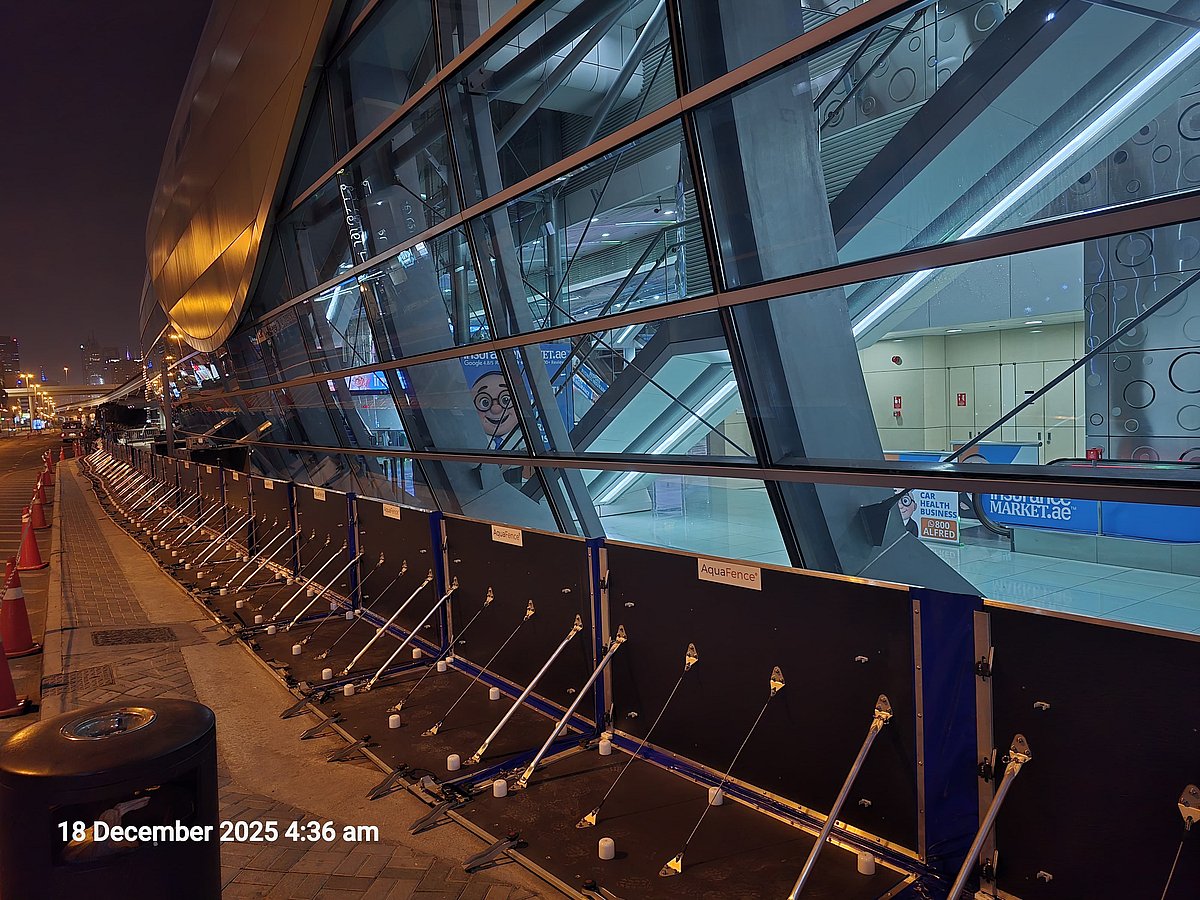
If you've spotted flood barriers outside some Dubai Metro stations recently, there's a good reason - they're FloodWall barriers, a Norwegian-engineered flood defence system.
Supplied
Dubai: If you’ve passed through Dubai Metro stations like OnPassive recently, you may have spotted sturdy barriers set up at the entrances as heavy rain and strong winds approach. These aren’t just temporary measures, they’re part of a carefully planned response shaped by lessons from one of the UAE’s most significant weather events.
Why barriers have appeared outside some Dubai Metro stations
On April 16, 2024, the UAE endured its most intense rainfall in 75 years. The deluge overwhelmed infrastructure of some Dubai Metro stations - Onpassive, Equiti, Mashreq, and Energy, which were forced suspend operations as floodwater inundated their surroundings.
In the aftermath, Dubai's Roads and Transport Authority (RTA) moved swiftly to identify the most vulnerable points across the network. Several above-ground stations were found to sit in low-lying areas particularly susceptible to rapid water accumulation and it was clear that a practical, deployable solution was urgently needed.
The answer came in the form of FloodWall, a flood barrier system developed by Norwegian manufacturer AquaFence - a company with considerable experience protecting critical infrastructure from extreme weather events.
Dubai-based Avalon Access Technical Services, operating through a joint venture with AquaFence, secured the contract to supply and implement the system for RTA. The barriers called ‘FloodWall’ are installed at heights of 1.2 and 1.8 metres and now form protective perimeters around four of the Metro's most at-risk stations.
"The solution was provided to Dubai Metro for four low-lying stations, including Onpassive and Equiti," Mujeeb Karim, head of operations at Avalon Access Technical Services, told Gulf News. "These specific Metro stations are above ground and are situated in low-lying areas that accumulate water very quickly.”
"If water does accumulate inside or outside the barrier, pumps are used to remove it," he explained. "The system helps manage flooding at stations like Onpassive, where even modest amounts of rainfall can otherwise find a way in."
The consequences of water ingress at Metro stations extend well beyond inconvenience - water leakage can trigger power disconnections and cause internal damage to electrical and operational systems, potentially rendering a station out of service for days.
Since the barriers were installed following the 2024 floods, Karim noted that damage at the affected stations has been markedly reduced. "We, along with RTA, implemented this after the 2024 floods, and since then we have prevented and reduced damage to these stations," he said.
Stay updated: Get the latest faster by downloading the Gulf News app - it's completely free. Click here for Apple or here for Android. You can also find it us on the Huawei AppGallery.
What is FloodWall and how does it work?
Karim explained that FloodWall operates on a principle of redirection rather than containment. “Rather than simply holding water back, the system guides flow away from vulnerable assets and towards designated drainage areas. Once deployed, aluminium rubber along the base of the barriers prevent water from flooding into the protected structure.”
“What makes the FloodWall solution particularly well-suited to Dubai's sustainability ambitions is its environmental design. Unlike traditional sandbags, which are single-use and generate tonnes of contaminated waste after each flood event, the FloodWall system is fully reusable, certified for over 60 deployments, and leaves no permanent trace on the infrastructure it protects,” Karim said.
After each weather event, the barriers are dismantled, jet-washed, and returned to storage, ready for the next deployment. “The system produces zero waste and requires no structural modifications to existing buildings or stations, it’s a clean, responsible solution that aligns directly with the UAE's Net Zero 2050 vision and Dubai's commitment to smart, sustainable city infrastructure,” he added.
The ‘FloodWall’ system is also FEMA-compliant, meeting the standards of the US Federal Emergency Management Agency. In 2024, Tampa Bay, Florida, used AquaFence to shield the city's only trauma centre from severe storms, a setup that took three days and 60 people to install, yet was built to withstand 15-foot storm surges and winds of up to 130 miles per hour.
What makes the FloodWall solution particularly well-suited to Dubai's sustainability ambitions is its environmental design. Unlike traditional sandbags, which are single-use and generate tonnes of contaminated waste after each flood event, the FloodWall system is fully reusable, certified for over 60 deployments, and leaves no permanent trace on the infrastructure it protects.Mujeeb Karim, Head of Operations at Avalon Access Technical Services
How Dubai is strengthening flood prevention
FloodWall is just one part of a wider shift in how Dubai's transport authority prepares for extreme weather. In December 2024, RTA confirmed that permanent flood prevention measures had been rolled out across the network, acknowledging that low-lying stations had been left particularly exposed.
RTA also launched a Joint Flood Management Room that same year, one of the largest control centres of its kind to monitor water accumulation in real time and coordinate responses across traffic and transport during periods of heavy rainfall.
Since the April 2024 storms, the emirate has committed to a long-term investment programme in flood defence infrastructure. The new works are designed to serve 30 key areas across Dubai, covering an expansive 430 million square metres - a zone projected to support a population of three million residents by 2040.
Valued at Dh2.5 billion, the programme includes the construction of four-metre tunnels connecting high-risk neighbourhoods to the main drainage network, the extension of drainage infrastructure by more than 27 kilometres, and the addition of new strategic pumping stations at critical locations. Major arterial routes, including Sheikh Zayed Road, Sheikh Mohammed bin Zayed Road, Al Yalayis Road, and the Dubai–Al Ain Road will all benefit from enhanced protection.
Most notably, a new strategic lake is to be created to collect stormwater from Dubai's fastest-growing residential neighbourhoods, providing a dedicated buffer against future rainfall events.
Network Links
GN StoreAbout Gulf NewsTerms & ConditionsReach by GNSitemapContact usPrivacy PolicyGN FocusHave your sayWork with usAdvertise with usGulf News epaperPrinting Services
Download our app
© Al Nisr Publishing LLC 2026. All rights reserved.