Amitabh Bachchan and Dharmendra in Sholay (1975), one of Indian cinema’s greatest blockbusters. As the fun-loving Veeru, Dharmendra delivered an iconic performance that made him part of film history and immortalised his pairing with Hema Malini.
Why ‘Sholay’ was called a flop in 1975 — then became a classic
Fifty years after its release, ‘Sholay: The Final Cut’ returned to cinemas in restored 4K
Last updated:
3 MIN READ
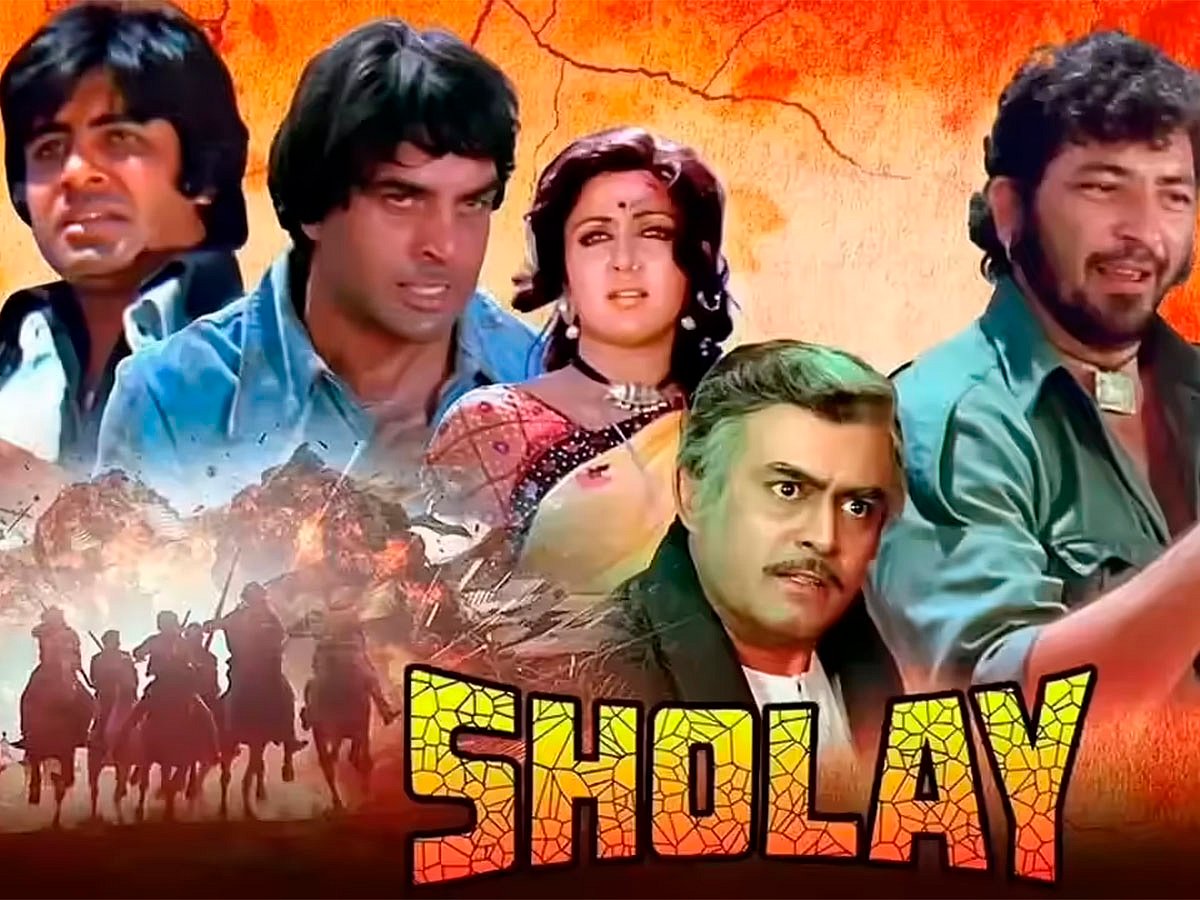
A poster featuring Amitabh Bachchan, Dharmendra, Hema Malini, Sanjeev Kumar and Amjad Khan from Ramesh Sippy’s 1975 classic ‘Sholay’.
IMDB
When Sholay arrived in theatres on August 15, 1975, it was expected to be a landmark film. Instead, its early box-office performance left its makers worried, and newspapers even declared the ambitious project a flop. Fifty years later, the film is regarded as one of the most influential movies in Indian cinema.
Directed by Ramesh Sippy, Sholay was an unusually expensive production for its time. Sippy recently recalled that the film was initially budgeted at Rs 1 crore but ultimately cost Rs 3 crore due to delays and reshoots. By his own comparison, Rs 1 crore in 1975 was roughly equivalent to Rs 100 crore today, meaning the final Rs 3-crore budget would be about Rs 300 crore in 2026 terms.
The film went on to collect a reported Rs 50 crore worldwide in 1975, an extraordinary figure for its time. Adjusted for inflation, that would be worth around Rs 1,540 crore in 2026 — putting the scale of Sholay’s commercial success into perspective.
Despite these huge numbers, Sholay was initially labelled a flop because its Rs 3-crore investment was considered exceptionally high. Sippy recalled, in a conversation with Siddharth Kannan, that newspapers reported the film would never recoup its investment and even warned that such expensive productions could damage the Hindi film industry.
That enormous investment made distributors, exhibitors and trade observers nervous. The film’s opening weekend appeared underwhelming, leading sections of the industry to believe the makers would struggle to recoup their investment. Sippy recalled that newspapers declared Sholay a flop and even warned that films with such huge budgets could damage the industry.
But the verdict changed quickly. Strong word of mouth brought audiences back, and within weeks the film began setting box-office records. Its characters, dialogues, music and performances turned Sholay into a cultural phenomenon.
The Emergency and the ending of ‘Sholay’
Sholay also faced a significant censorship battle amid the politically charged atmosphere of the Emergency, which began in June 1975, just weeks before the film’s release. Censors were particularly sensitive to depictions of violence and challenges to the authority of the law.
In the original climax, Thakur Baldev Singh takes revenge on Gabbar Singh and kills him. However, the censors objected to a former police officer taking the law into his own hands. The climax was subsequently changed, with the police arriving to arrest Gabbar instead.
The revised ending remained the version audiences knew for five decades. The 4K restoration has now brought back the original climax, allowing viewers to see the ending Ramesh Sippy had initially envisioned.
50 years later, ‘Sholay’ gets a 4K makeover
To mark its 50th anniversary, Sholay returned to cinemas as ‘Sholay: The Final Cut’, restored in 4K with Dolby 5.1 sound by the Film Heritage Foundation.
The restoration also features the original climax and previously deleted scenes, offering audiences a chance to experience the landmark film closer to Sippy’s original vision.
What began as a film some called a costly flop ultimately became a defining classic — a reminder that an early box-office verdict does not always determine a film’s legacy.
Network Links
GN StoreAbout Gulf NewsTerms & ConditionsReach by GNSitemapContact usPrivacy PolicyGN FocusHave your sayWork with usAdvertise with usGulf News epaperPrinting Services
Download our app
© Al Nisr Publishing LLC 2026. All rights reserved.