Lata Mangeshkar and Asha Bhosle
Asha Bhosle, the voice of a nation, dies at 92 — 8 decades of her love for music
The legendary singer’s eight-decade career defined generations of Indian music
Last updated:
5 MIN READ
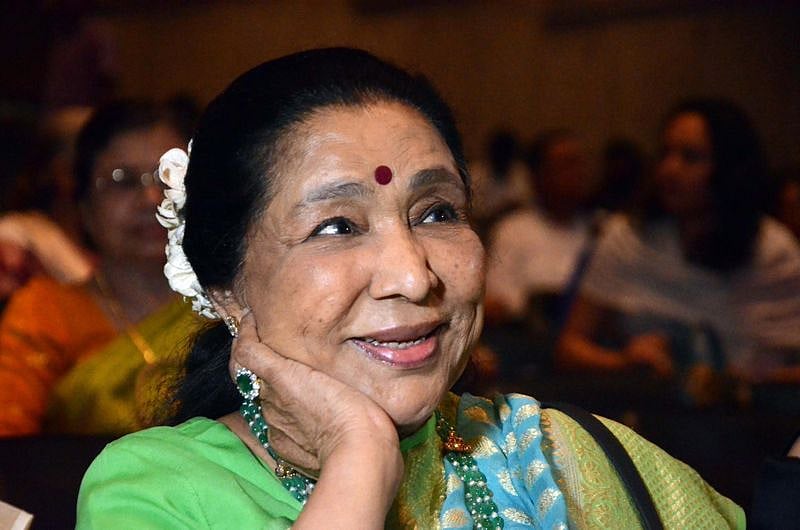
As the legendary singer Asha Bhosle turned 88 on September 8, several actors from Bollywood took to their social media handles to share heartfelt birthday greetings for their beloved 'Tai'
IANS
Dubai: India has lost one of its greatest voices.
Asha Bhosle, the legendary playback singer whose career spanned more than eight decades and whose voice became the soundtrack of a nation, passed away on Sunday at the age of 92.
She had been admitted to Breach Candy Hospital in Mumbai on Saturday evening after experiencing cardiac and respiratory issues and was being treated in the ICU.
Her granddaughter Zanai Bhosle had confirmed the hospitalisation on Saturday, saying Asha was being treated for extreme exhaustion and a chest infection.
"She passed away due to multi organ failure a few minutes ago," Dr Pratit Samdani told PTI on Sunday afternoon. Her son Anand confirmed the news shortly after.
The last rites will be conducted on Monday.
With her passing, an era truly ends. Asha was the last of the original titans of Bollywood music, the final surviving voice from a golden generation that included her elder sister Lata Mangeshkar, Mohammed Rafi, Mukesh and Kishore Kumar. Together, they shaped the sound of Hindi cinema for half a century. Now, as the youngest among them, she is the last to leave.
From Lata's little sister to a legend in her own right
Asha was born in 1933 into the musical Mangeshkar family and began singing professionally at the age of nine. By the time she recorded her first film song in 1943, her elder sister Lata was already establishing herself as the industry's most sought-after voice. For much of the 1950s, Asha navigated the long shadow that came with being Lata's younger sister, often typecast into cabaret numbers and dance songs while the more classically revered roles went elsewhere.
But she made those songs entirely her own. Piya Tu Ab To Aa Ja from Caravan, Ye Mera Dil from Don, Dum Maaro Dum from Hare Rama Hare Krishna, O Haseena Zulfowali from Teesri Manzil: these were not the songs of a singer playing second fiddle.
They were the defining moments of a genre, and for over two decades, if a major Bollywood film had a dance number, particularly one picturised on the iconic Helen, it was Asha's voice behind it. She did not just sing those songs. She owned them.
Silencing the doubters
By the 1980s, some had begun to suggest, quietly, that Asha was somehow lesser than Lata, that her range was narrower, her emotional depth shallower. She answered those doubts with one of the most celebrated performances in Indian film music history. Her work in Umrao Jaan, rendering ghazals with a grace and precision that silenced every critic, earned her the first of two National Film Awards. She followed it with Mera Kuch Saamaan from Ijaazat, a song of such quiet, devastating beauty that it opened her music to an entirely new generation of listeners and earned her a second National Award.
By then, the case was closed. Asha Bhosle was not Lata's little sister. She was a legend entirely on her own terms.
A life lived on her own terms
Her personal life was as bold as her professional one. At just 16, she eloped with her 31-year-old secretary Ganpatrao Bhosle, defying her family entirely. The marriage eventually broke down and they separated in 1960, by which point she had three children. She returned to her family home, but she never gave up the name Bhosle. It had become, she seemed to understand, part of who she was.
In 1980, she married the celebrated composer RD Burman, again against the wishes of those around her. She was 47. The marriage was, by all accounts, one of great love and creative partnership. Burman died in 1994, and she never remarried.
The record that may never be broken
The Guinness Book of World Records recognised Asha Bhosle as the most recorded artist in music history, a title she earned through thousands of songs across more than half a dozen Indian languages, recorded over a career that began before India's independence and continued well into the 21st century.
She won the Filmfare Best Female Playback Singer Award seven times, received the Dadasaheb Phalke Award, the highest honour in Indian cinema, and was awarded the Padma Vibhushan, India's second-highest civilian honour, in 2008.
Shaikh Mansour Bin Mohammad Bin Rashid Al Maktoum presenting Life Time Achievement award to legendary Indian singer Asha Bhosle in presence of Diff chairman Abdulhamid Juma on the opening day of Dubai International Film Festival on Wednesday.
In an interview with Hindustan Times in 2023, just three years before her death, she spoke with characteristic directness about contemporary music. "Main sach bolu toh main aaj ke gaane sunti hi nahi hoon," she said. If she had to listen to music, she said, she turned to classical singers, ghazals and the old songs. She was still learning, still practising, still refining her voice, at nearly 90 years old.
Still singing, until the very end
What made Asha Bhosle remarkable was not just the length of her career but how fully she lived it until its final chapter. Her most recently recorded work was a feature on The Shadowy Light, a track from Gorillaz's ninth studio album The Mountain, released in 2026, a collaboration that placed her voice alongside one of the most unconventional acts in contemporary music and proved, once again, that she belonged everywhere.
Before that came a string of recordings that showed a singer who never stopped evolving. In 2020, she featured on Jayatu Jayatu Bharatam, a multi-artist anthem recorded during the COVID-19 pandemic that brought together over 200 singers including SP Balasubrahmanyam and Sonu Nigam.
In 2016, at the age of 82, she released an entire studio album titled 82, recording six ghazals reimagined in modern genres including pop, reggae and rock. She named the album after her age at the time, because of course she did.
And then there was the stage. Even at 91, she was still performing live, still commanding a room.
In late 2024, she captivated audiences at a concert right here in Dubai, her voice filling the hall with the same warmth and power that had defined it for eight decades. Those who were there will not forget it. As it turns out, that performance was among her last.
Asha Bhosle has planned a special performance at Dubai’s Coca-Cola Arena on Sept 8
Network Links
GN StoreAbout Gulf NewsTerms & ConditionsReach by GNSitemapContact usPrivacy PolicyGN FocusHave your sayWork with usAdvertise with usGulf News epaperPrinting Services
Download our app
© Al Nisr Publishing LLC 2026. All rights reserved.