“Pretty much back to pre numbers in 2027.” That’s Marjan Hospitality CEO Alison Grinnell’s outlook for Ras Al Khaimah’s tourism recovery — but she says the next three to four months will be key as international travellers gradually return.
Marjan sees RAK tourism recovery by 2027 as new projects like Wynn, Jebel Jais take shape
Marjan says RAK is on track for recovery as major tourism projects advance
Last updated:
6 MIN READ
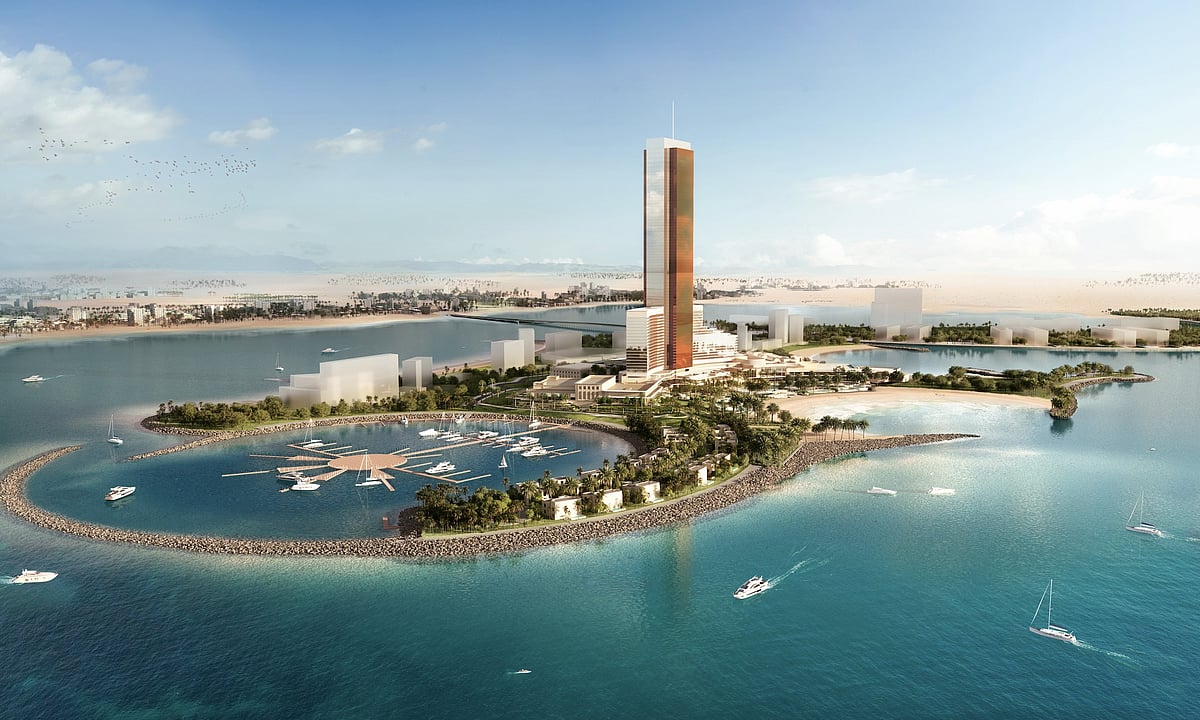
Wynn Al Marjan Island's beachfront takes shape on Al Marjan Island in Ras Al Khaimah as construction continues on the $5.7 billion resort.
Wynn Al Marjan Island
Dubai: Ras Al Khaimah is pressing ahead with its tourism expansion despite the disruption caused by the regional conflict, with Marjan Hospitality expecting the emirate to return to pre-conflict tourism numbers in 2027 as Wynn Al Marjan Island approaches its opening.
Alison Grinnell, Group Chief Operating Officer of Marjan and CEO of Marjan Hospitality, said the emirate’s hotels had initially lost international tourists during the conflict but were able to pivot quickly towards UAE and GCC staycation demand.
She said the recovery is now beginning to show, with international travellers, tour operators and transient guests returning, although volumes remain below the same period last year.
“I think we'll be pretty much back to pre numbers in 2027,” Alison told Gulf News. “But it all depends on what happens in the next three to four months.”
For Marjan, however, the disruption has not translated into a slowdown in investment.
Staycation pivot
The biggest immediate impact on Ras Al Khaimah’s hospitality sector was the loss of international visitors, Alison said.
Hotels responded by turning their attention to the domestic and regional market, promoting Ras Al Khaimah to UAE residents and GCC travellers looking for staycations.
“All of our hotels had an immediate action plan to be able to promote Ras Al Khaimah within the UAE and within the GCC to really focus on that staycation business,” she said.
“That has really supported us and supported the destination over the difficult few months that we’ve had behind us.”
Alison said the UAE’s resilience had helped the destination navigate the shock. “We are seeing the green shoots,” she said, pointing to international travellers, tour operators and transient customers returning.
“Is it in the numbers that we had this time last year? No, it’s not. But I think there is a good reason for positivity.”
Russia returns
The first major international market to return to Ras Al Khaimah has been Russia and the wider CIS region, traditionally an important market for the emirate, Alison said.
The booking pattern also gives the market an advantage during an uncertain period.
“Their booking window is relatively short,” she said, putting it at around two to four weeks.
That compares with longer booking windows in some Western European markets, where travellers have been more cautious about committing too far in advance.
Alison said transient travellers were also returning across markets as airline capacity recovers.
“Emirates is flying at pretty much full capacity to most countries, and so people are taking that opportunity,” she said.
Wynn effect
The major tourism milestone ahead is the opening of Wynn Al Marjan Island, which Alison described as critical for the emirate.
She expects the resort to change the visitor mix as it brings its own customer base to Ras Al Khaimah.
“Wynn come with their own customers, obviously,” she said.
The arrival of gaming as a new form of entertainment within the UAE will also bring visitors from markets where gaming is already an established part of the tourism proposition, she said.
But Alison stressed that Ras Al Khaimah’s visitor base has already been changing.
Luxury resorts including The Ritz-Carlton and Waldorf Astoria have increasingly attracted travellers from Asian markets over the past five years, including China, Japan, Taiwan and South Korea.
“So I think there’ll be a continued pickup of that, plus people travelling from more gaming-centric markets as well,” she said.
No slowdown
Marjan has not changed its strategy or slowed capital investment because of the conflict, according to Alison.
“No, the strategy hasn’t changed,” she said. “We haven’t slowed down investment. We haven’t slowed down refurbishment plans.” Instead, the quieter period created an opportunity to carry out some renovation work with less disruption to hotel operations.
Projects including refurbishment plans at Pullman on Marjan Island and Rixos Bab Al Bahr were continuing, she said.
“It just became an ideal time, obviously, to do those renovations now when the market was more subdued,” Alison said.
She also said supply-chain challenges experienced at the beginning of the conflict had eased, with materials redirected through ports including Fujairah.
Mountain boom
Wynn is only one part of Ras Al Khaimah’s tourism expansion.
Marjan is also developing a broader outdoor and adventure proposition around Jebel Jais, including an 80km hiking trail network and new mountain experiences. “Wynn is a major project for Ras Al Khaimah, but it is not the only project,” Alison said.
“We’ve got a huge history within Ras Al Khaimah. We have many different topographies.” The wider proposition includes beach resorts, desert camps, desert resorts and mountain camps, she said.
Parts of Jebel Jais have been temporarily closed while development work takes place, with Alison saying the areas are expected to reopen in early November. The new trail programme is designed to create a more structured mountain experience rather than a collection of individual attractions.
“It’s adding a number of experiences together that give a much more structured offering,” she said.
The programme includes hiking infrastructure, mountain rescue support, wayfinding and food-and-beverage concepts on the mountain.
Marjan’s wider Jebel Jais programme includes an 80km Grand Loop linking existing and new trails, while a planned five-day Via Ferrata (iron path) will extend up to 20km across four sections of varying difficulty.
New climbing routes, trail rehabilitation and environmental monitoring are also part of the programme.
Beyond adventure
Alison said Marjan is also looking at areas beyond adventure tourism.
One area under consideration is wellness and longevity, which she described as an underserved market, particularly on the longevity side.
“We’re looking at a couple of potential offerings on there,” she said.
The emirate is also expanding its desert proposition, including Ritz-Carlton branded residences in the desert.
That reflects another major part of Marjan’s strategy: branded residences.
Branded living
“Branded residences — it’s a huge potential,” Alison said.
She said the model can support developers’ returns, strengthen the hotel ecosystem and give buyers access to hotel facilities, while also bringing additional residents and spending into the emirate.
“It’s great for the emirate itself in that we are bringing residents in that will spend money, add to GDP,” she said.
Branded residences are therefore “an integral part” of Marjan’s strategy for Marjan Beach and the wider destination, she said.
Marjan Beach
Marjan Beach is being developed as a major mixed-use waterfront destination, with the masterplan spanning eight neighbourhoods across residential, hospitality, commercial, civic and logistics districts.
The development includes three kilometres of beach frontage and 6.5 million square feet of open green space.
The planned capacity includes around 22,000 residential units and 12,000 hotel keys, with capacity for about 74,000 residents and a projected workforce of 32,000.
Marjan expects the completed district to accommodate up to 180,000 visitors annually. Alison said discussions were under way with major hotel operators, although developers will ultimately bring individual operators into the projects.
“We’re in discussions with probably all of the big operating companies,” she said. More announcements are expected over the next two to three months, she added.
Hard Rock Hotel and Residences has already been announced as one of the signature projects in the Vive district of Marjan Beach.
Business district
The emirate’s growth is also extending beyond tourism and leisure.
Alison said RAK Central, Marjan’s major business district, is due to open in September 2027, with the topping-out ceremony for its office blocks expected in November 2026.
The project will include what she described as Ras Al Khaimah’s first Grade A, LEED-certified office buildings.
That broader development is important to Marjan because the infrastructure needed for Wynn and other projects cannot operate in isolation.
The ecosystem
For Alison, one of the biggest challenges is not a single project but making sure all the different pieces of Ras Al Khaimah’s expansion arrive together. “I wouldn’t say there’s anything specific that’s keeping me awake at night,” she said.
“Our biggest part of our job is making sure that everything comes together at the same time.” That means transport, infrastructure, supply chains and the wider ecosystem supporting Wynn, Marjan Island, Marjan Beach and RAK Central.
“When you open something like Wynn, and whilst we’re not the operator, we have to make sure that all of the infrastructure, the ecosystem, is there to support it,” she said.
The objective, she said, is to ensure visitors can reach Wynn easily and that the infrastructure is capable of supporting supplies to the integrated resort.
Network Links
GN StoreAbout Gulf NewsTerms & ConditionsReach by GNSitemapContact usPrivacy PolicyGN FocusHave your sayWork with usAdvertise with usGulf News epaperPrinting Services
Download our app
© Al Nisr Publishing LLC 2026. All rights reserved.