“AI is not going to smile at you,” says Philip Barnes, CEO of Rotana, arguing that technology can streamline hotel operations but will not replace the human interaction at the heart of hospitality.
‘AI is not going to smile at you’: Rotana CEO on UAE hotels, recovery and growth
Rotana kept its teams intact through the conflict as UAE hotels rebuild demand
Last updated:
6 MIN READ
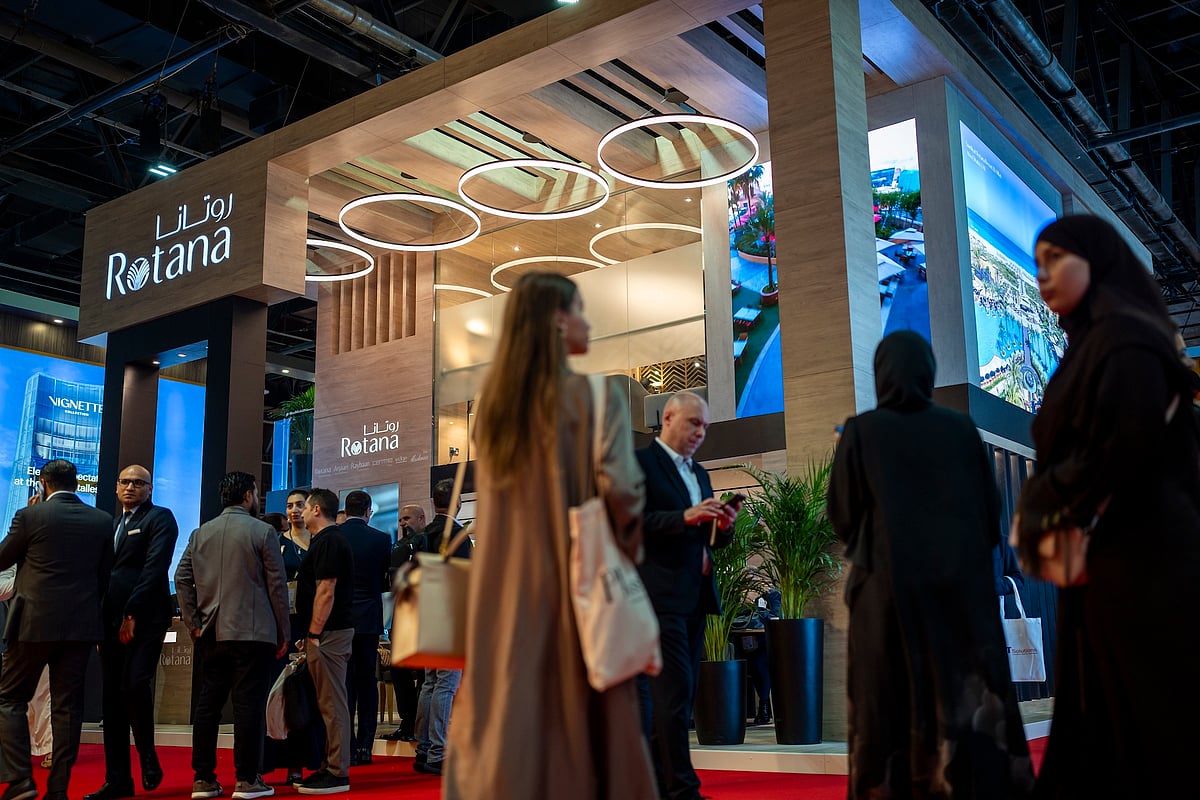
Philip Barnes, CEO of Rotana, says the group is planning for growth with about 40 hotels in its pipeline across markets including Saudi Arabia, Egypt, Africa and the CIS.
Rotana
Dubai: Artificial intelligence may be changing how hotels answer phones, manage bookings and interact with guests, but it cannot replace the human connection at the heart of hospitality, according to Rotana CEO Philip Barnes.
“AI is not going to smile at you,” Barnes said in an interview with Gulf News at Arabian Travel Market 2026. “It’s not going to replace a doorman or a receptionist, because our business, at the end of the day, we are people, and we like dealing with people.”
His comments come as UAE hotels emerge from one of their most difficult operating periods in recent years, following the outbreak of the US-Iran war at the end of February.
For Abu Dhabi-headquartered Rotana, the shock initially looked far worse than the eventual outcome. The group now expects its net operating profit for 2026 to reach about 80 per cent of its 2025 level — a year Barnes described as a “banner year”.
Conflict shock
“When the war broke out, so end of February, I expected the business to fall off a cliff and to stay that way for a long time,” the hospitality veteran said. March was initially less severe because people were still trying to leave the region, but Rotana saw business decline in the second half of March and through April. By May, however, the group began seeing a recovery.
The recovery did not come from simply waiting for international leisure demand to return.
Barnes said Rotana moved quickly to change its commercial strategy, including launching a staycation programme and refocusing its global sales team on whatever demand was available. “Go after every piece of revenue you can,” was his message to the group’s general managers.
“Don’t get proud. Don’t think about it. Does it make sense? Can I take it? Yes, I can. Then go for it," he said.
The second instruction was to contain costs, but not at the expense of quality. The third was more fundamental: “Take care of your people. Take care of your teams.”
“Because this will end,” Barnes said. “And when the business comes back, that our teams are in place.”
Staycation surge
The strategy helped Rotana tap a significant shift in travel behaviour during the disruption.
Rather than relying entirely on international leisure traffic, the group targeted demand from within the UAE and wider GCC, including Emiratis, Saudis and other regional travellers who preferred not to travel too far from home.
Barnes said this became particularly evident during July and August, when Rotana resorts in Fujairah and Saadiyat, among others, began picking up business from the region.
“Getting on a plane was an expensive proposition,” he said, as airlines reduced services and airfares rose. “For a family of four,” Barnes said, some travellers began asking whether it made more sense to stay within the Emirates.
The shift was not limited to beach resorts. City hotels also benefited as travellers chose to holiday within Dubai and Abu Dhabi.
Rotana's restaurants also saw strong local demand, with Barnes saying some were packed with residents as well as hotel guests.
80% occupancy
By August, Rotana's UAE hotels were operating at more than 80 per cent occupancy, according to Barnes.
He said Dubai and Abu Dhabi were recording similar levels, while room rates — which had fallen sharply at the beginning of the disruption — had started recovering.
The resorts were initially hit harder than city hotels because of their heavier reliance on international leisure traffic. “They suffered the most in March and April,” Barnes said.
But the staycation programme and changes to the group's commercial strategy helped bring demand back into the resorts from May and June.
Rotana Ras Al Khaimah - The Mangroves.
No layoffs
One of Rotana's key decisions during the downturn was to retain its workforce. Barnes said the group did not carry out layoffs or redundancies, although employees had to accept reduced income for a period.
“The reputation as an employer isn't something you build overnight, but you can lose it overnight,” he said.
Rotana currently has about 10,000 employees, with Barnes expecting another 5,000 positions to be required over roughly six years to support the group's development pipeline.
The jobs will largely support properties being developed across Saudi Arabia, Egypt and other markets rather than being concentrated in the UAE.
For Barnes, retaining employees was also directly connected to the customer experience.
“When you walk through the front door of ABC Hotel, and you see a friendly face that knows you, and you know them. That's worth its weight in gold,” he said. “That's what our business is about.”
AI has limits
That philosophy informs Rotana's approach to artificial intelligence.
The company is already using AI tools on its website and is piloting AI-powered phone answering at its corporate office, including the ability to communicate with callers in different languages.
But Barnes does not see the technology replacing the human element of hospitality. “AI will help us facilitate the process. It will ease the bureaucracy. It will help us to do a better job of, you know, in our business looking after guests,” he said.
“But it won't replace that person who makes the bed, cooks the breakfast, serves the breakfast.”
For Rotana, the post-conflict recovery therefore comes at a time when hotels are having to balance two very different pressures: using technology to make operations more efficient while preserving the personal service that differentiates hospitality from other industries.
Winter uncertainty
The recovery is continuing, but Barnes said forecasting remains unusually difficult because international travellers are still booking at short notice.
He said Rotana's hotels had entered previous months with little business on the books, only for demand to materialise shortly before arrival.
“That is the problem right now: the predictability is really challenging,” he said. He linked the current short booking windows partly to uncertainty over air connectivity and whether international carriers will resume services.
40 hotels
Despite the disruption, Rotana has not abandoned its expansion plans.
The group has 40 properties and 8,334 keys under development, according to the company's ATM announcement. Saudi Arabia accounts for 10 of those properties and 1,404 keys.
Barnes said the developments would take between two and five years to open, while the broader pipeline should be viewed as flexible because projects can be delayed, cancelled or added as market conditions change.
Saudi Arabia remains a major focus, particularly beyond the biggest cities, while Barnes also identified Africa, Egypt and Oman as markets where Rotana is seeing opportunities.
“Africa is a major focus point for us,” he said, pointing to investment flowing into the continent. The group also continues to receive enquiries about Pakistan, although Barnes said little had progressed there since the regional disruption began.
Owners stay confident
Rotana's owners, Barnes said, have generally remained confident following the difficult March-April period.
He said he had not faced significant pressure from owners demanding immediate action to address the downturn, while government and banking measures had also helped.
“March and April was tough,” he said. “But in general terms, our owners are very pleased with the results, especially as they've seen them from May through to August.”
He said at least 70 per cent of Rotana's hotels were currently ranked either first or second in their competitive sets year to date, according to the group's internal performance assessment.
Investment in existing hotels is also continuing.
Rotana is discussing further investment at properties including its Fujairah resort, while Cove Rotana in Ras Al Khaimah is undergoing pool investment and other properties continue to receive capital spending.
Barnes said Rotana asks owners to maintain a capital reserve equivalent to 3 per cent of annual revenue for ongoing investment, although major renovations require considerably more.
Global guests
Rotana is also trying to reduce its reliance on individual markets by expanding its global distribution.
Its move to the Global Hotel Alliance has given Rotana access to a loyalty ecosystem of about 35 million members, compared with roughly 850,000 members under its previous Rotana Rewards programme, Barnes said.
In some hotels, Barnes said, as much as 50 to 60 per cent of business was now coming through channels managed by the brand, including global sales, partnerships, its website and loyalty programme.
For a hotel group operating through a period of geopolitical uncertainty, that diversification is becoming increasingly important.
And while technology will play a larger role in how Rotana reaches and serves those guests, Barnes sees the industry's fundamental proposition remaining unchanged.
“It doesn't matter what you say, doesn't matter what you do. It's how you make people feel, and that's what matters.”
Network Links
GN StoreAbout Gulf NewsTerms & ConditionsReach by GNSitemapContact usPrivacy PolicyGN FocusHave your sayWork with usAdvertise with usGulf News epaperPrinting Services
Download our app
© Al Nisr Publishing LLC 2026. All rights reserved.