ATM 2026 top 5 highlights: UAE travel sector faces challenges, but ambition holds
From aviation recovery to DWC and AI, ATM 2026 offered clues to travel’s next phase
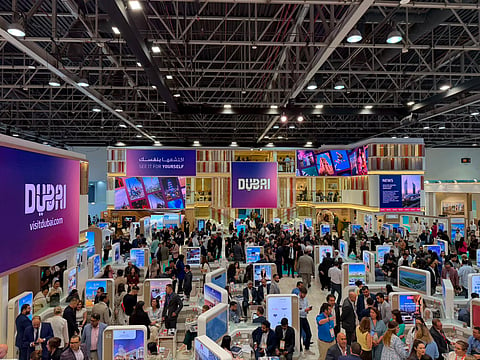
Dubai: It was a long week for the media at Arabian Travel Market.
Between navigating packed halls, rushing between interviews and shoots, filing stories at breakneck speed and trying to keep up with a seemingly endless stream of announcements, there was rarely time to pause and take in the bigger picture.
But stepping back, one thing was clear: while participation appeared somewhat softer than in previous years, the ambition across the UAE’s travel and tourism industry had barely faded.
The drive to make the UAE one of the world’s leading tourism destinations remains firmly in place — from airlines expanding their networks to tourism authorities developing new attractions and hotel operators adapting to a more challenging market.
Here are our five biggest takeaways from ATM 2026:
Dubai’s airport story is entering a new phase
Perhaps the biggest long-term aviation story from ATM was not about a new route or aircraft, but about where Dubai intends to handle its future passengers.
Dubai Airports CEO Paul Griffiths, a week ahead of ATM, has put the focus firmly on Al Maktoum International, with the new passenger terminal at Dubai World Central set to become the centre of Dubai's long-term aviation strategy.
The scale is extraordinary: the planned passenger terminal is valued at about Dh128 billion, while the eventual airport is designed to handle hundreds of millions of passengers a year.
Dubai is also working towards major supporting infrastructure, including an automated people-mover system, a direct rail line, and more, linking the airport's facilities.
Griffiths described DXB's recovery as “incredible”, pointing to the sharp rebound in monthly traffic after the disruption.
But the numbers also illustrate the gap the airport still has to close: the 2026 forecast of around 70 million passengers remains well below the 95.2 million recorded last year.
At the same time, Dubai Airports has lowered its 2026 passenger forecast to about 70 million following the disruption earlier this year, with the previous target now expected to be reached in 2027.
If anything, the disruption appears to have reinforced rather than diluted Dubai's long-term aviation ambition.
Griffiths recalled the advice he received when he arrived in Dubai: “Do not constrain the growth of aviation in Dubai.” Almost two decades later, he said that principle remains central to the airport's strategy.
UAE airlines are recovering faster
The second major ATM story was the strength of the Gulf carriers' recovery.
Emirates reported carrying more than 8.6 million passengers in July and August, operating at about 93 per cent of its pre-disruption capacity. The airline also reported strong forward bookings in several markets as it heads into the winter season.
The summer season saw a healthy seat factor of approximately 75 per cent. And current capacity sits at 93 per cent, with positive booking trends coming from Europe, the UK, China, Africa, and the Americas.
“I mean, the outlook overall looks quite promising, quite positive. We are building quite a good journey, I would say, in terms of the capacity, in terms of the network that we built in summer,” said Adnan Kazim, Deputy President and Chief Commercial Officer, Emirates.
UAE’s national carrier, Etihad, delivered a similarly strong message. Its August load factor reached 92 per cent, while available seat kilometres were 15-17 per cent above the same period last year. The airline is simultaneously expanding its network and fleet.
“Demand is very strong, so demand does not keep me awake,” said Antonoaldo Neves, group CEO, Etihad Airways, while admitting that higher jet fuel prices caused by the escalating conflict worries him.
flydubai, meanwhile, said it expects to return to full network capacity by the end of 2026, with its fleet set to pass 100 aircraft following deliveries this year.
“Before the end of the year, we should go back to 100 per cent, and even a little bit more, because we will be getting more aircraft,” said CEO Ghaith Al Ghaith as the airline gears up for travel demand “returning with a vengeance.”
And in Sharjah, an Air Arabia-led consortium is launching a new national low-cost airline based at King Fahd International Airport. Flight operations begin on September 20, 2026, after the carrier received its Air Operator Certificate.
But there is an important caveat. The recovery is uneven. Gulf carriers have been able to restore capacity faster, while some European airlines remain constrained by continuing aviation-security advisories linked to the regional conflict.
Dubai tourism looks beyond recovery
Dubai’s tourism sector is no longer talking about recovery. The focus has shifted firmly towards sustained growth, with the emirate continuing to build on its diverse international visitor base, strong air connectivity, and expanding range of tourism offerings.
Hoor Al Khaja, senior vice president of international operations at the Dubai Corporation for Tourism and Commerce Marketing (DCTCM), has demonstrated the emirate’s tourism industry had demonstrated its resilience in the face of recent challenges.
“Dubai’s response to any crisis, not just this one, truly speaks for itself. The way it carried itself through was a big testament to how the city operates,” said Al Khaja.
The UAE is building a bigger tourism map
Another clear ATM theme was the UAE's continued attempt to broaden its tourism proposition beyond the established Dubai luxury-and-city-break model.
Ras Al Khaimah's push into adventure tourism, including the planned 80km Grand Loop at Jebel Jais, is one example. Across RAK, cranes are moving. "I'm delighted to say that construction continued pretty much unhindered over the period," Phillipa Harrison, CEO of RAKTDA, said, calling it a vote of confidence in the long-term vision.
Sharjah's investment in Al Faya and other experience-led projects is another.
The broader strategy is visible across the UAE: develop more destinations, create reasons for visitors to stay longer and spread tourism spending across different emirates and experiences.
And in outbound travel, tourism boards ranging from Jamaica to Maldives to Kerala, have said they remain invested in the UAE as well as the wider region.
AI: Industry buzzword to tourism infrastructure
ATM's 2026 theme — Travel 2040: Driving New Frontiers Through Innovation and Technology — put artificial intelligence, digitalisation and smart mobility firmly on the agenda.
But the most interesting aspect was that AI was not being discussed simply as another customer-service tool.
The conversations increasingly centred on how technology could affect everything from travel planning and personalisation to airline operations, destination management, hotel staffing and the way travellers discover experiences.
But veteran hotelier and CEO of Rotana, Philip Barnes has provided some incredible insight on that front. “AI is not going to smile at you. It’s not going to replace a doorman or a receptionist because our business, at the end of the day, is with people,” he said.
What ATM 2026 really showed
The ambition is clear, the recovery is underway and the UAE’s aviation and tourism sectors are continuing to invest for the next phase of growth.
But how quickly that ambition translates into passenger numbers and stronger business performance will hinge on two factors largely outside the UAE’s control: jet fuel prices and the removal of international travel advisories.
Lower fuel costs would ease pressure on airline margins and fares, while the lifting of advisories would help restore confidence and demand in markets that remain cautious.
For now, the UAE has built the capacity for growth; the question is how quickly the rest of the market catches up.


