Legal experts say there is no provision under the International Law (International Convention on the Law of the Sea, UNCLOS) allowing a coastal state like Iran to charge for passage through a natural waterway, impose a "toll" or a "service fee". The Institute for the Study of War (ISW) has stated that Iran’s “management” narrative over Hormuz is "coercive signaling", not legal authority under international law.
Iran’s 7% Hormuz toll could mint $100+ billion a year — bigger than Nvidia, Apple, or a third of Iran’s entire economy — without pumping a single barrel
Iran’s Hormuz toll plan could rival tech giants and reshape global energy trade
Last updated:
5 MIN READ
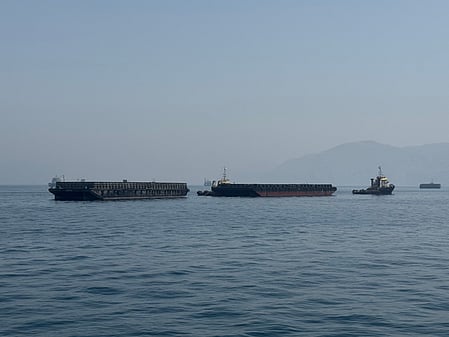
Iran says talks with Oman focused on designating temporary route for safe shipping in Hormuz Strait.
File
Iran and Oman are reportedly closing in on a framework to restore shipping through the Strait of Hormuz. The emerging deal could potentially leave Tehran with a clear degree of control over the world’s most important oil chokepoint.
Now, US President Donald Trump has said that Washington's war with Tehran is nearing an "end".
"War's got to the end pretty soon", Trump was quoted as saying, adding that "Iran can't go on for pretty much longer."
'Normal' traffic through Hormuz
In normal (pre-war) times, the narrow waterway handled roughly 20–21 million barrels per day of crude and petroleum products — about one-fifth of global oil consumption and roughly 25% of seaborne oil trade — plus significant LNG volumes.
Amidst the conflict that disrupted marine traffic, Iran has pushed for a formal role in managing the waterway jointly with Oman.
Deal does not guarante opening: Gharibabadi
Even so, Iran's emerging deal with Oman will, by itself, not guarantee the reopening of the Strait of Hormuz to normal commercial shipping, Iran's Deputy Foreign Minister Kazem Gharibabadi has stated.
Tehran has stressed that the US must first meet a series of political and economic conditions before free navigation can resume.
Gharibabadi's clarification comes a day after Tehran announced that it had agreed with Oman on the geolocated route that vessels would follow through the narrow waterway.
This raised hopes that one of the world’s most important energy corridors could soon reopen.
Tehran is seeking transit or “service” fees of 5–7% of cargo value on commercial ships using the strait, a senior Iranian official told Reuters.
Oman, on the other hand, has floated a voluntary-fee model modeled on the Strait of Malacca (contributions for navigation, environmental, and rescue services rather than a mandatory toll).
The US opposes any Iranian-controlled mandatory fees.
Discussions continue amid incomplete traffic recovery, insurance complications, US sanctions risks, and questions about enforceability.
'Service fees'
Earlier Iranian estimates of revenue from broader “security/safety/ environmental services” shared with Gulf states were far more modest (~$40 billion a year total).
Flat-fee ideas (e.g., ~$1–2 per barrel or $2 million per VLCC) have also circulated, producing much smaller projected totals.
How much could a 7% toll generate?
One widely circulated estimate assumes a return to pre-war commercial volumes and cargo values:
Roughly $385 million per day, or up to $140 billion per year gross.
Applying a high-margin assumption (~97% “pure profit,” given minimal cost of goods sold for collecting a transit fee) yields roughly $136 billion in hypothetical annual net income.
Single-tanker illustration
A typical Very Large Crude Carrier (VLCC) can carry up to about 2 million barrels.
At an oil price of ~$80/barrel the cargo is worth ~$160 million; a 7% fee would equal roughly $11–11.2 million for that one voyage.
These figures treat the toll as applying to the full value of commercial cargo moving through the strait at historical throughput.
One must note, however, that they are scenario calculations, not forecasts.
Actual collections would depend on the final rate (if any), the share of traffic that pays, exemptions, enforcement success, and whether shippers continue using the route at scale.
Scale comparisons
At the high-end net scenario (~$136 billion), the hypothetical revenue would rival or exceed the recent annual net income of major corporations such as Alphabet, Nvidia (around $120 billion in one recent fiscal year), Apple, Microsoft, and Saudi Aramco.
It would dwarf the Suez Canal’s performance: Egypt’s Suez Canal Authority reported $4.67 billion in revenue for the 2025/2026 fiscal year (up 23% as traffic partially recovered from earlier Red Sea disruptions).
Peak historical Suez revenues were higher but still only a fraction of the Hormuz high-end scenario (roughly 15–20× or more).Relative to Iran’s own economy, World Bank data put Iran’s 2025 nominal GDP at approximately $363 billion.
A $140 billion gross (or ~$136 billion net) take would equal roughly 37–39% of that GDP figure — without any additional oil production by Iran.
There are important caveats
A toll booth on the world’s premier oil artery looks extraordinarily profitable on paper because collection costs are low. In practice the plan faces major hurdles:
Shippers and insurers may avoid the strait or demand exemptions if costs or legal risks rise.
Alternative pipeline capacity (Saudi Arabia, UAE, and limited Iranian options) can bypass only a portion of normal volumes.
Legal, insurance, and sanctions issues complicate payments; some industry sources have described compulsory percentage fees as a “toll in all but name” that could conflict with international norms governing straits used for navigation.
Reduced traffic, a lower agreed rate, voluntary contributions only, or revenue-sharing with Oman and other Gulf states would shrink the numbers dramatically.
7% scenario
In short, the 7% scenario highlights the enormous theoretical leverage of geographic control over Hormuz.
Turning that leverage into a reliable, high-volume revenue stream comparable to the world’s largest companies would require sustained high traffic, broad acceptance of the fee, and a workable political-legal framework — none of which is guaranteed.
What the law says
Tehran can't simply slap this service fee: Legal experts say Iran would face significant international-law obstacles if it sought to make payment a condition for ordinary commercial passage through Hormuz.
Under the UN Convention on the Law of the Sea (UNCLOS), ships enjoy a right of transit passage through natural waterways — including straits — used for international navigation, and that passage “shall not be impeded.”
Coastal states may regulate navigation, maritime safety and pollution, but their regulations cannot discriminate against foreign ships or have the practical effect of denying, hampering or impairing transit passage.
That does not mean every payment connected with a vessel's passage would automatically be unlawful.
Fees permitted under UNCLOS
UNCLOS Article 26 permits charges in a territorial sea when they are payment for specific services actually rendered to a ship.
The legal question, therefore, turns in part on whether a proposed Iranian “service fee” genuinely pays for identifiable maritime services — such as navigation or safety assistance — or effectively operates as a toll for permission to transit.
The distinction is important.
Currently, the details remain contested and the shipping industry has raised serious legal and practical concerns.
The legal picture is further complicated by the fact that Iran and the United States have not ratified UNCLOS.
Nevertheless, key principles governing navigation through international straits are widely treated as reflecting customary international law, while Iran disputes the extent to which UNCLOS constrains it.
The Institute for the Study of War's Critical Threats Project has characterized Iran's effort to establish an Iranian-controlled transit system as an attempt to normalise de facto control over Hormuz, warning that recognition of such control could undermine freedom of navigation and give Tehran a lasting mechanism to condition access to the waterway.
In practical terms, the dispute is therefore about more than a fee.
If payment became a prerequisite for passage, critics argue it could amount to recognition of an Iranian authority to control international shipping through Hormuz — precisely the precedent Washington and much of the shipping industry are seeking to avoid.
Sign up for the Daily Briefing
Get the latest news and updates straight to your inbox
Network Links
GN StoreAbout Gulf NewsTerms & ConditionsReach by GNSitemapContact usPrivacy PolicyGN FocusHave your sayWork with usAdvertise with usGulf News epaperPrinting Services
Download our app
© Al Nisr Publishing LLC 2026. All rights reserved.