The US Strategic Petroleum Reserve (SPR) contains crude oil, and is an emergency backup, not America's main tank. The US petroleum system doesn't work from the SPR alone. The latest US Energy Information Administration data show the country producing roughly 13.9 million barrels of crude a day, holding about 424.5 million barrels in commercial crude inventories and running refineries at roughly 17.5 million barrels a day. The US also imports and exports millions of barrels of crude and petroleum products every day. The 20.7 million barrels-a-day figure is total petroleum products supplied, a broad measure of domestic consumption that includes gasoline, diesel, jet fuel and other products.
Does America really have just '14 days of oil left'?
Viral ‘14 days of oil’ claim confuses emergency reserves with total supply
Last updated:
8 MIN READ
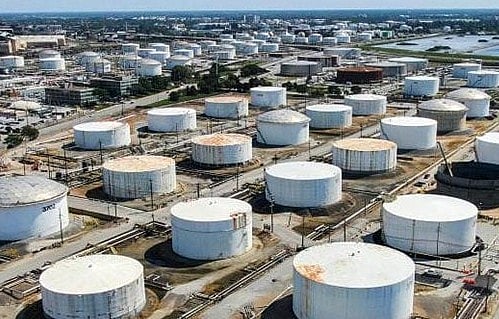
The US Strategic Petroleum Reserve (SPR) is the world’s largest supply of emergency crude oil, with a storage capacity of 714 million barrels in four underground salt caverns along the Gulf Coast, as per the US Department of Energy.
DOE
Posts circulating online claim the United States has only about 14 days of oil left.
The math looks simple: the US Strategic Petroleum Reserve holds about 286.6 million barrels, while the country uses roughly 20.7 million barrels of petroleum products a day.
Divide one by the other and you get about "14 days".
On August 16, NPR ran a story stating that the US Strategic Petroleum Reserves (SPR) have "hit their lowest level in more than four decades".
Reserves dropped earlier last month to under 300 million barrels, down from 415 million barrels at the start of the year.
This viral calculation gets one important thing right: the US Strategic Petroleum Reserve (SPR) is historically low.
But it badly overstates the risk.
How? It treats the emergency reserve as if it were America’s entire oil supply.
The problem: Those numbers are measuring different things.
Get it: Fast, verified news for FREE ... download the Gulf News app — simply click here
The SPR contains crude oil.
The 20.7 million barrels-a-day figure is total petroleum products supplied, a broad measure of domestic consumption that includes gasoline, diesel, jet fuel and other products.
So the calculation is a little like saying a household has 14 days of food because it counted the canned goods in the emergency cupboard against everything the family eats — while ignoring the grocery store, the refrigerator and the food being delivered every day.
The US petroleum system doesn't work from the SPR alone.
The latest US Energy Information Administration (EIA) data show the country producing roughly 13.9 million barrels of crude a day.
It holds about 424.5 million barrels in commercial crude inventories and running refineries at roughly 17.5 million barrels a day.
The US also imports and exports millions of barrels of crude and petroleum products every day.
The SPR is the emergency backup, not America's main tank. And that's where the real story gets interesting.
The real concern: America's emergency cushion is getting thin
So the United States is not about to run out of oil in two weeks. But it does have far less emergency crude sitting in government-controlled storage than it did a few years ago.
Think of the SPR as an insurance policy.
You don't normally live on your insurance policy. But if something goes badly wrong — a war, blockade, major hurricane or sudden interruption of global oil supplies — you want that policy to be there.
And America's policy is much smaller than it used to be.
At the end of 2020, the SPR was holding about 638 million barrels. By Aug. 28, 2026, it had fallen to roughly 286.6 million barrels, its lowest level since November 1982.
The reserve has been drawn down heavily under both Joe Biden and Donald Trump, for very different emergencies.
That is the part of the viral claim worth paying attention to.
Why America created the SPR
The Strategic Petroleum Reserve was born out of the 1973-74 Arab oil embargo, when an international supply shock demonstrated just how badly an oil-dependent economy could be hit.
Congress authorised the reserve in 1975.
The oil is stored underground in huge salt caverns along the Gulf Coast, close to the nation's refining, pipeline and shipping infrastructure.
The reserve was designed to do one thing: provide an emergency supply when normal oil flows are seriously disrupted.
Its design capacity is about 714 million barrels.
So having 286.6 million barrels doesn't mean America has 286.6 million barrels of oil, period.
It means the federal government has about that much crude in its emergency stockpile.
Biden's oil shock
The first huge drawdown came after Russia invaded Ukraine in February 2022.
Oil prices surged as markets feared that sanctions and geopolitical turmoil would remove Russian barrels from global markets. Brent and West Texas Intermediate both climbed above $100 a barrel.
In response, Biden announced a historic release of 180 million barrels from the SPR, roughly 1 million barrels a day for six months.
The idea was straightforward: put more oil into the market while global supplies were under pressure.
The move helped increase available crude supply.
The US Treasury later estimated that the coordinated releases helped reduce gasoline prices by roughly 17 to 42 cents per gallon compared with what prices might otherwise have been.
But there was a cost: The emergency stockpile got much smaller.
The Biden administration subsequently began rebuilding it, and the SPR had recovered to about 413 million barrels by the end of 2025.
Then came another major shock.
Trump is drawing down the SPR
The latest test has been the war involving Iran and the disruption of oil traffic through the Strait of Hormuz, a key energy chokepoint.
In March, the International Energy Agency's 32 member countries agreed to make 400 million barrels of emergency stocks available — the largest coordinated release in the agency's history.
The US committed 172 million barrels from its SPR. The result has been another sharp decline in America's emergency stockpile.
EIA data show the SPR falling from:
413.3 million barrels on April 3, 2026
286.6 million barrels on Aug. 28.
Thi is a drop of nearly 127 million barrels in less than five months.
That is a big number. But again, it does not mean the US consumed 127 million barrels of its total oil supply.
A maze of crude oil pipelines and equipment is seen at the Strategic Petroleum Reserve during a tour by the Department of Energy in Freeport, Texas, US, with the American and Texas flags flying in the background. (Photo/Reuters)
Interplay of factors
The country was simultaneously producing crude, importing oil, exporting oil, refining crude and drawing on commercial inventories.
There's another important wrinkle: the current SPR program is structured as an exchange, rather than simply selling the oil.
Companies receive SPR crude now and are required to return comparable crude later, along with additional barrels as a "premium".
So some of today's drawdown is essentially oil being borrowed from the emergency reserve.
That's good news for the eventual refill. But there's an obvious downside: A barrel promised back in the future isn't available for an emergency today.
So where is all the oil coming from?
This is where the viral 14-day calculation falls apart.
America has several sources of petroleum supply operating simultaneously.
US crude production: About 13.9 million barrels per day
Commercial crude stocks: About 424.5 million barrels
Refining: US refineries are processing roughly 17.5 million barrels of crude per day
Imports: The US continues to import millions of barrels of crude every day
Exports: It also exports millions of barrels of crude and petroleum products
Strategic reserve: The SPR provides an additional emergency source when Washington decides the market needs it
Those flows constantly change.
Oil isn't sitting in one giant tank somewhere waiting for Americans to consume it.
It's moving through a massive network of wells, pipelines, tankers, storage terminals, refineries, fuel stations and international markets.
The SPR is still important — very important
So does the low SPR matter? Yes. A lot.
It just matters for a different reason than the viral posts suggest.
Suppose another major supply disruption hits tomorrow.
Washington has fewer barrels immediately available to release than it did in 2020.
That doesn't mean Americans suddenly have no gasoline. It means the government has less ammunition to cushion a shock.
And understanding this point is important when the disruption involves the Middle East, the Strait of Hormuz and Bab al Mandab.
The US doesn't have to import all of its oil from the Middle East for Hormuz to matter.
Oil is traded globally.
If millions of barrels are suddenly prevented from reaching the international market, global prices can rise.
That affects American crude prices, gasoline, diesel, jet fuel and other petroleum products even if much of the crude physically entering US refineries comes from domestic wells or other suppliers.
That's why the SPR can influence prices even though it represents only a fraction of the daily US petroleum system.
What the latest numbers actually tell us
The recent petroleum balance is revealing.
Over the latest four-week period, commercial US crude inventories increased by an average of about 624,000 barrels a day, while SPR inventories declined by roughly 650,000 barrels a day.
Those movements nearly offset each other.
That doesn't mean every barrel released from the SPR went straight into commercial storage. Production, imports, exports, refinery runs and other flows were changing at the same time.
But it illustrates something important:
The SPR release is helping cushion the broader petroleum balance.
At roughly 650,000 barrels a day, the SPR release is also less than 4% of the crude being processed by US refineries.
That's significant enough to influence a tight market.
It's nowhere near large enough to replace America's entire petroleum supply system.
What happens when the SPR drawdown ends?
This is the more serious question.
The current emergency release can't continue forever.
Eventually, the additional barrels coming out of the SPR will stop.
At that point, the market has to rebalance.
That could happen through:
higher US crude production;
increased imports;
reduced exports;
commercial inventory draws;
lower refinery utilisation;
weaker fuel demand;
or, most importantly, higher prices that encourage some combination of those responses.
Markets also don't wait until the last SPR barrel is released.
Traders look ahead: If markets believe the SPR release is about to end while the global oil market remains tight, prices can start adjusting before the program actually stops.
And there's another issue: Because the current program involves exchanges, some crude will eventually have to flow back into government storage.
If global oil supplies are plentiful when that happens, rebuilding the SPR could be relatively painless.
If the market is still tight, buying those replacement barrels could add another layer of pressure.
So, how much oil does America really have?
There isn't a useful single number called "days of oil left."
It depends on what you're measuring.
SPR alone: about 286.6 million barrels.
Commercial crude inventories: about 424.5 million barrels.
US crude production: about 13.9 million barrels a day.
Refinery crude inputs: about 17.5 million barrels a day.
And then there are imports, exports, petroleum-product inventories and other supply streams.
More importantly, crude oil isn't the same thing as gasoline or jet fuel. Crude has to be transported and refined into the products consumers actually use.
So dividing the SPR by total petroleum consumption produces a dramatic number — 14 days — but not a meaningful estimate of how long America can function before it "runs out of oil."
How strong is America's emergency backup?
That's the question worth asking. The US isn't sitting on 14 days of oil.
It has a huge petroleum industry that produces, imports, stores, refines and moves millions of barrels every day.
But the government's emergency cushion is now dramatically smaller than it was before the major drawdowns of recent years.
That, industry experts say, is a genuine vulnerability. The SPR can help blunt a sudden supply shock, but every barrel released today reduces the number of barrels Washington can deploy during the next crisis — at least until the reserve is replenished.
So the viral claim gets the headline risk wrong while accidentally pointing toward the real issue.
TLDR:
America isn't running out of oil in 14 days.
There's one valid concern, though: if another major supply shock hits while the SPR is this depleted, the US government has less emergency firepower than it had before.
And with the global oil market already dealing with disruptions around the Strait of Hormuz and Bab al Mandab, that's a much more important story than a viral countdown clock.
Network Links
GN StoreAbout Gulf NewsTerms & ConditionsReach by GNSitemapContact usPrivacy PolicyGN FocusHave your sayWork with usAdvertise with usGulf News epaperPrinting Services
Download our app
© Al Nisr Publishing LLC 2026. All rights reserved.