Residents swim in the waters of the Strait of Hormuz as a small motorboat passes cargo ships and other commercial vessels offshore near Bandar Abbas, in Iran.
Iran warns US to ‘be careful’ after Trump warning as Vance meets Iranian delegation in Switzerland
Qatar, Pakistan push mediation as US and Iran seek to salvage Lebanon truce, war deal
Last updated:
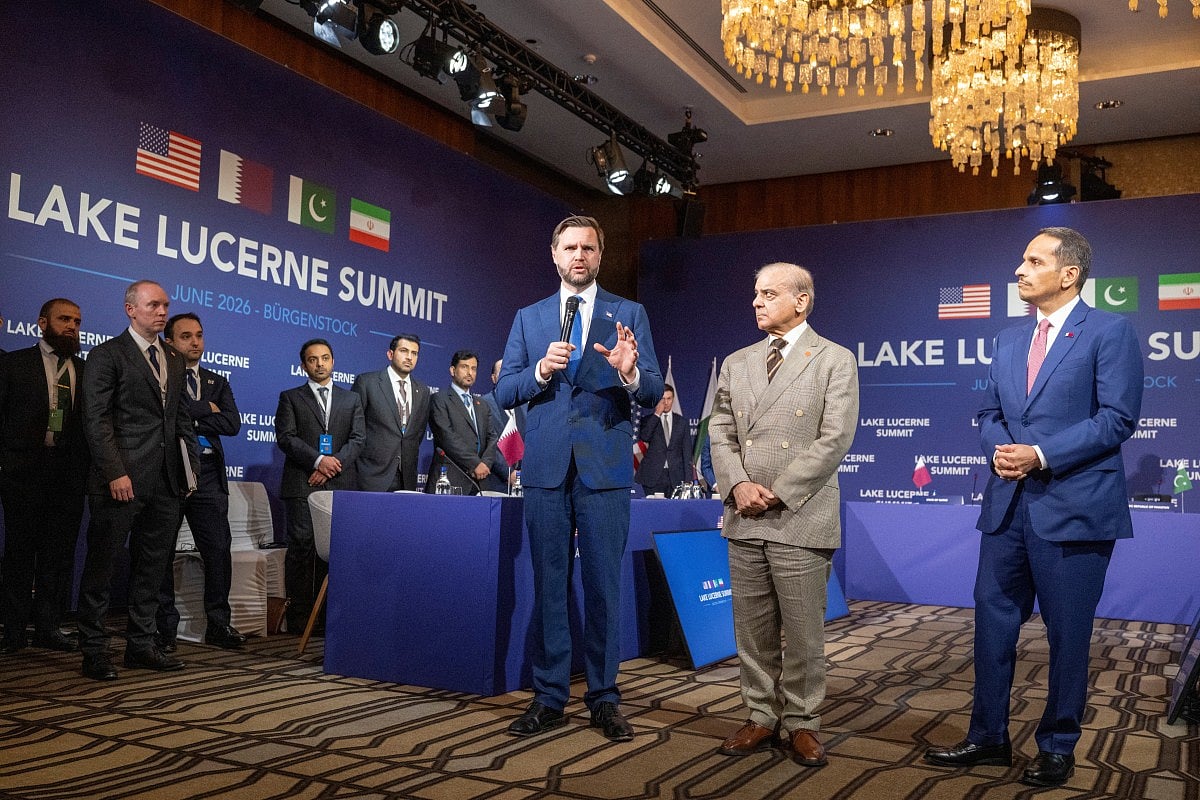
US Vice President JD Vance (L) speaks next to Pakistan's Prime Minister Shehbaz Sharif (C) and Qatar's Prime Minister Sheikh Mohammed bin Abdulrahman bin Jassim Al Thani prior to a quadrilateral meeting between the United States, Iran, Pakistan and Qatar at the Burgenstock luxury hotel complex overlooking Lake Lucerne, Switzerland, on June 21, 2026.
AFP
US President Donald Trump warned Iran of possible tougher military action if it does not restrain allied groups in Lebanon, as tensions rose ahead of a new round of negotiations in Switzerland. The talks, involving US Vice President JD Vance and Iranian officials, aim to build on a recent interim deal to end hostilities and stabilise the Strait of Hormuz, with mediators from Pakistan and Qatar also present. Iran’s chief negotiator Mohammad Bagher Ghalibaf rejected the threats, saying Tehran’s armed forces were ready to respond. Vance, meanwhile, said the discussions offered a chance to “turn over a new leaf” in relations between the two sides. Follow all the latest developments here:
US‑Israel war on Iran: Recent developments
US and Iran set for new talks after delay and deadly strikes
A new round of negotiations over the Middle East war is set to kick off today, with Iranian negotiators arriving in the Swiss host city hours ahead of US Vice President JD Vance, even as Tehran said it was closing the Strait of Hormuz again over Israeli attacks in Lebanon.
Before boarding his flight to Europe, Vance told reporters he hoped to "make progress on the nuclear issue, make progress on the Lebanon ceasefire issue. Those are the two big things that I think we're going to be focused on".
Follow-up talks had been planned in Switzerland on Friday but were postponed at the last minute after Israel launched deadly strikes in Lebanon following the deaths of four of its soldiers in combat.
Washington announced a renewed ceasefire there later Friday - a condition of its preliminary agreement with Iran - but Israeli troops clashed again with Hezbollah fighters on Saturday, with each side accusing the other of breaking the truce.
Citing a US "breach of contract" and "the Zionist regime's continuous and relentless violation of the ceasefire in southern Lebanon", Iran's central military command said "the Strait of Hormuz will be closed to vessel traffic."
Hormuz, a key conduit for oil and gas shipments, was blockaded by Iran for much of the war, sending shockwaves through global energy markets.
Tehran had agreed to reopen it under the preliminary accord signed by President Donald Trump and his Iranian counterpart Masoud Pezeshkian, and shipping traffic had begun to recover.
US Central Command said after Iran's announcement that safe passage through the international waterway had "remained intact" and that US forces were "present and vigilant".
Trump later warned that Washington could impose its own tolls on Hormuz if negotiators failed to complete the deal.
There would be no tolls "unless they are imposed by and for the United States of America", Trump wrote on Truth Social.
Switzerland push
An Iranian delegation arrived in Switzerland late Saturday, state media and the Swiss foreign ministry said.
Iran's official broadcaster said it included parliamentary speaker Mohammad Bagher Ghalibaf and Foreign Minister Abbas Araghchi.
Foreign ministry spokesman Esmaeil Baqaei said the delegation would "demand implementation of the other party's commitments" under the deal.
"Otherwise, the entire understanding will be in trouble," he said, according to official news agency IRNA.
Vance left Washington on an afternoon flight to join the talks, saying he could only stay "a day or two."
US negotiators Jared Kushner and Steve Witkoff were already there handling "some of the technical elements" and had reported that "things are going well," Vance said in an interview with Fox News earlier Saturday.
Mediator Pakistan - whose interior minister was reportedly in Iran on Saturday for meetings with officials - said "technical-level talks" were scheduled for Sunday in Burgenstock, Switzerland, with Pakistani and Qatari mediators joining US and Iranian representatives.
The talks are meant to open a two-month negotiation period on issues left unresolved by the initial accord, notably Iran's nuclear programme.
Lebanon truce frays
Israel and Hezbollah continued trading accusations Saturday as fighting persisted in southern Lebanon.
The Israeli military said one soldier was killed in combat, the fifth such fatality since the US-Iran deal was reached.
An Israeli army official later said the military had received orders from the country's political leadership to cease fire, adding that troops were "not conducting proactive strikes" but operating defensively inside a security zone.
Earlier, an Israeli military official said fresh attacks were under way after Hezbollah "launched more than 50 projectiles at Israeli forces in southern Lebanon" overnight.
Hezbollah accused Israel of carrying out "under the cover of the ceasefire...an infiltration attempt towards the Ali Taher hills", a strategic feature overlooking Nabatieh, and said its fighters had responded "with appropriate weapons".
Lebanese state media reported Israeli air raids on around 20 locations, with authorities counting more than 30 dead. The overall death toll from the fighting in Lebanon had surpassed 4,000, the health ministry said.
Hezbollah lawmaker Hassan Fadlallah said his group retained "the full right to confront this enemy when it attacks us".
Israel's US ambassador Yechiel Leiter maintained it was Hezbollah that broke the truce, saying Israel was "defending itself against terrorist attacks".
But Hezbollah said Israel bore "full responsibility".
Fadi Zayat, who fled the southern Lebanon town of Tayr Debba, told AFP that "fear dominates" the south.
"We returned to the village a few days ago, but our bags are ready to flee again," the 53-year-old said.
Hezbollah pulled Lebanon into the wider Middle East conflict in early March when it fired rockets at Israel in retaliation for the killing of Iran's supreme leader in US-Israeli strikes.
A previous ceasefire meant to take effect in Lebanon in April was never honoured, with each side justifying its attacks by citing alleged violations by the other.
Vance departs Washington for Iran talks
US Vice President JD Vance took off for Switzerland for talks with Iran on implementing a deal to end the Middle East war, saying negotiators would discuss the Islamic republic's nuclear program and the Lebanon ceasefire.
"I think we're going to hopefully make progress on the nuclear issue, make progress on the Lebanon ceasefire issue. Those are the two big things that I think we're to be focused on," Vance told reporters before departing from Joint Base Andrews, saying he could only join the talks "for a day or two."
Vance said the situation in Lebanon was "actually getting better."
"It's going to be something we're just going to have to continuously manage to ensure that... Israel and Lebanon are both safe and secure," he said.
"The big problem is that you have somebody will shoot and then somebody will respond, and you kind of have a chicken and egg problem where you've just got to stop the shooting for long enough to get the ceasefire to keep hold."
US negotiators Jared Kushner and Steve Witkoff were already in Switzerland handling technical elements of the talks, Vance said earlier.
Iranian delegation arrives in Switzerland
An Iranian delegation landed in Switzerland late Saturday ahead of talks at the Burgenstock resort on the preliminary US-Iran deal to halt the Middle East war, said Bern.
"We welcome the arrival of the Iranian delegation in Switzerland," the Swiss foreign ministry said on X, adding that the talks were part of the implementation of the memorandum of understanding signed with the United States.
Iran's official news agency IRNA also said Tehran's delegation had arrived in Switzerland ahead of the talks.
Ghalibaf invokes memories of Minab victims
Iranian Parliament Speaker MB Ghalibaf invoked the memory of victims of the Minab school incident ahead of technical talks with the United States in Switzerland, saying their sacrifice would guide the actions of the Islamic Republic during the negotiations with Washington as part of the 14-point memorandum of understanding (MoU) reached between the two sides to end the hostilities in West Asia.
In a post on X, Ghalibaf said he, along with the Iranian delegation, carried the memory of the children of Minab and other Iranian martyrs with them as they prepared for the talks.
"I consider the innocent children of Minab and all the martyrs of dear Iran to be watching over my every action and behaviour at every moment. They see us and expect things of us. God forbid that I should ever bring shame to the innocent martyrs and the people of Iran," Ghalibaf wrote, adding the hashtag "Minab168" and dedicating the message to the memory of the children of Minab School.
Iran does not control Hormuz: CENTCOM
The US Central Command (CENTCOM) said that Iran does not exercise control over the Strait of Hormuz, even as tensions remain high in the region after heightened military developments linked to Israeli strikes in Lebanon, following which the Islamic Republic announced the closure of the strategic waterway.
According to remarks shared by a CENTCOM spokesperson with Al Jazeera Arabic, Iran does not control the strategic waterway, which is one of the world's most critical maritime chokepoints for global energy supplies.
The spokesperson further stated that US forces are closely monitoring the situation in the Strait of Hormuz to ensure the continued and uninterrupted flow of maritime traffic through the region.
The Central Command also emphasised that maintaining safe navigation and protecting commercial shipping remain its primary objectives in the area.
US Vice President JD Vance lands in Switzerland
US Vice President JD Vance landed Sunday in Switzerland to help formally launch negotiations with Iranian leaders over curbing Tehran's nuclear program and building out the fragile interim deal to end the war in Iran.
Vance and his wife, second lady Usha Vance, arrived at Emmen Air Base outside Lucerne at just before 6am local time, according to his office.
Vance joins special envoy Steve Witkoff and Jared Kushner, President Donald Trump's son-in-law, who have already been on the ground to begin sifting through the technical details of the nuclear talks.
The talks between US and Iran will also include Pakistani Prime Minister Shehbaz Sharif and army chief Field Marshal Asim Munir, as well as Qatari mediators.
While Vance said he planned to be in Switzerland for just "a day or two," leaving much of the detailed negotiations to be spearheaded by Witkoff and Kushner, his role in the talks has heightened the scrutiny of the vice president at a time when he's actively considering a 2028 presidential campaign.
Get updated faster and for FREE: Download the Gulf News app now - simply click here.
Pakistan delegation arrives in Switzerland
Pakistan's Prime Minister Shehbaz Sharif and the head of the military, Asim Munir, arrived in Switzerland on Sunday for talks over the Middle East war, Sharif's office said.
"Prime Minister Muhammad Shehbaz Sharif and Field Marshal Syed Asim Munir will participate in the High-Level Talks on the implementation of the Islamabad Memorandum of Understanding," the Prime Minister's Office wrote on X, referring to the US-Iran deal to end the war.
Get updated faster and for FREE: Download the Gulf News app now - simply click here.
Iran says Lebanon conflict 'main topic' in US talks
Iran said on Sunday that the ongoing conflict in Lebanon between Israel and militant group Hezbollah will top the agenda in talks with the United States in Switzerland, as well as issues such as frozen Iranian funds and the sale of the country's oil.
"The Zionist regime continues to violate its commitment in Lebanon, this issue will be the main topic of discussion in today's talks," foreign ministry spokesman Esmaeil Baqaei said in a video shared by IRNA state news agency.
"The issue of making available Iran's frozen or restricted assets, as well as the discussion related to issuing the necessary licenses for the sale of Iranian oil," will also be on the agenda, he added.
Poll finds Israelis believe Iran won Mideast war
Israelis overwhelmingly believe that Iran emerged stronger from the Middle East war and its subsequent deal with the United States, a poll released on Sunday found.
The poll of 3,644 respondents, conducted between June 17 and 20 by the Hebrew University of Jerusalem in collaboration with the Agam Institute, paints a stark picture of public sentiment following the US-Iran deal.
Of those surveyed, 92.1 per cent said Iran had won or gained more from the conflict, while 82.9 per cent felt that Israel's long-term security had been weakened.
The survey found that even among voters who support the right-wing bloc, the electoral base of Prime Minister Benjamin Netanyahu, 93.1 per cent believed Iran had won.
Opposition to the US-Iran agreement was widespread, with 63.2 per cent of respondents opposing it compared with just 12.1 per cent expressing support.
The findings pointed to a broader crisis of confidence in Israel's leadership.
Nearly three-quarters of those surveyed, 72.5 per cent, said they did not believe Netanyahu's claims about the military campaign's achievements, while 56.4 per cent rated his management of the campaign as "failed" or "poor".
The poll also pointed to the political price paid by Netanyahu, with support for his premiership plummeting from 40.5 percent in early March to 29.4 percent in June.
Despite this, the survey found ongoing support for military action against Hezbollah in Lebanon.
Nearly half of respondents, 48.2 per cent, backed renewed major military action against Hezbollah in Lebanon, even if it risked confrontation with Washington, while only 21 per cent opposed such a move.
Negotiations to turn the temporary Iran-US agreement into a more permanent deal were to take place in Switzerland on Sunday, despite the conflict in Lebanon threatening negotiations.
Washington announced a renewed ceasefire there on Friday after Israeli troops clashed with Hezbollah fighters in southern Lebanon, with each side accusing the other of breaking the truce.
Iran says not seeking nuclear weapon or relinquishing enrichment rights
Iranian President Masoud Pezeshkian reiterated on Sunday that Tehran was willing to provide assurances that the country was not seeking a nuclear weapon, while insisting that Iran would not relinquish its right to enrich uranium.
"What the United States demands is that Iran not build an atomic bomb. This is nothing new, and we can also state in writing that we have no intention of building a bomb," the president's website quoted him as saying.
"However, we will not relinquish our right to enrichment, and the other side will have no choice but to accept this right," he added, before Iranian and US negotiators were set to meet for talks in Switzerland later on Sunday.
Get updated faster and for FREE: Download the Gulf News app now - simply click here.
Iran says can't enter final US deal talks without end to Lebanon war
Iran warned on Sunday that it would not enter into talks on a broader agreement with the United States unless the war in Lebanon comes to an end.
"Without the implementation of these provisions, especially paragraph 1 (termination of the war on all fronts, including Lebanon), entry into the negotiation phase for the final agreement is not possible," foreign ministry spokesman Esmaeil Baqaei wrote on X, referring to a provision in the initial deal between Tehran and Washington.
US delegation meets Pakistani mediators ahead of Iran talks
A US delegation led by Vice President JD Vance, Special Envoy Steve Witkoff and President Donald Trump’s son-in-law Jared Kushner met Pakistani mediators in Burgenstock, Switzerland, ahead of scheduled talks with the Iranian delegation later on Sunday.
The US officials were seen greeting and shaking hands with Pakistan’s Prime Minister Shehbaz Sharif and Army Chief Asim Munir before negotiations were due to begin.
Israel says Hamas, Islamic Jihad operatives eliminated
The Israeli military said that they "eliminated" Hussein Qadra and Mohammed Farra, operatives in the military wings of Hamas and Islamic Jihad.
Qadra, who headed the network with Farra, acted under Hamas leadership and facilitated the transfer of more than half a billion shekels to Hamas, according to an Israeli military X post.
US, Iran talks kick off in Switzerland, Qatar announces
Mediating country Qatar confirmed the start of talks between the United States and Iran in Switzerland aimed at a permanent end to the Middle East war.
In a statement Qatar's foreign ministry announced "the launch of the Lake Lucerne Summit and the first meeting of the high-level committee with the participation of representatives from the United States of America, the Islamic Republic of Iran, and the two mediating states, the State of Qatar and the Islamic Republic of Pakistan".
The gas-rich emirate added it hoped the meetings would "lead to a comprehensive and lasting agreement addressing all aspects covered by the Memorandum of Understanding", referring to an accord signed by the US and Iran earlier this week.
UN nuclear watchdog chief meets Swiss FM
The head of the United Nations nuclear watchdog has met Switzerland’s foreign minister at the Bürgenstock resort, according to a post on X.
Rafael Grossi, Director General of the International Atomic Energy Agency, said he held talks with Swiss Foreign Minister Ignazio Cassis to review recent developments on Iran, discuss possible next steps, and reaffirm the agency’s role in the process.
“At this critical moment, it is important to give diplomacy every opportunity to succeed,” Grossi wrote on X, underlining the push for continued dialogue amid rising tensions.
Iran holds meeting with US, Qatar on Lebanon, frozen funds
Iran's Foreign Minister Abbas Araghchi (L) shakes hands with Switzerland's Foreign Minister Ignazio Cassis at the Burgenstock luxury hotel complex overlooking Lake Lucerne, Switzerland, on June 21, 2026.
Iranian state television said that delegations from Iran, Qatar and the United States were holding a meeting in Switzerland to discuss a ceasefire in Lebanon and Iran's frozen assets.
"A tripartite meeting involving Iran, the United States and Qatar on the subjects of a comprehensive ceasefire in Lebanon and Iran's blocked assets is currently being held at the negotiation venue," state broadcaster IRIB said in a report.
Israel says it will not withdraw from Lebanon security zone
Israel’s defence minister has said the military will not pull back from the “security zone” in Lebanon, following a ceasefire announcement with Hezbollah, according to CNN.
Israel Katz said there is “no restriction” on Israeli soldiers operating inside Lebanon.
“Our forces remain deployed in the security zone along the Yellow Line in Lebanon and operate from there against terrorists and terrorist infrastructure,” he said.
Katz added that the ceasefire announced earlier does not change troop deployment.
He said the Israel Defense Forces (IDF) will remain in all positions within the security zone, which he described as protecting communities in northern Israel.
Regional envoys push for swift progress in US-Iran talks
Envoys from regional heavyweights Pakistan, Turkey, Saudi Arabia and Egypt pushed for swift progress in US-Iran talks at a meeting in Cairo on Sunday, as negotiations between the two foes began in Switzerland.
In a joint statement, the ministers called for a "swift and successful conclusion" to negotiations aimed at reaching a solution to outstanding issues that is "lasting, verifiable and mutually acceptable", while taking into account regional concerns, particularly the security and stability of Gulf states.
Saudi Arabia joined mediator Pakistan alongside Turkey and Egypt in facilitating negotiations weeks into the Middle East war.
Vance warns Mideast at turning point in US-Iran talks
Vance says at US-Iran talks that Mideast is at turning point where it can 'turn over a new leaf' or revert to 'old way.'
Sharif praises Trump’s leadership at key meeting
Pakistan's Prime Minister Shehbaz Sharif speaks next to US Vice President JD Vance and Qatar's Prime Minister and Minister for Foreign Affairs Sheikh Mohammed bin Abdulrahman bin Jassim Al-Thani.
Pakistan’s PM Shehbaz Sharif has thanked US President Donald Trump, crediting his “visionary and very dynamic leadership” for enabling the high-level meeting.
“Productive results expected from talks”
Sharif said the gathering was made possible due to Trump’s leadership, adding that it would pave the way for constructive engagement.
“I think here we are going to have wonderful discussions which will lead to, hopefully, very productive results in times to come,” he said.
US, Iran can work together for peace and prosperity: Vance
US Vice President JD Vance speaks during a quadrilateral meeting between the United States, Iran, Pakistan and Qatar at the Burgenstock luxury hotel complex overlooking Lake Lucerne, Switzerland.
JD Vance said Washington and Tehran could move towards a future of cooperation aimed at promoting “peace and prosperity”, despite ongoing tensions.
Vance noted that Iran remains a “driver of regional instability”, even as he acknowledged what he described as “great” progress in recent discussions over the past few hours.
He said both sides now see a possible future of engagement and cooperation, adding that President Donald Trump has urged efforts to “turn over a new leaf” in relations with the Iranian people.
Vance hails 'historic' moment as US-Iran talks start
JD Vance said he hoped Washington and Tehran could reset their relationship, at the start of what he called "historic" face-to-face talks in Switzerland on Sunday.
“This is a historic meeting,” Vance said at the Burgenstock resort, saying the goal was to “turn over a new leaf, transform our relationship with the people of Iran, and extend an outstretched hand.”
Trump threatens to strike Iran if it does not stop its 'proxies in Lebanon'
Trump threatened to strike Iran if it did not stop Hezbollah from "causing trouble," as peace talks between senior US and Iranian officials began in Switzerland.
The negotiations opened against a backdrop of clashes in recent days between the Israeli army and Hezbollah - a Tehran ally - in southern Lebanon, threatening to derail the preliminary peace deal between Tehran and Washington.
"Iran must immediately stop their highly paid PROXIES in Lebanon from causing trouble," Trump posted on his Truth Social platform. "If they don't, we'll hit Iran very hard again, just like we did last week, only harder!!!"
Qatar reaffirms mediation role in Switzerland talks
Qatar has reiterated its commitment to supporting ongoing mediation efforts during high-level talks in Switzerland, according to a video shared by the country’s Foreign Ministry.
Qatar’s Prime Minister and Foreign Minister Mohammed bin Abdulrahman Al Thani said Doha would remain engaged in the process until a resolution is achieved.
“Qatar will stay dedicated to this partnership to support these mediations until the end, until we reach a solution,” he said.
He added that Qatar would continue working with partners to promote peace, prosperity, and long-term stability in the region, underlining its role as a consistent mediator in ongoing diplomatic efforts.
Trump warns US could ‘take over’ Strait of Hormuz
Trump has said Washington could “take over” the Strait of Hormuz if a deal is not reached with Iran, escalating tensions as negotiations continue in Switzerland, CNN reported.
Speaking during a phone interview with Fox News, Trump said the US could impose control over the strategic waterway if talks fail.
“We may take over the Strait, if we have to… If they don’t make a deal, we’ll collect tolls,” he said.
We may take over the Strait, if we have to… If they don’t make a deal, we’ll collect tolls.Donald Trump
Trump also issued a direct warning to Iranian officials, saying closure of the strait would have severe consequences.
“You close it and you won’t have a country,” he said, adding that he had conveyed the message to Iranian representatives.
He further suggested the US could act as a “guardian angel” of the Strait, including collecting a share of oil shipments passing through the key global trade route.
Trump wishes UK PM Starmer well amid reports of resignation plans
Trump said he wished UK Prime Minister Keir Starmer well amid reports he plans to resign.
"Keir Starmer will resign as Prime Minister of The United Kingdom," Trump wrote on Truth Social in a post that gave no evidence he had inside information. "I wish him well."
His post came as British media reported that the embattled Labour Party leader will resign in a matter of days.
Trump has slammed Starmer for not supporting the US-Israeli war against Iran, and in his post Sunday the president repeated criticism of the British premier on two issues: borders and fossil fuels.
"He failed badly on two very important subjects- IMMIGRATION AND ENERGY (OPEN NORTH SEA OIL!)," Trump wrote.
Get updated faster and for FREE: Download the Gulf News app now - simply click here.
First round of Iran-US talks concludes in Switzerland, reports say
The high-level negotiations between the United States and Iran in Switzerland have concluded after approximately 80 minutes of discussions, according to Fars News Agency.
The report said the meeting was brought to an end for “internal consultations,” with no immediate details released on the outcome of the latest round of discussions.
Israel PM says troops to stay in Lebanon 'as long as necessary'
Israeli Prime Minister Benjamin Netanyahu said that Israeli forces would remain in southern Lebanon "as long as necessary", while also vowing to prevent Iran from acquiring nuclear weapons.
"We will remain in the security zone in southern Lebanon for as long as necessary to protect the cherished residents of the north and all the citizens of Israel... Nothing will alter that commitment," Netanyahu said.
"And with regard to Iran: whatever political developments may unfold, I will not allow Iran to acquire nuclear weapons. As long as I serve as prime minister of Israel, that will not happen."
Iran state media says nuclear programme not discussed in US talks
Iranian state television reported a pause in the US-Iran talks mediated by Pakistan and Qatar in Switzerland, and said that the Islamic republic's nuclear programme had not been discussed.
"No negotiations regarding Iran's nuclear programme took place during the 80-minute first round of talks," the state broadcaster said, adding that the focus had been on the implementation of the memorandum of understanding between Tehran and Washington, and the situation in Lebanon.
Tehran–Qatar Bilateral talks begin
Bilateral talks between Tehran and Qatari delegations have begun following the conclusion of the first round of US–Iran negotiations in Switzerland, according to semi-official IRIB news agency.
The report said it remains unclear whether the broader quadrilateral format of the discussions will continue or be paused, as consultations are still underway.
Iran warns US to 'be careful', warns of response
Iran’s parliament speaker and chief negotiator Mohammad Bagher Ghalibaf has dismissed US threats, saying Tehran is fully prepared to respond if necessary.
In a post on X, Ghalibaf questioned the effectiveness of Washington’s warnings, suggesting they reflected “desperation” rather than strength.
“If their threats had any effect, they wouldn’t have reached the point of desperation they are in today. We don’t count on the American threats,” he wrote.
He also cautioned against further rhetoric, saying Iran’s armed forces were prepared to act.
“They better be careful with their comments, our armed forces are ready to respond in a different way. Whatever they say, we are the ones who will act,” he added.
German minister blames Trump for Strait of Hormuz closure
German Defence Minister Boris Pistorius on Sunday blamed US President Donald Trump for the closure of the Strait of Hormuz, calling for the vital waterway to be reopened.
"Ultimately, the cork in the bottle neck of the Strait of Hormuz was pushed in by Donald Trump, not by us, but we have an interest in getting it out again," Pistorius said in an interview with broadcaster ARD.
"The opening of the Strait of Hormuz, or rather safe passage through it, is in Europe's interest, in the interest of our energy supply and our economic recovery," Pistorius said.
The minister added that any agreement to reopen the strait would need the support of Iran and Oman.
Berlin has repeatedly distanced itself from Trump's campaign against Iran, though officials have stopped short of blaming the US for the conflict.
When Trump pressed allies to help re-open or secure the Strait of Hormuz in April, German Chancellor Friedrich Merz said the war was "not a matter for NATO".
Merz and Pistorius have also criticised the US for not consulting its allies before beginning strikes on Iran.
Hezbollah chief rejects any Israeli security zone in Lebanon
Hezbollah chief Naim Qassem rejected any Israeli security zone in Lebanon, after Israel's Prime Minister Benjamin Netanyahu vowed his troops would remain in the country's south for "as long as necessary".
Israeli troops "remaining on Lebanese land is impossible. There are no security zones for Israel... we have a national army which deploys, and it is responsible for preserving sovereignty, and it is who we cooperate with," Qassem said in a televised address.
"Israel is an aggressor and must leave. America bears full responsibility," Qassem said, adding that "Israel will not remain in Lebanon, even if it increases its crimes, and we will defend ourselves."
US senator outlines Trump’s Strait of Hormuz plan
US Republican Senator Lindsey Graham has said President Donald Trump is prepared to take control of the Strait of Hormuz and impose tolls if diplomatic efforts with Iran do not succeed.
In an interview with CBS, Graham said he spent several hours with Trump on Friday and was briefed on what he described as a contingency plan if negotiations collapse.
“If this deal fails, President Trump is going to take the Strait of Hormuz over by force,” Graham said. “The United States will control the Strait of Hormuz, we’ll charge a fee for all those who go through to pay for the operation.”
Iran says draft oil sanctions relief deal finalised in talks
A member of Iran’s delegation said a draft agreement on a temporary exemption from US sanctions on Iranian oil and oil derivatives has been completed during talks in Switzerland, CNN reports, citing Iran’s semi-official Fars News Agency.
Economy expert on the delegation Hossein Ghorbanzadeh said the exemption is expected to move towards implementation, with talks focused on Clause 13 of a memorandum and wider framework discussions.
He said key points include ending hostilities, lifting restrictions, reopening the Strait, temporary oil sanctions relief and releasing frozen assets, adding that further steps depend on resolving the situation in Lebanon.
Iran delegation left talks venue after Trump threat
The Iranian delegation on Sunday left the venue of talks with the United States seeking to permanently end the Middle East war, after President Donald Trump threatened to strike the Islamic republic.
"The delegation of the Islamic Republic of Iran, after meeting with the Qatari delegation as one of the mediating parties, left the building where the negotiations were being held," Iran's state news agency IRNA said.
"At the same time as the talks began in Switzerland, Donald Trump published a message on X in which he repeated his threats and remarks against Iran," it added.
Pakistan PM praises Iran and US role in easing tensions
PM Shehbaz Sharif has praised both Iran and the United States for their efforts to reduce regional tensions amid ongoing diplomatic engagement in Switzerland.
Speaking to reporters at Burgenstock, Sharif said Iran’s leadership had handled the crisis “with dignity” and shown commitment to de-escalation.
He added that Tehran’s intent appeared focused on promoting regional stability, while also describing Trump as a “man of peace,” saying he believed both sides were engaging constructively in the talks.
Israel lifts all war-related restrictions on northern border areas
Israel is set to end public restrictions across the country, including in areas along the Israel–Lebanon border, in a key sign of progress under the latest ceasefire arrangement.
Israel’s Home Front Command said the current measures, which had limited public gatherings and school activities in northern regions, will expire at 6:00 a.m. local time on Monday.
Iran delegation 'remains engaged' in Switzerland talks
Iranian is still engaged in talks with the United States in Switzerland, mediated by Pakistan and Qatar and aimed at ending the Middle East war, a diplomat with knowledge of the negotiations told AFP late Sunday.
"The Iranian delegation remains engaged in the talks and has not indicated to the mediators any intention to leave," the diplomat told AFP on condition of anonymity to discuss the sensitive topic after Iranian media reported Tehran's negotiators had left the venue where the summit was being held.
Negotiations between Washington and Tehran in Switzerland stalled on Sunday after US President Donald Trump publicly threatened Iran's negotiating team during a television interview, according to an Iranian source. The remarks triggered a sharp response from Iran's chief negotiator, casting doubt on momentum toward a broader agreement.
Trump said earlier Sunday that the United States could resume military strikes against Iran and even "take over" the Strait of Hormuz if negotiations collapse. His comments reignited uncertainty over the strategic waterway, despite both countries having signed an initial memorandum aimed at restoring freedom of navigation through the vital oil shipping lane.
Another major sticking point remains the conflict between Israel and the Iran-backed Hezbollah militant group, overshadowing Vance's diplomatic push. Tehran has insisted that Israel halt its military operations in Lebanon before any meaningful progress can be made in negotiations with Washington.
Netanyahu acknowledges halt in fighting with Iran but vows to respond ‘with force’ to future attacks
Israel struck Iran on Monday after being targeted by missiles, while a U.S. military base in Saudi Arabia came under fire in the most serious exchange of hostilities since an April ceasefire, raising the possibility of a return to heavy fighting and complicating mediation efforts to end the war, AP reported.
In a brief statement, Netanyahu said the fighting has stopped “after we hit the terror regime in Tehran.” But he said, “If the terror regime in Iran makes the mistake and returns to attacking us, we will respond with force.”
Netanyahu also said that Israel is continuing to operate against Iran’s ally, the Lebanese militant group Hezbollah, and that Israel “has full right to self-defense and we will exercise it to the full extent necessary.”
Iranian military’s joint command said it is halting its offensive operations vs Israel
The Iranian military’s joint command said that it is halting its offensive operations hours after Israel and Iran began trading fire early Monday in retaliatory strikes that threatened to drag the wider Middle East back into a full-scale regional war.
Iraq pressing ahead with plans to export crude oil through Syria
Iraq is pressing ahead with plans to export crude oil through Syria's Mediterranean coast even as shipping through the Strait of Hormuz gradually returns to normal, underscoring how this year's Gulf crisis has permanently reshaped energy security calculations across the Middle East.
The move follows the disruption caused by the temporary closure of the Strait of Hormuz during the U.S.-Iran conflict, which exposed Iraq's heavy dependence on a single maritime chokepoint. Iraqi officials told Reuters that Baghdad intends to maintain the new export corridor through Syria's port of Baniyas as a permanent alternative rather than merely an emergency contingency.
The decision reflects a broader strategic lesson from the conflict: even if Hormuz is reopened, countries that rely on it are no longer willing to assume the world's most important oil shipping lane will always remain accessible.
Iraq, the second-largest producer in OPEC, typically exports about 3.6 million barrels of crude oil per day, with roughly 3.4 million barrels traditionally shipped through its southern Gulf terminals connected to the Strait of Hormuz. When the waterway was effectively closed earlier this year, exports slowed sharply and crude inventories accumulated as storage facilities filled.
To reduce that vulnerability, Baghdad is developing an alternative outlet through Syria. Initial crude exports from the Mediterranean port of Baniyas are expected to begin as early as July at around 50,000 barrels per day, while fuel oil is already being trucked across the border for shipment to buyers in Europe and Africa. Syrian authorities are expanding storage and unloading facilities at Baniyas to accommodate higher export volumes.
Egypt, Pakistan, Saudi Arabia, Türkiye affirm US-Iran MoU should ensure security, stability of Gulf region
The foreign ministers of Egypt, Saudi Arabia, Türkiye and Pakistan, emphasised that the US-Iran agreement should take into account the csecurity and stability of countries across the region.
In a joint statement after a consultative meeting held in Cairo, the ministers described it as "a constructive step towards de-escalation and towards ending a conflict which posed significant risks to regional security and stability, as well as to energy markets, international maritime routes, global supply chains, and international trade." Building on the memorandum of understanding, the ministers emphasised the need for a swift conclusion to the next phase of negotiations to reach "a lasting, verifiable, and mutually acceptable solution" to the remaining issues.
US-Iran talks expected to continue through the night
The first round of direct US-Iran talks since deal expected to continue through the night. US President Donald Trump, who is not at the talks, had earlier exchanged warnings with Iran's negotiator over clashes between Israel and Hezbollah in Lebanon.
Iran, US agree roadmap to 'final deal within 60 days', lay foundation for immediate commencement of further technical talks: Qatar, Pakistan mediators
Iran and the United States agreed on a roadmap towards reaching a final deal to end the war within 60 days, meditors Pakistan and Qatar said in a joint statement on Monday.
"The High Level Committee has agreed upon a roadmap towards reaching a final deal within 60 days, laying the foundation for the immediate commencement of further technical talks," the joint statement read.
Iran, US to set up 'de-confliction cell' with Lebanon to stop military operations: mediators
Iran and the United States have agreed to set up a "de-confliction cell" with Lebanon to stop military operations, mediators Pakistan and Qatar said in a joint statement on Monday.
"The parties agreed on the creation of a de-confliction cell, between the parties, the Lebanese Republic and facilitated by the Mediators, to ensure the adherence of the termination of military operations in Lebanon," the joint statement read.
Brent crude drops to $79 — oil markets mixed as Iran, Israel announce halt of offensive, easing war fears
Oil prices were mixed in Asian trading Monday as markets weighed fresh Middle East de-escalation signals against lingering supply and security risks, with WTI edging up while Brent fell sharply and Murban also slipped, as of 10:33 am Tokyo time on June 22, 2026.
WTI crude was quoted at $75.91 a barrel, up 6 cents or 0.08%.
Brent crude, the global benchmark, stood at $79.71, down 86 cents or 1.07%, while Murban crude was at $73.63, down 30 cents or 0.41%.
The market reaction came after Iran’s military joint command said it was halting offensive operations against Israel, following hours of retaliatory strikes that had raised fears of a broader regional conflict.
Get updated faster and for FREE: Download the Gulf News app now - simply click here.
We are closing this coverage now. For the latest updates, click here.
Sign up for the Daily Briefing
Get the latest news and updates straight to your inbox
Network Links
GN StoreAbout Gulf NewsTerms & ConditionsReach by GNSitemapContact usPrivacy PolicyGN FocusHave your sayWork with usAdvertise with usGulf News epaperPrinting Services
Download our app
© Al Nisr Publishing LLC 2026. All rights reserved.