US President Donald Trump speaks during a cabinet meeting in the Cabinet Room of the White House in Washington, DC, on May 27, 2026.
Why Trump warned Oman over Iran’s Strait of Hormuz fee plans
Tehran’s reported talks with Muscat raised fears of a long-term Hormuz control framework
Last updated:
4 MIN READ
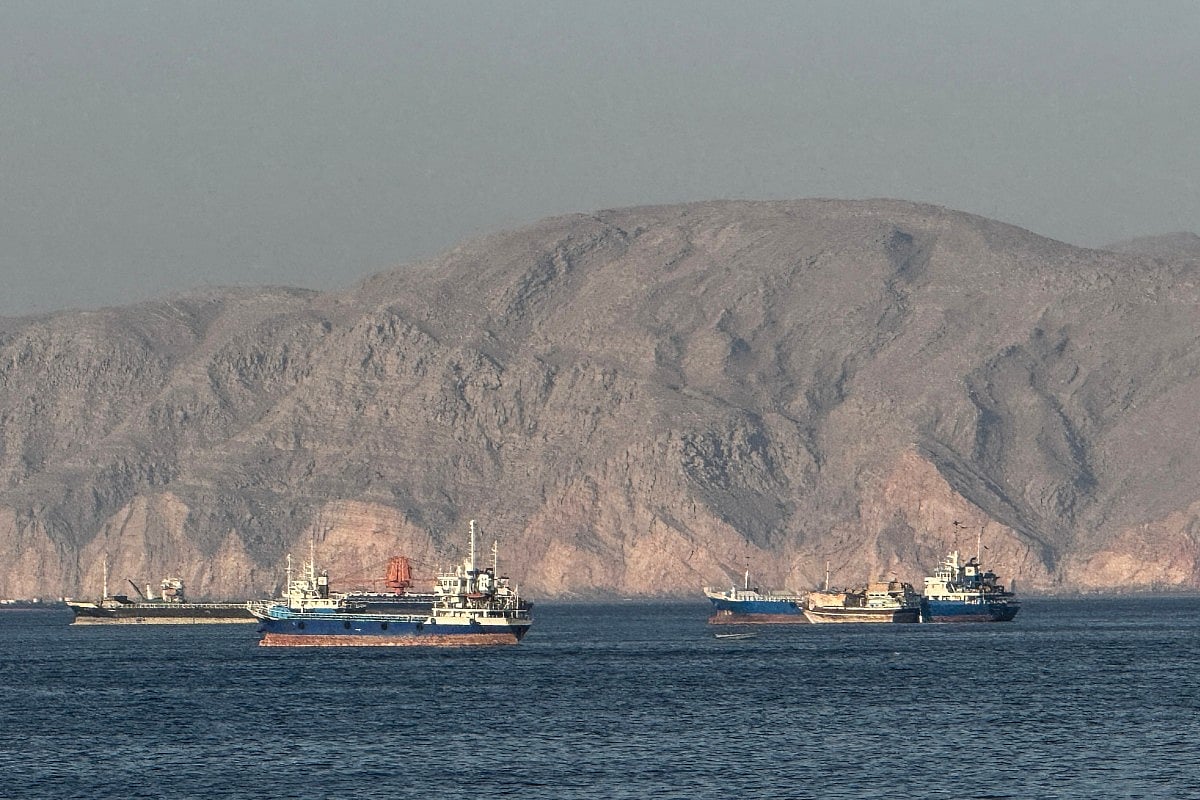
Vessels anchored in the Strait of Hormuz, off the port city of Khasab on Oman’s northern Musandam Peninsula on May 17, 2026.
AFP
Dubai: For years, Oman was the quiet Gulf mediator trusted by both Washington and Tehran — hosting secret talks, passing sensitive messages and helping prevent regional crises from spiralling further.
So when US President Donald Trump suddenly warned that “Oman will behave just like everybody else or we’ll have to blow ’em up,” it signalled something larger than a diplomatic outburst.
While there was initial speculation that Trump may have misspoken and meant Iran rather than Oman, the US State Department later shared the remarks on social media along with an official transcript explicitly referring to the Arab country.
Asked if he would accept a short-term deal that would allow Iran and Oman to control the critical waterway, Trump said, “No, the strait’s going to be open to everybody.”
“It’s international waters. Nobody’s going to control it. We’re going to watch over it. We’ll watch over it, but nobody’s going to control it,” Trump said. “That’s part of the negotiation that we have.”
Analysts say the remarks reflect a deeper and increasingly important battle over the future of the Strait of Hormuz — and who gets to shape its rules after months of war, naval blockades and disrupted shipping.
Why did Trump suddenly mention Oman?
The comments came after reports that Iran and Oman had discussed possible maritime arrangements linked to the Strait of Hormuz, including a potential payment framework tied to shipping management and security services.
Trump rejected any suggestion that Iran or Oman could oversee the strategic waterway.
“It’s international waters. Nobody’s going to control it. We’re going to watch over it,” he said during a White House Cabinet meeting.
The unusually sharp comments towards Oman appeared to signal Washington’s opposition to any future regional system that could give Iran indirect influence over Hormuz.
Iran’s Foreign Minister Abbas Araghchi with Oman’s Sultan Haitham bin Tariq in Muscat
Why is Oman important in the Hormuz crisis?
Oman occupies one of the most strategically sensitive locations in the Gulf.
The Gulf of Oman forms the main maritime approach to the Strait of Hormuz from the Arabian Sea, making Muscat a key stakeholder in regional shipping security.
But Oman’s importance is not only geographic.
For decades, Muscat has maintained close ties with both Western powers and Iran, allowing it to play the role of neutral intermediary during periods of tension.
Oman hosted backchannel talks during previous US-Iran nuclear negotiations and has frequently acted as a discreet diplomatic bridge between Tehran and Washington.
That reputation is one reason Trump’s comments drew attention across the region.
What exactly are Iran and Oman discussing?
According to recent reports by Bloomberg News and The New York Times, Iranian officials have discussed possible systems under which ships crossing Hormuz would pay fees linked to maritime services, navigation support or traffic management.
Iranian officials have reportedly argued that any future arrangement would be transparent and connected to regional security responsibilities rather than direct transit tolls.
Iranian Ambassador to France Mohammad Amin-Nejad said Iran and Oman must “mobilise all their resources” to provide security services and manage navigation through the strait.
“This will entail costs,” he said.
Iranian officials have reportedly framed the proposal as a maritime “service fee” rather than a direct transit toll — a distinction that could prove important under international maritime law.
Why is the idea controversial?
The distinction between a “service fee” and a “transit toll” is now becoming central to the diplomatic battle.
Under international maritime law, including principles contained in the UN Convention on the Law of the Sea, ships are generally guaranteed the right of transit passage through international straits without interference.
Legal experts say directly charging vessels simply for crossing Hormuz would likely trigger major international opposition.
But fees linked to specific maritime services could potentially fall into a legal grey area if carefully structured.
Critics, however, argue that any such system could amount to a disguised form of leverage over one of the world’s most important energy corridors.
One maritime law expert quoted by The New York Times compared the idea to “protection money”.
Critics also argue the arrangement could effectively function like a toll on one of the world’s most strategically important waterways.
Why are Gulf states worried?
The UAE has already publicly rejected any attempt to impose charges on ships transiting Hormuz.
Speaking at the United Nations earlier last week, UAE Deputy Permanent Representative Mohamed Abushahab said international waterways “must not be subjected to extortion”.
The UAE has also accused Iran of continuing to threaten shipping security in the strait.
For Gulf states, the concern is not only economic but strategic.
Analysts say regional governments fear that temporary wartime disruptions in Hormuz could gradually evolve into a more permanent political framework in which Iran gains influence over navigation, security coordination or shipping costs.
Is this why Trump reacted so strongly?
Many analysts believe so.
Trump’s remarks suggest Washington fears that wartime arrangements around Hormuz could evolve into a longer-term regional framework that sidelines direct US influence over Gulf shipping security.
The US position remains that Hormuz is an international waterway that must remain open to all countries without regional restrictions or political conditions.
By publicly warning Oman while rejecting any Iranian role in overseeing the strait, Trump appeared to draw a red line against any future Hormuz system built around regional management rather than international oversight.
So what is the bigger picture?
The Hormuz crisis may no longer be only about reopening shipping lanes after months of war.
Increasingly, it appears to be evolving into a larger geopolitical struggle over who will shape the future rules of one of the world’s most strategically important waterways.
And in that battle, Oman — long seen as the Gulf’s quiet mediator — has suddenly found itself at the centre of the storm.

A Senior Associate Editor with more than 30 years in the media, Stephen N.R. curates, edits and publishes impactful stories for Gulf News — both in print and online — focusing on Middle East politics, student issues and explainers on global topics. Stephen has spent most of his career in journalism, working behind the scenes — shaping headlines, editing copy and putting together newspaper pages with precision. For the past many years, he has brought that same dedication to the Gulf News digital team, where he curates stories, crafts explainers and helps keep both the web and print editions sharp and engaging.
Sign up for the Daily Briefing
Get the latest news and updates straight to your inbox
Network Links
GN StoreAbout Gulf NewsTerms & ConditionsReach by GNSitemapContact usPrivacy PolicyGN FocusHave your sayWork with usAdvertise with usGulf News epaperPrinting Services
Download our app
© Al Nisr Publishing LLC 2026. All rights reserved.