Trump draws red line on Hormuz control, warns Oman over Iran talks
Trump says no one will control the Strait of Hormuz as US vows to ‘watch over’ it
Dubai: US President Donald Trump declared Wednesday that the Strait of Hormuz would remain open to all countries under any future agreement with Iran, while warning Oman not to interfere in negotiations over the world’s most strategically vital energy corridor.
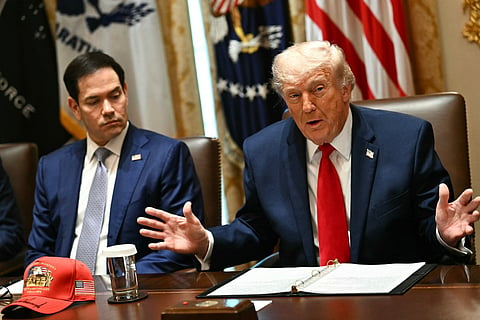
“It’s international waters. Nobody’s going to control it. We’re going to watch over it,” Trump told reporters during a Cabinet meeting at the White House, describing freedom of navigation through Hormuz as a central part of ongoing talks with Tehran.
The remarks came amid growing confusion over reports of a possible draft understanding between Washington and Iran aimed at reopening the strait and reducing military tensions in the Gulf after months of war and disruption.
Trump rejected suggestions that Iran or Oman could oversee any future shipping arrangement or toll system in Hormuz, Trump said.
“No, the strait’s going to be open to everybody,” he said when asked whether he would accept a temporary arrangement involving Iranian or Omani control of the waterway.
'Oman will behave just like everybody else'
In one of his sharpest comments yet directed at Muscat, Trump added: “Oman will behave just like everybody else or we’ll have to blow ‘em up” — remarks that appeared to blur Washington’s frustration with both Iran’s negotiating position and regional mediation efforts.
While there was initial speculation that Trump may have misspoken and meant Iran rather than Oman, the US State Department later shared the remarks on social media along with an official transcript explicitly referring to the Arab country.
Iran has repeatedly insisted that management of the Strait of Hormuz is not a matter for the United States and would instead be coordinated with Oman and regional states. Iranian Foreign Ministry spokesman Esmaeil Baghaei reiterated that position earlier this week.
The White House also dismissed reports aired by Iranian state television claiming that a draft memorandum of understanding under discussion would see the US lift its naval blockade on Iran, restore commercial shipping through Hormuz and withdraw American forces from the Gulf.
White House officials described the report as “a complete fabrication”.
Still, Trump acknowledged that negotiations were continuing, even as he signalled dissatisfaction with Iran’s latest proposals.
“Iran is very much intent, they want very much to make a deal. So far they haven’t gotten there. We’re not satisfied with it, but we will be,” Trump said.
'I don’t care about the midterms'
“Either that or we’ll have to just finish the job,” he added, referring to possible renewed military operations after the conflict that began on February 28 and later paused under a fragile ceasefire.
Trump also suggested Tehran was negotiating from a weakened position.
“They’re negotiating on fumes,” he said.
Despite repeatedly claiming over recent days that a deal could be close, Trump insisted he was under no pressure to quickly reach an agreement ahead of November’s midterm elections, even as the war continues to push up fuel and consumer costs in the United States.
“They thought they were going to outwait me… he’s got the midterms,” Trump said, referring to Iran. “I don’t care about the midterms.”
US Secretary of State Marco Rubio, who was seated beside Trump during the Cabinet meeting, said there had been “some progress and some interest” in negotiations but cautioned that the coming days would determine whether any breakthrough was possible.
Trump also appeared to confirm reports that a phased agreement under discussion could initially focus on reopening Hormuz and stabilising the Gulf, while postponing more contentious disputes over Iran’s enriched uranium stockpiles.
“Well, I would for some of it,” Trump said when asked whether he would accept a temporary memorandum of understanding that delayed a final uranium settlement.
“Because it’s a memorandum of understanding for speed.”
But he rejected suggestions that Russia or China could take custody of Iran’s uranium reserves under a future arrangement.
The latest comments underscore the increasingly tangled diplomacy surrounding Hormuz, where shipping traffic remains far below normal levels despite months of negotiations and repeated claims that a broader agreement may be near.
Analysts say the latest exchanges also highlight a widening gap between competing visions for the future of the strait — with Washington insisting on international oversight and open navigation, while Tehran increasingly frames Hormuz as a regional security and sovereignty issue tied to Oman and Gulf states.
-- With AFP inputs


