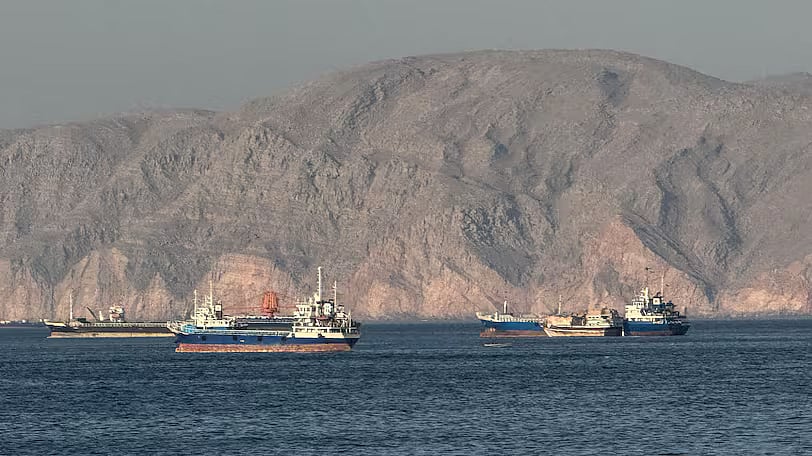
To facilitate the departure from the Gulf of long-trapped mariners, the International Maritime Organization (IMO) and Oman organized an "evacuation" in late June 2026 via Omani waters to the south of both Iranian waters and traditional Hormuz traffic lanes.
The United States could face an extraordinary post-war choice over the Strait of Hormuz: continue providing security and effectively administer shipping through the strategic waterway — or hand responsibility back to regional powers and risk renewed disruption.
The debate has gained urgency after President Donald Trump repeatedly asserted that Washington has control over the strait and floated increasingly ambitious ideas for managing traffic through it.
A Congressional Research Service (CRS) report examined the strategic implications for shipping and energy, while subsequent congressional hearings have focused on the cost and feasibility of maintaining a prolonged US military presence.
Trump’s increasingly expansive Hormuz claims
Trump has moved well beyond simply demanding that Iran reopen the waterway.
In May, he announced “Project Freedom,” under which US forces would escort civilian vessels through the strait. He described the operation as a humanitarian gesture.
By June, Trump claimed US forces had secretly been moving ships and oil cargoes through Hormuz for weeks, saying: “The Straits have been open for a number of months already, and you just didn't know about it.” He also claimed US forces had attacked Iranian maritime assets and radar systems.
In July, Trump went further, declaring that the US would become the “Guardian of the Hormuz Strait” and proposing a 20% charge on cargo transiting the waterway to pay for US security operations.
Get it: Fast, verified news for FREE ... download the Gulf News app — simply click here
Trump's rhetoric
That proposal would represent a dramatic shift: from freedom-of-navigation operations toward an American-managed security and transit system.
Trump's rhetoric escalated again in August.
He said the US had “total control” of the area, while Iranian officials insisted the strait remained under Iranian control.
He has even threatened to declare Hormuz “a territory of the United States,” a claim that would raise enormous questions under international law and about the sovereignty of Iran and Oman.
The CRS, a public policy research arm of the US Congress and housed inside the Library of Congress, has considered dramatic scenarios amidst the ongoing US-Iran standoff.
One possible scenario: the US could move beyond protecting or escorting shipping in the Hormuz, in which Washington could seek its own “formal administration” of the Strait.
This comes with an important caveat —"if Iran either agrees to such an arrangement or becomes unable to continue fighting".
Under such a model, the United States could potentially seek economic incentives, including fees or investments in the US.
Get it: Fast, verified news for FREE ... download the Gulf News app — simply click here
Major break from pre-war status quo
The proposal would represent a major break with the pre-war status quo and traditional US policy, the report stated.
It would also go beyond the preferences of allied states, including Europe Turkey, India, China and the Gulf Arab counties, which have generally sought to preserve free and uninterrupted transit through the waterway.
The report noted, however, that such a "permanent US administrative role could require substantial long-term military, diplomatic and financial commitments."
A possible international model
The report also considers a "cooperative administration" involving the United States, Iran and/or Gulf Arab states.
It points to the Strait of Malacca as a possible precedent.
Indonesia, Malaysia and Singapore established a cooperative mechanism in 2007 that includes an Aids to Navigation Fund, financed by "voluntary contributions" from governments and maritime industry stakeholders to maintain critical navigational infrastructure.
This particular Hormuz management proposal would therefore not necessarily mean US sovereignty over the waterway.
Instead, it could envisage a "jointly managed system" designed to keep one of the world's most important shipping chokepoints operating.
But Washington could also walk away
The report lays out a far less interventionist scenario: prolonged instability.
Under this possibility, Iranian attacks on shipping and US retaliatory strikes could continue disrupting traffic through Hormuz, potentially keeping the waterway "effectively closed" or severely restricted for an extended period.
The economic consequences could remain significant, particularly for oil, gas and commodity markets, the report notes.
Another option would be for Washington to reprioritise shipping away from Hormuz, reducing the resources it devotes to keeping the waterway open.
That possibility reflects a tension in US policy.
Washington has identified keeping Hormuz "open" as a core national interest, but President Donald Trump has also questioned whether the United States should continue bearing the burden of protecting the oil flows of other countries.
Why Hormuz matters
The stakes are enormous.
The Strait is only about 22 nautical miles (40km) wide at its narrowest point, yet it is a critical gateway between the Arabian Gulf and global markets.
In 2024, roughly 20 million barrels of oil a day passed through it — about 27% of global maritime oil trade.
That makes the latest scenario discussion far more consequential than a dispute over maritime administration: who controls access to Hormuz can influence global energy prices, shipping costs and the economic security of major Asian importers.
The latest publicly-accessible Congressional Research Service report R45281, “Iran Conflict and the Strait of Hormuz: Oil and Gas Market Impacts,” is dated Aug. 4, 2025, and lists Michael Ratner as coordinator.
Recent developments
Actions, reversals, and competing claims that have characterised competition over the Strait of Hormuz since February 2026 reveals the Strait's increasingly central role in the US-Iran conflict, as well as a progressively more assertive Iranian claim to, and attempt to formalize control over, the Strait.
Before February 28, 2026: Though Iranian forces sometimes attacked ships in the Gulf (including in the 2019 confrontation between Iran and the US), they did not do so in a comprehensive way or seek to fully prevent or redirect cross-Strait traffic.
February 28-April 7, 2026: Days after US-Israeli attacks on Iran began, Iranian forces declared the Strait closed and cross-Strait traffic largely halted, with hundreds of vessels and thousands of mariners effectively trapped in the Gulf. During the conflict, Iran announced that ships from certain nations (such as Pakistan and Iraq) were permitted to transit the Strait through Iranian waters and reportedly charged fees to allow some ships to pass, but traffic remained below pre-conflict levels.4
April 7, 2026: The US and Iran agreed to a two-week ceasefire; no mutually agreed-on text was released, but President Trump said the ceasefire was "subject to … Iran agreeing to the COMPLETE, IMMEDIATE, and SAFE OPENING of the Strait of Hormuz." Some ships transited the Strait, but Iran halted traffic in response to Israeli attacks in Lebanon.
April 13, 2026: After the failure of US-Iran talks in Islamabad, Pakistan, President Trump ordered a US blockade of Iranian ports and ships leaving or going to them, with an exception for shipments of humanitarian aid. During this initial blockade, which lasted through mid-June, US Central Command (CENTCOM) reported having redirected over 140 ships and "disabled" 9 ships not complying with the blockade.
May 3, 2026: President Trump announced "Project Freedom" to help mariners navigate the Strait via a southern route that avoids Iranian waters. Two days later, after Iranian attacks against the UAE and Oman and reported Saudi opposition to the United States' use of its airspace, President Trump said that Project Freedom was paused at the request of Pakistan and other countries.
June 17, 2026: The US and Iran signed an MOU that commits the two countries to terminating military operations. Iran also committed to "make arrangements using its best efforts for the safe passage of commercial vessels with no charge, for 60 days only," through the Strait.
Post-June 17, 2026: Following the signing of the June 17, 2026 MOU, crossings temporarily increased, though not to their pre-war averages.
Early July: Traffic through the strait remained severely restricted, averaging only about 28 ships a day as lingering fears stalled a return to normal capacity.
July 8, 2026: The fragile US-Iran truce completely collapsed following a flurry of renewed military strikes and exchanges between the two sides.
Mid-July: Transit dropped to roughly 33 recorded transits for the week of July 13–19 as Iran declared the waterway closed once again and the U.S. revived aspects of its naval pressure.
July 30–31, 2026: The Islamic Revolutionary Guard Corps (IRGC) stated the strait would remain shut down due to US rhetoric and interference, subsequently striking and halting two oil tankers transiting via routes it deemed illegal. Prediction markets tracking a return to normal traffic by July 31 failed.
Early August (August 3–5): CentCom reported redirecting or handling dozens of commercial vessels, while simultaneous back-channel talks mediated via Oman surfaced regarding potential separate shipping coordinates. Trump and US officials teased that an alternative maritime agreement might be imminent.
August 12–13, 2026: Commercial transits hit a weekly low (dropping to single-digit daily crossings on certain days), prompting Trump to assert on social media that the US maintained "total control" over the strait despite the severe traffic slowdown.
Mid-August (August 16–17, 2026): The initial 60-day timeline outlined in the June MoU formally expired. Tensions spiked further as Washington demanded an Iranian surrender and friction mounted over Omani mediation efforts regarding future toll and user-fee structures.
Network Links
GN StoreAbout Gulf NewsTerms & ConditionsReach by GNSitemapContact usPrivacy PolicyGN FocusHave your sayWork with usAdvertise with usGulf News epaperPrinting Services
Download our app
© Al Nisr Publishing LLC 2026. All rights reserved.