US Secretary of War during a US media briefing on "Project Freedom".
US Secretary of War Pete Hegseth has said communication with the Iranian regime continues — both "overtly and quietly” — in order to create conditions for a "deal”, even as US President called talks with Iran "very positive".
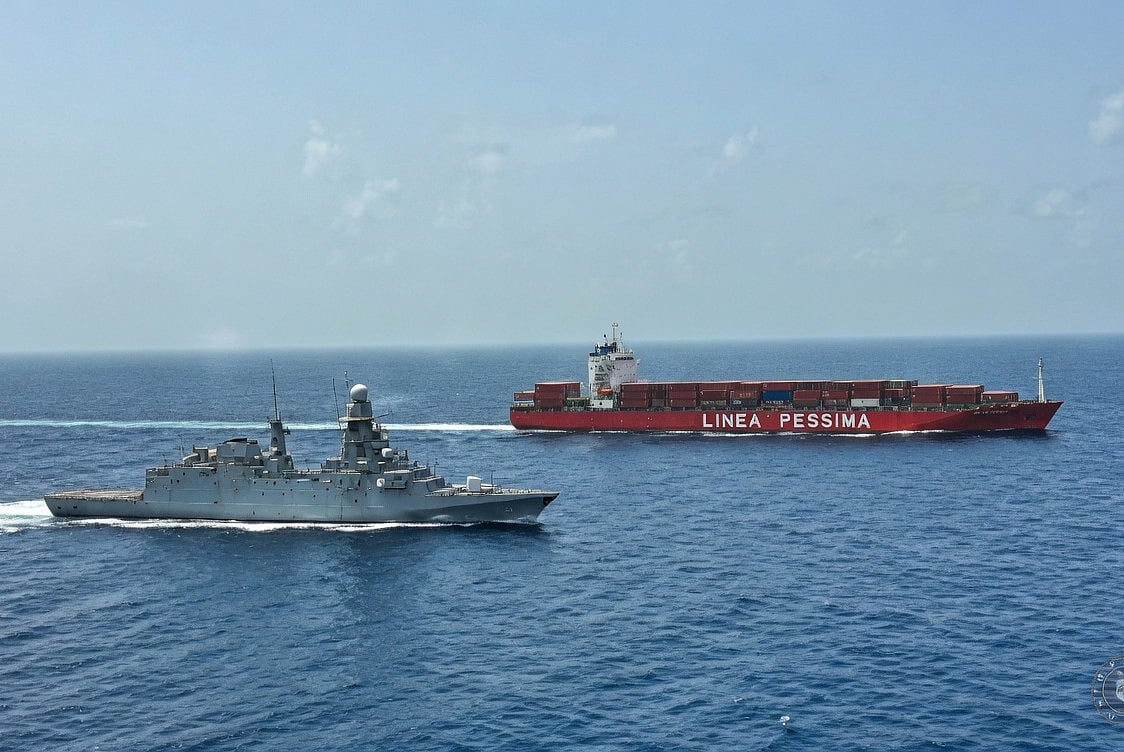
The US kicked off “Project Freedom” to escort commercial ships stuck in the Gulf through Hormuz Strait as a "humanitarian" gesture on Monday (May 4, 2026).
Hegseth was speaking alongside US Chairman of the Joint Chiefs of Staff Gen. Dan Caine for a briefing surrounding the launch of "Project Freedom" in the Strait of Hormuz, designed to counter Iranian threats over the strait, which began on Monday, May 4, 2026.
"Iran has the ability to make that deal," Hegseth added.
Project Freedom: 'Defensive' operation
"We’re communicating, both overtly and quietly, to the Iranians to try to allow this defensive operation to happen on behalf of the world,” Hegseth told the US defence press.
On social media, however, Iranian Foreign Minister dismissed “Project Freedom” as “Project Deadlock”.
On Sunday (May 3, 2026), US President Donald Trump ordered US Central Command (CentCom) forces to guide stranded merchant ships through the Strait of Hormuz from May 4.
'Dual blockades'
The initiative aims to restore navigation in the vital oil chokepoint — handling 25% of global sea trade — amid "dual blockades": Iran's February 28 mine-laying and vessel seizures, followed by the US April 13 port blockade.
Iran's Foreign Minister Abbas Araghchi has blamed US "threats" for stalling diplomacy, while critics note Iran's $2 million transit toll is a bargain for $200 million cargoes, explaining scant foreign pleas to Trump.
The Iranians accuse the US side of being desperate for a reason to end the ceasefire and bomb anew. Tehran demands sanctions relief and blockade lifts for access.
US wants Iran to lift IRGC threats to commercial shipping crossing Hormuz, explaining "Project Freedom" offers deterrence and mine-avoidance.
While the latest US move risks escalation, and with Iranian side showing no signs of budging, oil prices eased on Hegseth's statement about the US-Iran communication.
Iranian hardliners dismiss Project Freedom as a "Trojan horse" for invasion, suspecting that Trump seeks to manoeueer warships near Kharg Island — site of prior US strikes — for an amphibious assault, citing three alleged past "backstabs."
Iran's unified command warned on May 3: "Security of the Strait is under our control... any safe passage must be coordinated," threatening attacks on US forces.
CentCom commander Adm. Brad Cooper called it a "defensive mission essential to regional security and the global economy," while upholding the blockade.
Moreover, Hegseth hinted at signs of cracks within the Iranian regime, specificaly between the Republican Guards and Iranian negotiators.
The Pentagon chief said: "There are some actions the IRGC takes sometimes outside the bounds of what, maybe, Iranian negotiators would like, that’s their job to rein that in, and ultimately create conditions for a deal.”
He added: "Iran has the ability to make that deal."
Key statements from US defence leaders:
"Project Freedom” is defensive/temporary: Hegseth stated that Project Freedom is "defensive in nature, focused in scope and temporary in duration, with one mission -- protecting innocent commercial shipping from Iranian aggression".
No Iranian control: Hegseth claimed that despite Iranian assertions, they "do not" control the strait.
"Red, White, and Blue Dome": Hegseth described the US military presence as a "red, white, and blue dome" over the waterway, aimed at protecting international shipping.
Warning to Iran: Hegseth warned that Iran "will face overwhelming firepower" if they attack commercial shipping.
Ceasefire status: Hegseth indicated that the US-Iran ceasefire "is not over," despite Iranian attacks on commercial shipping vessels. The statement drove key crude oil benchmarks down.
Oil prices: Despite the reported escalation in the Gulf on Tuesday, WTI Crude was down 3.51% to 102.7 as of 13.24 pm GMT (May 5), while Brent dropped 2.69% to $111.4 following the statements.
Strait of Hormuz efforts: Regarding the US efforts to open the strait, Hegseth noted on May 5th that the last 24 hours (including May 4th) showed that Iranians "don't control the strait".
What Gen. Caine said: General Caine mentioned that the US military is acting against specific "military objectives" and indicated that Iran seemed to be "grasping at straws”.
These statements were made amidst high tension, with the Iranian regime labeling the US move "Project Deadlock" and a ceasefire violation.
Sign up for the Daily Briefing
Get the latest news and updates straight to your inbox
Network Links
GN StoreAbout Gulf NewsTerms & ConditionsReach by GNSitemapContact usPrivacy PolicyGN FocusHave your sayWork with usAdvertise with usGulf News epaperPrinting Services
Download our app
© Al Nisr Publishing LLC 2026. All rights reserved.