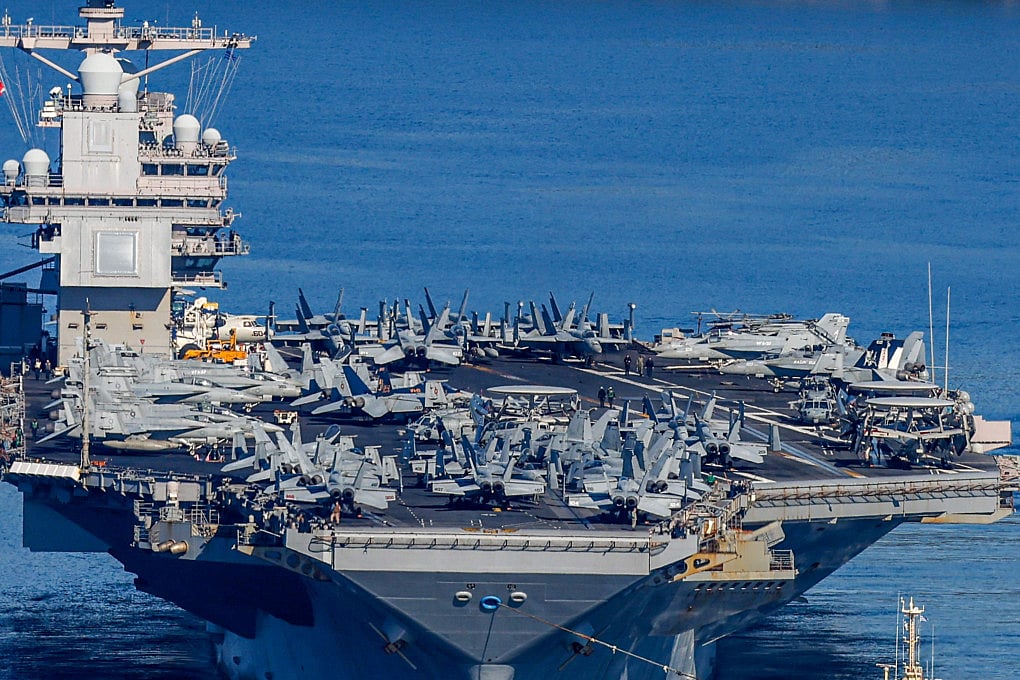
Washington: The Trump administration is actively weighing targeted military strikes on Iran, with potential operations expected to focus on the country’s nuclear and missile infrastructure, The News York Times said.
But even as military planning intensifies, a central question remains unresolved: what, precisely, would such a campaign seek to achieve?
Quoting officials familiar with internal discussions, the report said the strikes under consideration would likely aim to degrade Iran’s nuclear facilities and missile capabilities.
Yet President Donald Trump has not publicly defined the broader strategic objective — either for the American public or for the troops who could be tasked with executing the mission.
In his State of the Union address this week, Trump signaled that Iran must effectively pledge never to acquire a nuclear weapon. However, critics note that Tehran has long maintained that its nuclear program is peaceful, even as its uranium enrichment activities have fueled international scepticism.
While US intelligence assessments indicate that previous American strikes significantly damaged Iran’s key nuclear sites, officials caution against claims of permanent destruction. The facilities, they say, are currently non-operational but not “obliterated,” leaving open the possibility of future reconstruction.
For Israel and US military planners alike, Iran’s missile arsenal represents the most immediate threat. Analysts say destroying missile stockpiles and launch systems could reduce Tehran’s capacity for retaliation against Israeli territory and American bases across the region. But such gains may prove temporary.
“Iran can rebuild,” US defence officials acknowledge privately, noting that Tehran has dispersed parts of its missile infrastructure, complicating any sustained campaign.
Limited strikes could serve symbolic purposes
Beyond physical damage, some administration officials argue that limited strikes could serve symbolic purposes — allowing Trump to claim a decisive show of force while pressuring Iran’s leadership into concessions. Yet skepticism persists within both military and intelligence circles over whether such actions would alter Tehran’s nuclear posture.
Gen. Dan Caine, Chairman of the Joint Chiefs of Staff, has repeatedly warned in Situation Room meetings that even a limited operation carries substantial risks, including potential American casualties and strain on US weapons stockpiles.
“When we initiate contact, we should expect retaliation,” Maj. Gen. Paul D. Eaton, a retired US Army officer, who cautioned that Iran could launch large-scale missile attacks on American bases, told the Times.
Unlike Israel, he noted, US forces in the region lack comparable layered defence systems and hardened bunker networks.
The debate has also exposed deeper tensions over strategy. Critics argue that any military engagement requires clearly defined objectives and congressional authorisation — elements they say are currently absent.
“The president has not explained why now is the moment,” said Representative Jim Himes, warning that military action without a coherent endgame risks repeating past Middle East conflicts.
Two broad options
Inside the administration, discussions have reportedly revolved around two broad options: a limited strike targeting nuclear and missile assets, or a far more expansive campaign designed to cripple Iran’s military capacity and potentially destabilise its leadership structure.
Trump is said to favour the narrower approach, viewing it as a means of forcing negotiations. But military planners caution that the Pentagon’s current force posture may not support a prolonged air campaign, with some officials estimating that sustained operations could be limited to little more than a week.
Complicating calculations further is the threat of Iranian retaliation through proxy networks. Recent intelligence assessments warn that Tehran could mobilise allied armed groups across the region to target US interests if strikes proceed.
Even among hawkish analysts, doubts linger. Joseph Zacks, a former CIA officer, said limited strikes could harden rather than soften Iran’s stance. “Pressure may not produce capitulation,” he warned, adding that Iran’s leadership has historically resisted concessions under military duress.
Despite the uncertainties, Trump’s public messaging remains unequivocal.
“One thing is certain,” the president declared, “I will never allow Iran to have a nuclear weapon.”
For now, diplomacy continues alongside military preparations — a dual-track approach that underscores both the volatility of the standoff and the absence of a clearly defined endgame.

Sign up for the Daily Briefing
Get the latest news and updates straight to your inbox
Network Links
GN StoreDownload our app
© Al Nisr Publishing LLC 2026. All rights reserved.