US, Iran hold fresh talks to avert war amid mounting pressure
The sides showed ‘unprecedented openness’ to new ideas, says Omani minister
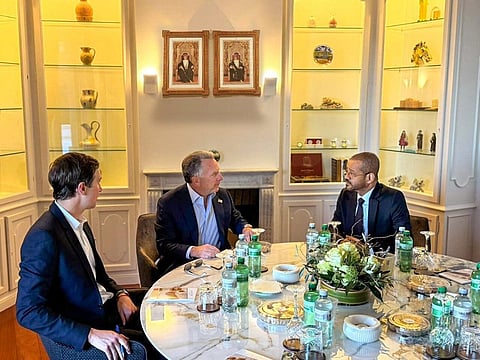
Dubai: Iran and the United States held another round of indirect nuclear talks in Geneva on Thursday, as rising military tensions and a significant American force buildup in the Middle East cast a long shadow over diplomatic efforts.
The Oman-mediated discussions, hosted at the Omani ambassador’s residence under tight security, mark the latest attempt by the two long-time adversaries to defuse tensions over Tehran’s nuclear programme and avoid the prospect of renewed conflict in an already volatile region.
The talks come as Washington continues one of its most substantial military deployments in the Middle East in decades. The United States currently has an aircraft carrier, multiple destroyers and other combat vessels operating across the region, with rare dual-carrier dynamics adding to the pressure on Tehran.
President Donald Trump has repeatedly warned of possible military action if diplomacy fails, recently giving Iran a deadline to reach a deal. While the White House insists it prefers a negotiated settlement, American officials have made clear that all options remain on the table.
Iranian Foreign Minister Abbas Araghchi, who is leading Tehran’s delegation, warned that any US military strike could trigger a broad regional conflict. Iran has consistently stated that American bases across the Middle East would be considered legitimate targets in the event of hostilities.
“There would be no victory for anybody — it would be a devastating war,” Araghchi said ahead of the negotiations, underscoring the risks of escalation.
Opportunity for diplomacy
Despite the heightened rhetoric, both sides have publicly framed the Geneva discussions as an opportunity for diplomacy.
Before the talks were adjourned for three hours, Oman’s Foreign Minister Badr Albusaidi said the delegations demonstrated “unprecedented openness” to new and creative proposals.
Reports from diplomatic sources indicated that Rafael Grossi, Director General of the International Atomic Energy Agency (IAEA), joined the talks, highlighting the centrality of nuclear verification and monitoring issues in the negotiations.
However, significant differences persist. Tehran has maintained that the discussions must remain strictly limited to its nuclear programme, rejecting attempts to broaden the agenda.
The United States, by contrast, has pushed for parallel constraints on Iran’s ballistic missile development and its regional activities.
‘A big, big problem’
Secretary of State Marco Rubio described Iran’s refusal to engage on missile issues as “a big, big problem,” though he reiterated that the administration’s preferred path remains diplomatic.
The negotiations unfold against a backdrop of deep mistrust. A previous diplomatic push collapsed last year when Israel launched surprise strikes on Iran, triggering a 12-day conflict that briefly drew in US forces targeting Iranian nuclear facilities.
American intelligence assessments indicate that while those strikes caused significant damage, Iran’s nuclear infrastructure was not permanently destroyed. Officials say key facilities are currently non-operational but could potentially be rebuilt over time.
Trump, in his State of the Union address this week, accused Iran of pursuing “sinister nuclear ambitions” and developing missile capabilities that threaten Western interests. Tehran dismissed those claims as “big lies,” insisting its nuclear programme is exclusively for civilian purposes.
Meanwhile, regional anxieties remain high. Iran has warned of retaliation not only against US assets but also against Israel, raising fears that any miscalculation could ignite a wider Middle East conflict.
Separately, legal controversy emerged in Switzerland, where lawyers filed a complaint accusing Iranian deputy foreign minister Kazem Gharibabadi of crimes against humanity linked to past protests. The move added another layer of tension to an already delicate diplomatic moment.
For now, diplomacy continues alongside military posturing — a dual-track dynamic that reflects both the urgency of the talks and the fragility of the standoff.
-- With AFP and AP inputs


