F-22s to Israel, carriers deployed: Iran outgunned but still dangerous
US airpower surge signals dominance, but Tehran retains asymmetric retaliation options
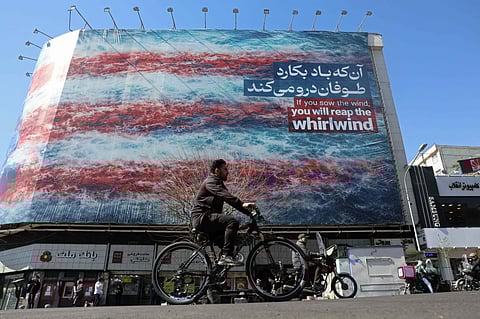
Dubai: As US forces mass across the Middle East, Iran is staring at the threat of major American strikes that could target its leadership, military command structure, nuclear sites and critical infrastructure — a showdown Tehran would almost certainly lose in conventional terms, but one that could still exact a painful cost on US forces, allies and global markets.
AP reported that Iran is more vulnerable than it was a year ago, after a 12-day war with Israel last June and fresh waves of anti-government protests that exposed internal strains.
Yet even after suffering major losses, Tehran retains “lingering capabilities” that could make any conflict messy, region-wide and economically disruptive.
Iran’s longer-range missile forces took a heavy hit during last year’s fighting, along with elements of its military leadership and parts of its nuclear programme.
The United States also struck Iran’s main nuclear sites during the conflict, with President Donald Trump declaring at the time that they had been “obliterated.” But the extent of the damage — and how much Iran has rebuilt — remains unclear.
What is clearer, analysts say, is that Iran’s shorter-range missile arsenal was not the primary target set in those strikes.
Danny Citrinowicz, an Iran expert at Israel’s Institute for National Security Studies, told the AP that much of Iran’s short-range capability was largely untouched — a reality that could push Tehran to retaliate against US positions in the region if the Islamic Republic believes its survival is on the line.
That matters because tens of thousands of American personnel are stationed across a wide arc — including in Qatar, Saudi Arabia, Jordan and elsewhere — and many facilities fall within range of Iran’s shorter-range missiles.
US assets
Iran also still has hundreds of missiles capable of hitting Israel, according to Israeli estimates cited by the AP, even if its longer-range stockpiles suffered.
Iran has demonstrated before that it can strike US assets directly while calibrating escalation. After the 2020 killing of its top general, Tehran launched missiles at a US base in Iraq. And near the end of last year’s war,
it targeted a US base in Qatar. Those attacks appeared to be telegraphed in advance and caused damage but no fatalities, as missile defenses and warning systems were activated. The precedent underscores a key point: Iran may not be looking for a full-scale war, but it can still impose costs and create political pressure.
The AP also noted that Iran has been accused of using criminal gangs and armed groups to plan or carry out attacks beyond the region, including against dissidents, Israelis and Jewish targets — an element of hybrid warfare that complicates the risk picture for US and allied security services.
Internally, Iran also has reason to tighten security and plan for contingencies. Last year’s Israeli strikes killed senior commanders and nuclear scientists, exposing vulnerabilities. At one point during the crisis, Trump said the US knew where Supreme Leader Ayatollah Ali Khamenei was hiding, calling him an “easy target.”
Iranian officials have warned that American strikes could spark a wider regional war; Iran’s UN ambassador Amir Saeid Iravani said “all bases, facilities and assets of the hostile force in the region” would be legitimate targets if conflict erupts, according to the AP account.
Beyond military retaliation, the most immediate global pressure point remains energy. Around one-fifth of the world’s traded oil passes through the Strait of Hormuz, just off Iran’s coast. Iran has long threatened to close the waterway in wartime scenarios, and the AP reported Tehran claimed it partially shut the strait during military drills last week — a signal, analysts say, that it could attempt to disrupt shipping if it feels cornered.
Talks to avert war
Even short-lived attacks or harassment could spike oil prices and rattle markets, as the far weaker Houthis managed to disrupt trade routes in the Red Sea for much of the past two years.
US allies in the Gulf are anxious about being dragged into open conflict. Arab Gulf states have relied on Washington for defence while seeking to avoid becoming a battlefield.
An Arab Gulf diplomat cited by the AP said regional leaders were talking to Tehran and Washington to avert war, warning of severe consequences including a surge in oil prices.
Even as diplomacy continues — with another round of indirect talks set for Geneva — Washington’s military posture has sharpened.
CNN reported that the Wall Street Journal said the US has sent F-22 fighter jets to Israel for the first time for a potential wartime mission, describing the move as a deeper level of US-Israeli military coordination amid tensions with Tehran.
Military options
The deployment would bolster defence of Israeli territory and help protect American forces from potential Iranian retaliation, according to the report cited by CNN.
Behind the scenes, CNN reported that Chairman of the Joint Chiefs Gen. Dan Caine has been drafting military options for potential strikes on Iran and has quietly convened senior uniformed leaders in unusually discreet settings — avoiding the Pentagon’s highly visible “Tank” conference room out of concern that assembling the top brass on short notice could draw attention in an administration focused on preventing leaks.
In those meetings, Caine has warned about the potential downsides of a major operation, raising concerns about scale, complexity and the risk of US casualties, according to sources familiar with his advice.
Those internal cautions have not always matched White House rhetoric. CNN reported that Trump has been bullish publicly about how easily the US could prevail, while military planners have pressed to define what “success” would look like — especially if options broaden from strikes on missile and nuclear facilities to ambitions that include regime-change scenarios.
Caine could not predict the outcome
In a Situation Room meeting last week that ran far longer than scheduled, CNN reported, Caine could not predict the outcome of a regime-change operation, underscoring uncertainty about how Iran’s power structure might adapt under extreme pressure.
Experts cited by the AP say even the death of Khamenei would not necessarily end the Islamic Republic; power could shift to a committee, to a successor from the inner circle, or to the Revolutionary Guard, at least until hostilities subside.
The result is a familiar Middle East equation at a higher temperature: Iran is outgunned, but not toothless; the US has overwhelming force, but not guaranteed control over escalation.
With missiles, proxies and chokepoints in play — and with diplomacy running alongside war planning — both sides are signaling resolve. The danger is that one signal is misread, and the region pays the price.


