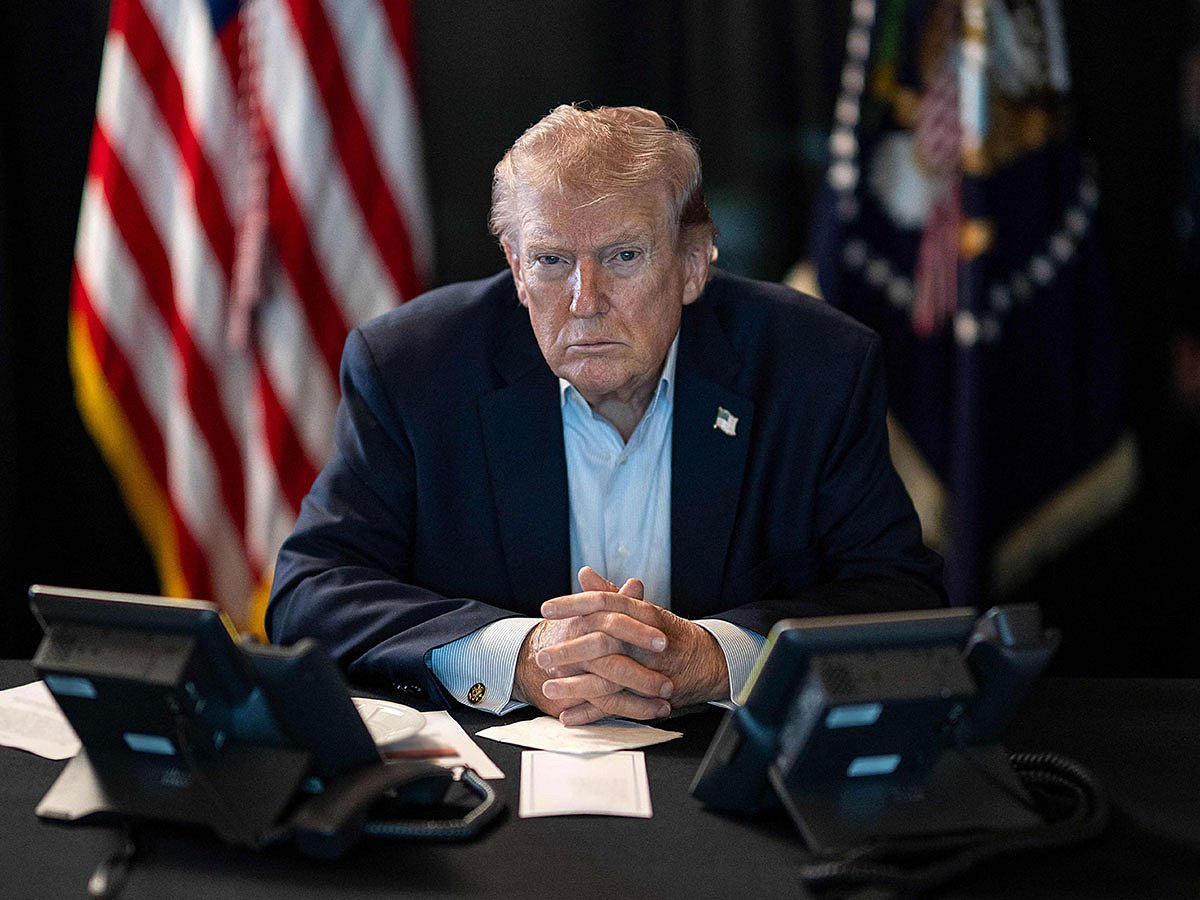
US President Donald Trump has issued a statement from the White House outlining four clear objectives for the ongoing US military operation against Iran on Monday (March 2, 2026).
It was Trump's first public statement since the launch of "Operation Epic Fury" on Saturday.
This operation, launched in partnership with Israel, represents a significant escalation in US-Iran conflict, following years of tensions over Iran's nuclear ambitions, missile development, naval activities, and support for proxy militias.
The strikes aim to neutralise immediate threats while preventing future risks to US interests and allies.
According to the White House, the campaign was initiated after Iran ignored warnings not to rebuild its nuclear program post-2025 strikes.
Critics argue the justifications have shifted, with some viewing it as preemptive aggression amid opaque intelligence, the US CNBC reported.
The operation has already resulted in significant Iranian losses, including the death of its supreme leader, and US casualties.
Below, each objective is explained in detail, drawing on analyses from diverse sources:
Objective #1: Destroying Iran's missile capabilities
The primary goal is to dismantle Iran's ballistic missile arsenal and production infrastructure, which Trump described as a "colossal threat" capable of targeting US bases overseas and potentially reaching American soil soon, as per Politico.
Iran's missile programme, one of the largest in the Middle East, includes short- and medium-range ballistic missiles like the Shahab-3, with ranges up to 2,000 km, posing risks to Europe and US forces in the region, reports NPR.
US strikes have targeted launch sites, storage facilities, and manufacturing plants, with reports indicating hourly degradation of these assets.
Proponents, including White House officials, argue this prevents Iran from shielding nuclear development behind missile defences, echoing past US efforts like the 2019 drone strikes on Iranian facilities.
However, such actions may escalate regional instability, as Iran's programme is seen by Tehran as a deterrent against invasion, and rapid rebuilding could follow without broader diplomatic resolutions.
CNN reports that Secretary of State Marco Rubio emphasised eliminating short-range ballistic missiles to protect naval assets, highlighting the operation's focus on immediate tactical threats.
This objective aligns with long-standing US policy under Trump to curb Iran's conventional military growth, as detailed in fact sheets from earlier in 2026, cites the New York Times.
Objective #2: Knocking off Iran's navy
The second aim targets the Islamic Republic of Iran Navy (IRIN) and the Islamic Revolutionary Guard Corps Navy (IRGCN), seeking to neutralise threats to international shipping and US naval forces in the Arabian Gulf and the Strait of Hormuz.
Trump stated that US forces are "annihilating" Iranian naval capabilities, with reports confirming at least 10 ships sunk in initial strikes.
Iran's navy, comprising frigates, submarines, and fast-attack boats, has historically harassed vessels in the Strait of Hormuz, a chokepoint for global oil trade, as NPR reported.
The operation involves airstrikes and naval engagements to degrade these assets, preventing disruptions like the 2019 tanker attacks attributed to Iran. Trump also blamed Iran for the attack on USS Cole.
Defence Secretary Pete Hegseth described this as essential to "destroy the navy" without prolonged conflict or nation-building.
From a critical viewpoint, The Guardian reports that this could prolong the war, as Iran might respond asymmetrically through proxies like Hezbollah, Houthis and its allies in Iraq, potentially drawing in more US resources.
Al Jazeera highlights Trump's projection of a 4-5 week timeline, but warns of extensions if naval resistance persists, noting Iran's use of swarm tactics.
This objective builds on prior US actions, such as the 2020 killing of General Soleimani, aimed at curbing IRGC influence.
Objective #3: Ensuring Iran can never obtain a nuclear weapon
This objective focuses on permanently halting Iran's nuclear program, labelled by Trump as the "world's number one sponsor of terror" acquiring forbidden weapons.
Following the US withdrawal from the JCPOA in 2018 and strikes in 2025 that reportedly obliterated key sites, the current operation targets any rebuilding efforts, including underground facilities.
Iran has enriched uranium to near-weapons-grade levels, prompting fears of breakout capability "within months", according to Al Jazeera.
US and Israeli intelligence claim preemptive action was necessary to avert an "imminent threat," though some sources including the New York Times question the immediacy,
NPR notes Trump's emphasis on preventing long-term development, rejecting regime change but insisting on "no nukes."
Conversely, European Council on Foreign Relations analyses suggest such strikes could accelerate clandestine programmes, as seen in Iraq's post-1981 Osirak bombing, CNBC reported. Other US media outlets stated that ongoing strikes to ensure compliance, with Rubio briefing Congress on the nuclear focus.
Objective #4: Ensuring the Iranian regime cannot arm, fund, and direct terrorist armies outside their borders
Trump's final goal is to sever Iran's support for proxy groups like Hezbollah, Hamas, the Houthis, and Shia militias in Iraq and Syria, which he calls "terrorist armies."
This involves targeting financial networks, arms supply lines, and command structures to cripple Tehran's regional influence, according to the White House.
Iran annually funnels billions of dollars to these groups, enabling attacks on US allies and interests, such as the 2023-2024 Gaza conflicts, according to NPR.
Strikes have hit IRGC bases and logistics hubs, aiming to degrade proxy capabilities without direct invasions. ABC News clarifies that this includes destroying ballistic missile stocks used by proxies.
Critics in Politico argue this could backfire, unifying anti-US forces and extending the conflict.
Trump has not ruled out ground troops, while initially focusing on containment to prevent further terrorism funding.
This objective echoes Trump's earlier sanctions and Soleimani strike, viewed by supporters as restoring US deterrence.
Takeaways
All told, these objectives frame a limited but intense campaign projected to last 4-5 weeks, though "extensions" are possible, as Trump stated.
While US official statements emphasise these limited objectives and defensive necessity, international perspectives warn of humanitarian and geopolitical costs.
Sign up for the Daily Briefing
Get the latest news and updates straight to your inbox
Network Links
GN StoreDownload our app
© Al Nisr Publishing LLC 2026. All rights reserved.