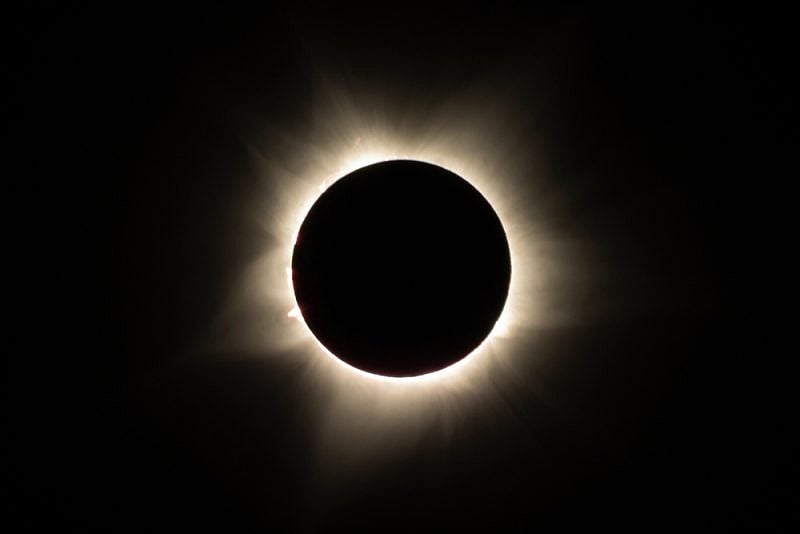
Dubai: Millions of skywatchers are expected to turn their eyes to the heavens on August 12, 2026, when one of the year's most significant astronomical events unfolds: a rare total solar eclipse.
While the path of totality will bypass the Arab world, parts of North Africa, particularly the Maghreb, are set to witness an unusually deep partial eclipse, with as much as 96 per cent of the Sun's disc obscured in some areas.
Get updated faster and for FREE: Download the Gulf News app now - simply click here.
The eclipse's path of totality will sweep across Greenland, Iceland, Spain, parts of the North Atlantic and northern Russia, where observers will experience the Moon completely covering the Sun, briefly revealing the Sun's outer atmosphere, or corona, in one of nature's most striking spectacles.
No Arab country lies within the path of totality. However, Algeria is expected to enjoy the region's best view, with the eclipse covering up to 96 per cent of the Sun in parts of the country.
Morocco is forecast to see up to 88 per cent coverage in Rabat, while Tunisia is expected to experience around 50 per cent, and Mauritania about 46 per cent, with visibility varying according to location and proximity to the Moon's shadow.
The phenomenon will be far less noticeable elsewhere in the Arab world. Egypt, Iraq, the Gulf states and the Levant, including Jordan, Syria, Lebanon and Palestine, lie outside the eclipse zone and are not expected to witness the event in any significant form. Libya is also outside the observable area.
A solar eclipse occurs when the Moon passes directly between the Earth and the Sun, blocking sunlight from reaching part of the Earth's surface.
During a total eclipse, the Moon completely obscures the Sun along a narrow corridor known as the path of totality, while surrounding regions experience a partial eclipse of varying intensity.
The total phase also allows the normally hidden solar corona to become visible, a phenomenon impossible to observe under ordinary daylight conditions.
Astronomers expect the August 12, 2026 eclipse to attract millions of observers worldwide, with travellers, photographers and astronomy enthusiasts expected to gather along the path of totality, while those in parts of North Africa prepare to witness one of the deepest partial solar eclipses visible from the Arab world in recent years.
Network Links
GN StoreDownload our app
© Al Nisr Publishing LLC 2026. All rights reserved.