Iran threatens 'faster, more intense' response to US attacks
The latest round of clashes comes amid a six-month deadlock in the US-Iran war
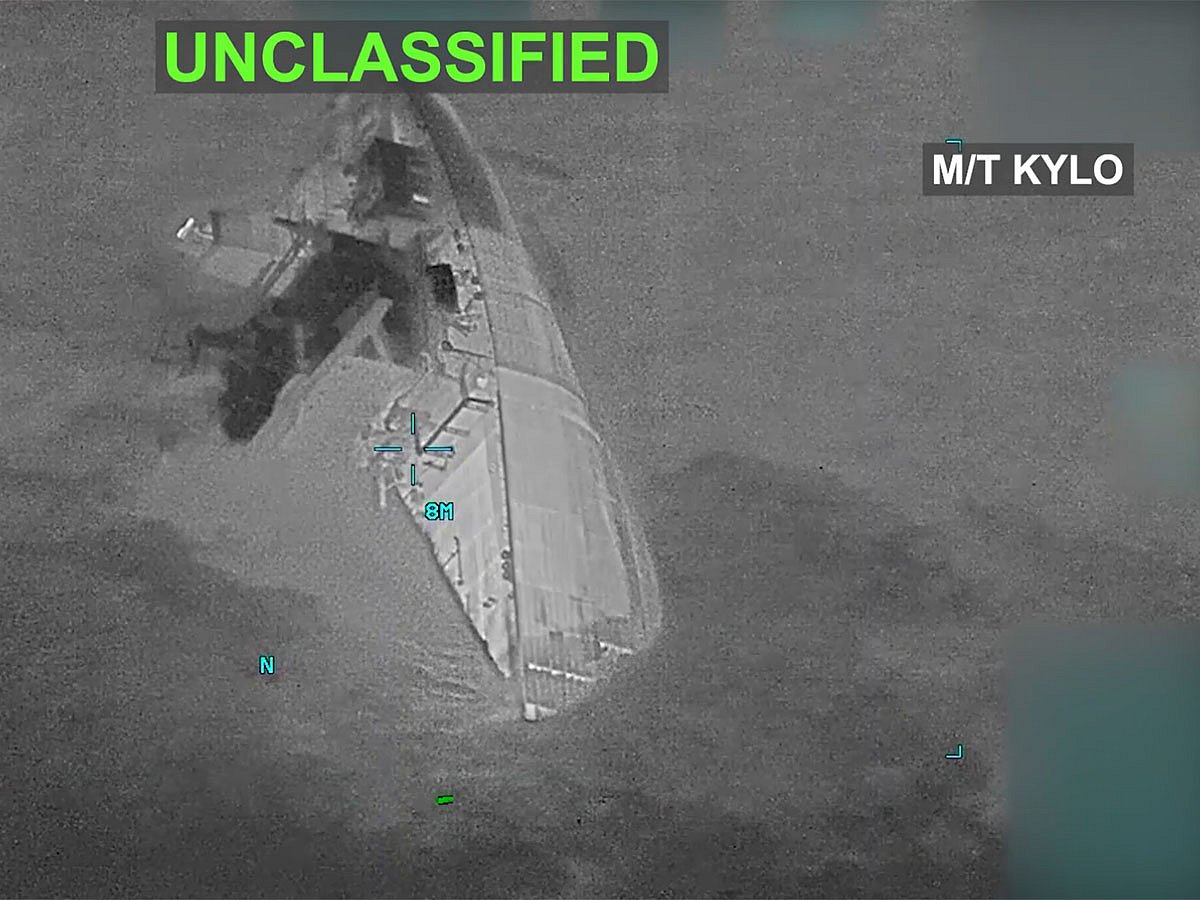
The United States said it destroyed three Iranian oil tankers on Saturday in response to attempted missile attacks on naval vessels, with Iran's Revolutionary Guards saying they targeted US-linked ships in response. The latest round of clashes, which began with US raids last week, comes amid a deadlock in the six-month war. Iran has maintained its stranglehold on the strategic Strait of Hormuz as Washington continues pressing its counter-blockade of Iranian ports. In addition to the renewed military action, Washington is also seeking to choke Iran's economy, announcing sanctions on entities with financial links to the Islamic republic in a bid to force it into submission. Follow all the latest developments here:
Day 180: Trump warns of more strikes on Tehran
At least 11 people were killed and seven others wounded as a fuel tanker exploded in a traffic accident in western Iran on Saturday, state-run IRIB news agency reported.
The incident occurred on an intercity road between Sanandaj County in Kurdestan province and Hamedan County in Hamedan province, the IRIB cited Babak Hodaei, head of the emergency medical services of Kurdestan University of Medical Sciences, as saying.
The incident caused several nearby vehicles to catch fire, Hodaei said, adding that rescue teams have transferred the wounded to a hospital in Sanandaj, reports Xinhua news agency.
Rescue operations are continuing at the scene, he said.
US Central Command (CENTCOM) said the M/T Kylo sank in the Gulf of Oman, crediting American service members for what it described as a precision operation.
In a post on X, CENTCOM said the tanker had “joined Iran’s navy at the bottom of the sea”.
CENTCOM also shared video footage showing a tanker engulfed in flames before sinking.
US President Donald Trump is working on what he has privately described as “something much bigger” for the Middle East after the Iran war — an ambitious strategy that could reshape Washington’s approach to the region by building a new alignment against Tehran and deepening ties between Israel and its neighbours.
The plan, according to Axios, is still being drafted and has been discussed by Trump in two meetings with senior advisers in recent weeks.
Read more here.
Iran's Revolutionary Guards said on Sunday that they had attacked a US naval drone that was trying to enter the Strait of Hormuz, hours after Tehran and Washington traded strikes.
"The heroic Naval Forces of the Islamic Revolutionary Guard Corps attacked an American military unmanned surface vessel (remotely operated vessel) that was attempting to enter the protected area of the Strait of Hormuz," the Guards said in a statement carried by Iranian state television IRIB.
The Israeli military said Hezbollah launched two drones towards IDF soldiers operating in the security zone in southern Lebanon.
The IDF said its troops opened fire and shot down one of the drones. No injuries were reported among Israeli soldiers, it said.
The military added that it was carrying out strikes in southern Lebanon in response to the incident.
Crude oil exports from the Middle East in August were 39 per cent below the January-February baseline of 18.5 million barrels per day (bpd), according to TankerTrackers.
In a post on X, the tanker tracking service said exports hit their lowest point in May, when they were down 67 per cent from the baseline.
The current shortfall stands at around 7.2 million bpd, an improvement from the 12.4 million bpd deficit recorded previously.
Thousands of US sailors aboard an aircraft carrier departed from Thailand on Sunday, AFP journalists said, concluding its first port call following reports of deteriorating living conditions on board after nine months at sea.
The 5,000-strong crew of the USS Abraham Lincoln docked just north of the resort town of Pattaya, near Bangkok, on Wednesday for five days of rest and recreation after a lengthy Middle East deployment.
Amid Thailand's tourism low season, their arrival raised hopes for businesses in Pattaya, a city known for its beaches and nightlife.
The Lincoln departed from the port of Laem Chabang, a half-hour drive from Pattaya, at around 11am (0400 GMT), AFP journalists saw.
Security was stepped up in Pattaya during the visit, with authorities cracking down on sex workers ahead of the sailors' arrival - although the mayor denied it was linked.
UAE travellers are facing a mixed picture on Sunday, with Emirates, Etihad and flydubai operating key regional services while delays and cancellations continue across Dubai and Abu Dhabi airports.
Air Arabia has cancelled several Kuwait and Bahrain flights, while a number of international airlines continue to suspend UAE services amid the evolving security situation.
Air France has also suspended flights to and from Dubai through September 8, while disruptions are also being reported on some routes because of operational issues and volcanic activity in Indonesia.
Iranian authorities have arrested a number of people accused of appearing in a rare video waving the flag of an outlawed opposition group, state television said Sunday.
Videos circulating online in recent days showed individuals riding motorbikes on empty streets in Iran while waving the white-and-red banner of the banned People's Mujahedin Organisation of Iran (MEK).
On Sunday, state television said authorities had identified and arrested "all the individuals who appeared in this clip" and that they were "associated" with MEK, without specifying how many.
It said the motorcade had been travelling near the city of Karaj, west of Tehran, but it was not clear when the footage was recorded.
Founded in the 1960s in opposition to Iran's then Western-backed shah, the MEK was outlawed after the 1979 Islamic revolution and later fought alongside Saddam Hussein's forces during the Iran-Iraq war.
The group has for decades advocated regime change in Iran from abroad, while Tehran has accused its members of cooperating with its arch-enemy, Israel.
Iran has been at war with the United States since February 28, when US-Israeli strikes killed the Islamic republic's supreme leader Ayatollah Ali Khamenei along with senior military officials.
Iran retaliated with attacks across the region as the conflict spread.
Lebanon's health ministry said Israeli strikes on Sunday killed four people in the south, while Israel said it carried out raids after Hezbollah launched drones at its soldiers.
The ministry reported two people killed in south Lebanon's Nabatieh al-Fawqa and two women killed in Arab Salim nearby. Twenty people were also wounded in several locations, including women and three children.
Read more here.
Get updated faster and for FREE: Download the Gulf News app now - simply click here.
Iran's top negotiator Mohammad Bagher Ghalibaf threatened on Sunday to launch swifter and more forceful responses to US attacks, after Tehran targeted American warships in retaliation for US attacks on tankers.
"The Americans must have understood that the era of proportionate responses has come to an end," said Ghalibaf in a speech carried by state media, adding that "any aggression against Iran's interests and security will receive a faster, more intense and more painful response".
Lebanese President Joseph Aoun urged Washington and the international community to help stop Israeli attacks after strikes on Sunday killed at least four people despite a truce and an Israel-Lebanon deal.
The strikes, which also damaged government premises and destroyed an out-of-service hospital, were "a dangerous escalation... reaching Lebanese state institutions" and health facilities, Aoun said in a statement, calling on the US and other countries "to urgently act to stop these violations".
A US Air Force F-35A stealth fighter jet patrols over regional waters as CENTCOM forces continue to enforce the maritime blockade against Iran. As of Sept. 6, U.S. forces have redirected 92 commercial vessels, disabled three and boarded two to ensure strict compliance.
The Islamic Revolution Guard Corps (IRGC) released footage for the first time showing the monitoring and action against violating vessels in the Strait of Hormuz, stressing decisive management against any suspicious activity in the region.
The footage initially featured short clips of US President Donald Trump, US Secretary of War Pete Hegseth, and Commander of US Central Command (CENTCOM), Admiral Brad Cooper respectively claiming the strategic waterway to be “open”, alleging Washington’s “control” over the route, and the American military’s having cleared the mines that have been planted to prevent illegal passage through the chokepoint.Afterwards, it showed the IRGC Navy conducting close surveillance of and surgically engaging non-compliant vessels on several occasions.
Iran's top negotiator on Sunday threatened a more forceful response to any further US attacks after Tehran targeted American warships in their latest round of clashes.
The exchanges of fire, which began with US raids last week, come amid a deadlock in the six-month war between the two sides.
Iran has maintained its stranglehold on the strategic Strait of Hormuz while Washington continues a counter-blockade of Iranian ports.
Washington is also seeking to choke Iran's economy, rolling out sanctions on entities with financial links to the Islamic republic in a bid to force it into submission.
Fighting between Yemeni government forces and Iran-backed Houthi rebels in southwest Yemen killed more than 140 combatants between midday Saturday and early Sunday morning, military sources said.
Two military officials with the Saudi-backed government forces told AFP that 84 of their troops were killed, mostly in missile attacks, while four Houthi military sources said 57 rebel fighters were killed in the same period.
Get updated faster and for FREE: Download the Gulf News app now - simply click here.
OPEC+ kept its oil output policy unchanged for October at a meeting on Sunday, it said in a statement, as the producer group needs to agree new quotas before deciding its next output steps, Reuters has reported.
The meeting of seven core OPEC+ members — Saudi Arabia, Russia, Iraq, Kuwait, Algeria, Kazakhstan and Oman — comes as the Iran war continues to disrupt oil exports through the Strait of Hormuz, limiting OPEC+'s influence over prices and market share.
The United States’ military conflict with Iran could continue for another six months without a resolution and risks becoming another prolonged Middle East war, former US Defence Secretary Leon Panetta has warned.
Panetta said Washington and Tehran were locked in a stalemate, with neither side appearing willing to negotiate, surrender or risk an even broader confrontation.
“I think the likelihood is this war is going to continue for another six months without being resolved,” Panetta told The Guardian in an interview published on Sunday.
An Israeli strike in southern Lebanon killed three people on Sunday, the Lebanese health ministry said, bringing the day's death toll to seven despite a fragile ceasefire between the two countries.
The drone strike hit a parking lot in a town near Nabatieh, the ministry said in a statement. State media earlier reported a lower death toll of two people killed in a strike on a car.
Three vessels, including two oil tankers and a Liquefied Natural Gas (LNG) carrier, changed course and turned back while seeking to transit the Strait of Hormuz via a southern route after receiving warnings from the navy of Iran's Islamic Revolutionary Guard Corps (IRGC), media reported on Sunday.
Citing the latest maritime tracking data, the semi-official Fars news agency identified the vessels as Marshall Islands-flagged oil tanker Velos Amber, Liberian-flagged oil tanker Bravo and Marshall Islands-flagged LNG tanker Al Sheehaniya, which belongs to Qatar.
It added that the IRGC's Navy had warned the three tankers that the southern route in the strait was closed.
The development comes amid a series of naval confrontations between Iran and the United States, Xinhua News Agency reported.
Israel's Prime Minister Benjamin Netanyahu has ordered the evacuation of some settlements in the occupied West Bank deemed illegal under Israeli law, Finance Minister Bezalel Smotrich said Sunday.
"To my knowledge, Netanyahu has given the instruction to evacuate" certain settlements, Smotrich said, adding that he did not approve of the measure.
While all Israeli settlements in the West Bank are considered illegal under international law, some established without government approval -- often consisting of just a few prefabricated homes -- are also considered illegal by Israel.
Iran's top security chief Mohsen Rezaei on Sunday said his country would establish a "prohibited zone" near the strategic Strait of Hormuz, state media reported.
"In the coming days, a prohibited zone will be announced outside the Strait of Hormuz. This zone will start from the US Navy's blockade line and include areas of the [Arabian] Gulf. Any ship entering this new zone will be placed on the sanctions list" of Iran, Rezaei told the state TV.
Iranian authorities on Sunday announced they were raising the price of petrol for heavier consumers, as the United States steps up sanctions seeking to isolate the country's economy.
Iran's quota system prices petrol in three tiers -- 1,500 tomans per litre for a consumer's first 60 litres in a given month, 3,000 tomans per litre for their next 50, and 5,000 tomans per litre after that. The toman is an informal unit equivalent to 10 Iranian rials.
On Sunday, government spokeswoman Fatemeh Mohajerani said the price for the third tier would double to 10,000 tomans (about 4.5 US cents).
"The rate will increase to 10,000 toman rials from the morning of September 8," Mohajerani said in remarks carried by state media.
Iran's expansion of its "restricted zone", announced by top security chief Mohsen Rezaei, follows an earlier Iranian campaign against vessels Tehran says have violated its navigation rules.
Iran has expanded its blacklist by 11 vessels, bringing the total to 56. The vessels include crude-oil tankers, LNG and LPG carriers and clean-product ships. Iran has also warned that vessels cooperating with blacklisted ships — including through ship-to-ship transfers — could face sanctions.
Meanwhile, the US blockade is also becoming more aggressive, as Central Command forces struck three Iranian oil tankers, according to US military officials.
The latest escalation marks a significant shift from economic pressure into direct confrontation over the movement of Iranian oil. The US says its naval presence is intended to enforce the blockade and protect maritime security. Washington has also argued that the Strait of Hormuz is a vital international waterway rather than an Iranian-controlled passage.
Oil prices were mixed early on Monday (September 7), with global benchmark Brent crude holding near $97 a barrel as markets continued to assess the impact of the U.S.-Iran conflict and disruptions around the Strait of Hormuz. As of 8:28 am Tokyo time on Sept. 7, the market snapshot showed: Brent crude up 0.43% to $96.69 , WTI Crude up 0.60% to $92.03, and Murban crude at $103.30, down -1.36%. Natural gas was down 1.5% to $2.929.
The Strait of Hormuz remains at the centre of the oil market's risk calculation. The waterway normally handles a huge share of global oil shipments, but tanker traffic has been severely disrupted amid the conflict.
Brent had already climbed above $96 last week after the latest escalation, while traders weighed the possibility of prolonged disruptions through Hormuz, as the market remained volatile. The premium could widen further if shipping restrictions become more severe or if attacks damage additional energy infrastructure.
President Donald Trump wants US oil companies to produce more gasoline and bring down prices at the pump. But the refiners he is pressing face a problem they cannot easily solve: there is little spare refining capacity to unlock, and building a new refinery would take years and billions of dollars.
Trump has few immediate options as gasoline prices remain elevated and the war between the US and Iran continues to disrupt oil and fuel supplies around the world.
Trump met this week with executives from major oil and refining companies, including Chevron, Marathon Petroleum, Valero Energy and PBF Energy, urging them to increase refining capacity and boost fuel supplies.
But US refineries are already operating at exceptionally high rates. The bigger obstacle may be even harder to overcome: the price of crude oil itself, with WTI crude trading around $92 a barrel Monday, while global benchmark Brent was near $97.
We are closing this live coverage. For the latest developments, click here.
Sign up for the Daily Briefing
Get the latest news and updates straight to your inbox
Network Links
GN StoreDownload our app
© Al Nisr Publishing LLC 2026. All rights reserved.