Trump is working on ‘much bigger’ Middle East plan. Here’s what he is plotting
Emerging US strategy could reshape regional alliances and Washington’s approach to Iran
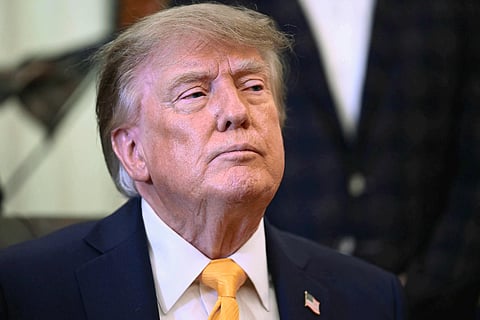
Dubai: US President Donald Trump is working on what he has privately described as “something much bigger” for the Middle East after the Iran war — an ambitious strategy that could reshape Washington’s approach to the region by building a new alignment against Tehran and deepening ties between Israel and its neighbours.
The plan, according to Axios, is still being drafted and has been discussed by Trump in two meetings with senior advisers in recent weeks.
Two US officials and two other people familiar with the discussions told Axios that the emerging strategy is intended to guide American policy in the Middle East after the Iran war ends and through the final two years of Trump’s term.
But there is a striking contradiction at its heart: Washington is already planning for the Middle East after the war even as the six-month conflict with Iran remains unresolved and its endgame uncertain.
Three pieces of the plan
The emerging strategy has three broad elements.
The first is to bring US allies in the region into closer alignment to contain Iran, with Washington potentially acting as a security guarantor.
The second is an attempt to wind down several conflicts and tensions that followed the October 7, 2023 attacks.
That could involve advancing the next phase of Trump’s Gaza plan, negotiating a security arrangement between Israel and Syria and implementing the existing Israel-Lebanon agreement.
The third — and potentially most ambitious — is expanding the Abraham Accords and securing a normalisation agreement between Saudi Arabia and Israel.
Such an agreement would represent a major diplomatic prize for Trump and could become the centrepiece of his attempt to build a new regional order after the Iran conflict.
Why Saudi Arabia matters
Saudi-Israel normalisation has long been viewed as potentially transformative because it could redraw political relationships across the Middle East.
But it would also be one of the hardest parts of Trump’s emerging strategy to achieve.
Riyadh has tied normalisation to progress towards Palestinian statehood, while Israeli opposition to such a pathway remains a formidable obstacle.
The wider challenge is whether Washington can bring countries with differing interests and relationships with Tehran into the kind of regional alignment envisaged by the administration.
A source briefed on the discussions told Axios that it remained unclear whether all US allies would ultimately support the plan.
Iran remains at the centre
Despite the broader diplomatic ambitions, Iran appears to remain the organising principle of the strategy.
The proposed regional alignment would seek to contain Tehran after a war that has already weakened parts of its military capability and put its economy under intense pressure.
Yet Iran has continued to demonstrate that it can impose costs.
The Strait of Hormuz remains a major point of confrontation, with Washington trying to restore commercial shipping while Tehran seeks to retain leverage over one of the world’s most important energy routes.
Trump’s administration has shifted repeatedly between military pressure, negotiations and economic warfare during the six-month conflict, leaving the path to a permanent settlement uncertain.
That raises a fundamental question over the emerging post-war strategy: What happens if there is no clear end to the war?
Israel election could complicate plan
Politics could also determine how quickly Trump can move.
Israel holds elections on October 27, while US midterm elections follow in November.
The Trump administration hopes that the Israeli government emerging from the election will be willing and able to cooperate with Washington’s regional strategy, according to Axios.
But US officials involved in the discussions say Trump could press ahead regardless of the Israeli result — even if it produces another political stalemate.
A plan still taking shape
For now, the strategy remains more ambition than blueprint.
Officials are working on it both at the senior political level and across US government agencies, and a source familiar with the process said it could take several more weeks before the proposal is ready.
The underlying ambition, however, is already clear: Rather than treating Iran, Gaza, Syria, Lebanon and Arab-Israeli normalisation as separate problems, Washington is considering whether they can be brought together as pieces of a single regional strategy.
Whether those pieces can actually be made to fit is another matter.
Trump may already be looking beyond the Iran war. But before Washington can build a new Middle East order, it still has to find a way out of the war it is fighting now.


