Former Iranian presidents Mohammad Khatami (left) and Hassan Rouhani.
Iran rocked by explosions as Trump says US-Iran war won't end until after midterm elections
Iranian state media reported blasts in Qeshm Island, Sirik and Minab
Last updated:
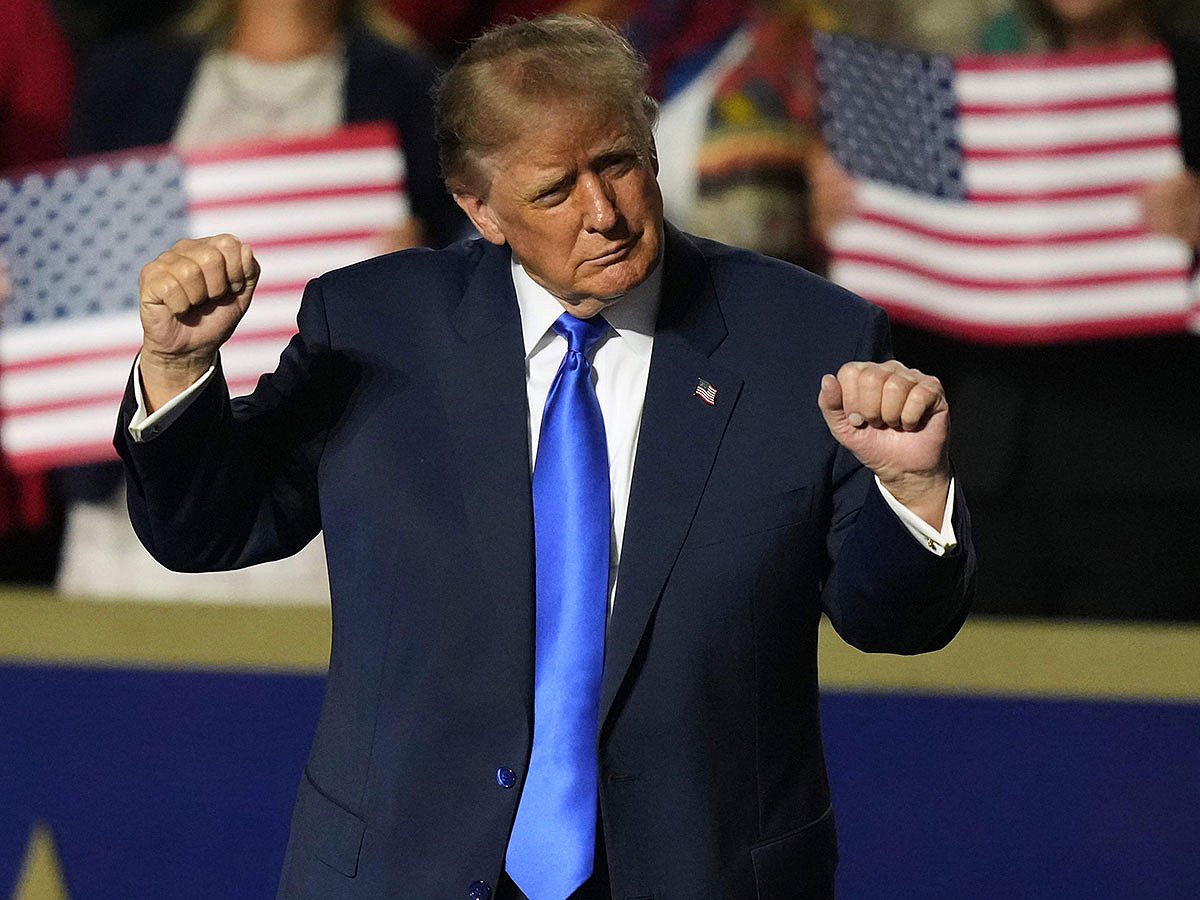
Trump said oil prices, which have surged amid the conflict, are unlikely to ease before the midterms
AP
Multiple explosions were reported across Iran’s coastal regions and near a Saudi military base, as US President Donald Trump said the war with Iran could drag on until after the US midterm elections. Iranian state media reported blasts in Qeshm Island, Sirik and Minab in Hormozgan province, while explosions were also reported near King Fahd Air Base and in Taif, Saudi Arabia. Authorities in Hormozgan said sounds heard over Qeshm appeared to have originated from the sea. Trump said oil prices, which have surged amid the conflict, are unlikely to ease before the midterms, and that the war would end “immediately” once the vote is over. He accused Iran of stalling in hopes of a shift in Washington. Follow our live blog for the latest developments as the situation unfolds.
US‑Israel war on Iran: Recent developments
CENTCOM shares image of E-3 Sentry refueling over Middle East
US Central Command posted an image showing a US Air Force E-3 Sentry airborne early warning and control aircraft being refueled by a KC-135 Stratotanker over the Middle East. The E-3 is used to coordinate air and ground forces across a wide operational area.
Iran's secretive underground nuclear site showing a surge in construction
Satellite imagery has revealed a significant increase in construction activity at Pickaxe Mountain, a deeply buried Iranian facility near Natanz that has attracted growing attention from US and Israeli intelligence officials.
A new analysis by the Center for Strategic and International Studies (CSIS) examined six years of satellite imagery and found that construction activity in 2026 is higher than at any previous point observed at the site, CNN reported.
The work includes:
reinforcement of underground access points;
paving and expansion of internal roads;
hardening around entrances;
removal of excavated material;
continued work on the underground complex.
CSIS said the imagery cannot confirm an Israeli intelligence claim that Iran moved uranium centrifuges and centrifuge components into the facility.
The analysts also said the site does not currently appear to be operating as an enrichment facility, based on the absence of certain observable activity.
The location is strategically important. Pickaxe Mountain is a heavily buried granite facility close to Iran's Natanz nuclear complex. Its depth and geology could make it extremely difficult to destroy with conventional weapons.
The development comes at an especially sensitive moment. The International Atomic Energy Agency's board on Wednesday voted to report Iran to the UN Security Council over its failure to provide sufficient cooperation and access relating to its nuclear programme. The resolution passed 23-3, with Russia and China opposing it.
Bahraini, Egyptian FMs discuss latest regional developments
Bahraini Minister of Foreign Affairs Dr. Abdullatif bin Rashid Al Zayani discussed with Minister of Foreign Affairs, International Cooperation and Egyptian Expatriates, Badr Abdelatty, the latest developments in the current situation in the region.
The Bahrain News Agency (BNA) reported that during a telephone call on Wednesday, the two ministers discussed diplomatic efforts aimed at reducing escalation and tensions in a manner that would contribute to strengthening security, stability, and peace in the region.
The call also covered the close relations between the two countries across various fields, amid their mutual commitment to developing and enhancing these ties and broadening their horizons in ways that serve the interests of both countries and their peoples.
Warning issued in Saudi Arabia over potential danger
Saudi Arabia's National Early Warning Platform issued a warning in Abha City, alerting residents to a potential danger.
Saudi Arabia issues brief warning in Khamis Mushait
Saudi Arabia's Civil Defence issued warnings alerting residents to potential danger in Khamis Mushait and the city of Abha. The warnings were lifted a few minutes later, with no explanation given for either the alert or its withdrawal.
Explosions heard across Iran's coastal regions
Multiple explosions were heard across Iranian coastal regions, including Qeshm Island as well as Sirik and Minab counties.
According to state broadcaster Islamic Republic of Iran Broadcasting (IRIB), the sounds of several explosions were reported along the coastal areas of Sirik and Minab County.
Addressing the incidents, the Hormozgan Governorate stated that the origin of the sounds heard in Qeshm was determined to be coming from the sea.
Oman, UN call for efforts to de-escalate regional tensions
Badr bin Hamad al Busaidi, Omani Foreign Minister, received a telephone call on Wednesday from António Guterres, Secretary-General of the United Nations.
During the call, the two sides discussed regional developments and their humanitarian repercussions. They also highlighted the efforts being made to de-escalate tensions and create conducive conditions for the return of dialogue and diplomatic endeavours, contributing to addressing outstanding issues through political means.
The UN Secretary-General praised the constructive role undertaken by the Sultanate of Oman in supporting diplomatic endeavours and bridging views, emphasising the importance of continued coordination and consultation between the two sides to enhance de-escalation efforts and support the humanitarian response.
For his part, the foreign minister affirmed the importance of continuing to intensify diplomatic efforts, exercising wisdom and restraint, and giving scope to political and diplomatic endeavours to contain tension and address issues of concern, thereby consolidating security, stability, and peace in the region.
Brent crude breaks $101 as tanker attacks tighten oil supply outlook
Brent crude settled above $100 a barrel Wednesday for the first time since late May after the US and Iran carried out their largest reciprocal wave of attacks on oil tankers and commercial vessels since their six-month conflict began.
Front-month Brent settled up $3.29, or 3.4%, at $101.21 a barrel, after climbing as high as $101.58. US West Texas Intermediate crude rose $3.02, or 3.3%, to settle at $96.45 a barrel.
Both benchmarks posted their highest settlements since May 22.
Murban crude was up 4.95% to $116.3, a $5.48 jump per barrel.
The price rally reflects a fundamental reassessment by traders of how long the conflict will restrict crude flows from the Middle East, rather than a brief reaction to a single disruption, analysts said.
The move towards and back above $100 Brent reflects a market that increasingly has to change its view on how long the Middle East crisis will continue to curb supply from the region, Ole Hansen, head of commodity strategy at Saxo Bank, told OilPrice.com.
Iran’s ex-presidents urge an end to war, drawing hardline backlash
Former Iranian presidents Hassan Rouhani and Mohammad Khatami have called for an “honourable” end to Iran’s war with the US, opening a sharper political dispute over whether public opinion should influence decisions about continued confrontation.
Rouhani went further than Khatami by arguing that Iranian leaders should consider whether the public accepts the costs of a prolonged conflict.
His remarks have drawn criticism from hardline figures, who say questions of national defense cannot be put to a popular test while Iran is under attack, as per London-based International.
“Tell them that our plan is to fight the great powers of the world for another 20 years,” Rouhani said at a meeting with former officials.
“If the people say they accept this, very well, let us continue. But if the people do not accept it and show us another way, do we not want to accept it?”
Rouhani said Iran should follow the view of an “overwhelming majority” of its people and end the war “with honour” so it can rebuild the country, repair war damage and offer greater hope for young people and investors.
His proposal has been widely interpreted as support for some form of public consultation, potentially including a referendum, on whether to continue the conflict.
Iran hardliners call diplomacy 'surrender'
Hardliners in Iran including Hossein Shariatmadari, editor of Kayhan newspaper, accused former presidents Hassan Rouhani and Mohammad Khatami of redefining a war of national defence as a matter of political preference.
Shariatmadari said their calls for an honorable peace amounted to “dishonorable and humiliating surrender” that would hand the US and Israel an outcome they had not achieved through military pressure.
Shariatmadari urged Iran’s judicial and security authorities to investigate the former presidents’ statements.
His response illustrates the political sensitivity of advocating compromise during wartime in a system where the country’s senior leadership and security establishment retain decisive authority over foreign and defence policy.
Khatami, a reformist former president, has argued that Iran must protect its national interests and future. Rouhani’s invocation of the public’s will, however, has moved the argument into more contentious constitutional territory by raising whether citizens should directly influence the decision to keep fighting.
Pentagon explores options for Iran’s deepest nuclear sites
The Pentagon is examining how US forces could strike and destroy Iran’s deepest underground nuclear facilities, as satellite imagery shows construction accelerating at a suspected site beneath Pickaxe Mountain near the Natanz nuclear complex.
The planning and reported testing effort is tied to the Iran conflict and focuses on the problem of attacking facilities built far beneath rock and specifically designed to survive conventional airstrikes, according to three people familiar with the matter cited by CNN.
The US maintains operational plans for a potential strike on the mountain complex, but it remains unclear whether existing weapons such as the so-called "bunker busters" could penetrate deeply enough to destroy any nuclear-related assets inside.
A new analysis by the CSIS found that construction activity at Pickaxe Mountain in 2026 has been greater than at any point in the site’s documented history.
The project appears to have shifted from major excavation to probable internal construction and external reinforcement, CSIS said.
US still blows up drug boats, depends on threat it poses, says Rubio
The United States continues to destroy suspected drug-trafficking vessels when necessary, Secretary of State Marco Rubio has said, while stressing that each operation is reviewed by lawyers and conducted under agreements with regional partners.
"Well, again, it depends; and we still blow up ships if need be," Rubio told reporters at the US Embassy in Quito, Ecuador, on Wednesday.
Rubio said the approach depended on the country, location of the vessel and threat involved. Many recent actions were joint operations conducted in the territorial waters of partner countries, he said.
"So it depends on the vessel; it depends on the threat it poses; it depends on where it's located," Rubio said.
The United States must follow the laws and procedures of partner countries while operating in their waters, he added.
"The important point is that these routes are being disrupted. These routes are being ended," he said.
Rubio said every target went through a legal review at the Department of War. Operational decisions were made on a case-by-case basis.
"So I think, really, it's a strike-by-strike or operation-by-operation determination," he said.
Oil prices flare as Iran tightens grip on Hormuz
Oil prices hovered above $100 a barrel on Thursday, a day after Iran said it attacked more than a dozen vessels trying to pass through the Strait of Hormuz.
Tehran tightened its grip on the vital oil and gas shipping route on Wednesday, expanding a no-go zone outside the waterway where it has restricted traffic since the war with the United States began on February 28.
The price of Brent crude, the benchmark international contract, was $101.28 per barrel in early Asian trade on Thursday, after spiking above $100 the day before for the first time since July.
The jump in crude prices came after Iranian state media reported that Tehran's Revolutionary Guards attacked two US vessels, eight oil tankers and 10 "non-compliant vessels" trying to pass through the strait, which normally carries around a fifth of the world's oil.
British maritime monitor UKMTO said "several merchant vessels in the Northern Arabian Gulf and the Gulf of Oman" - which surround the strait - were "subject to disabling fire as part of ongoing military activity in the region".
President Donald Trump pledged that oil prices would come down "as soon as" the United States wins the war, which has hit an impasse more than six months after US-Israeli strikes on Tehran triggered the conflict.
"Oil will be going down as soon as we win the war with Iran," Trump told Republicans in Texas, as the party struggles in polls against the Democrats.
"We're winning it. We control the Hormuz Strait," he said, repeating his suggestion of renaming the waterway as "Trump Strait".
Saudi Civil Defence lifts second warning in Khamis Mushait
Saudi Arabia’s Civil Defence has issued and lifted a warning over potential danger in Khamis Mushait Governorate for the second time today.
In a post on X, Civil Defence said the danger had passed and urged residents to continue following its safety instructions, avoid gathering and refrain from filming.
People were advised to call 998 in case of an emergency.
Iran denounces IAEA referral as elite dispute over war deepens
Iran has condemned a decision by the UN nuclear watchdog to report Tehran to the Security Council, calling the measure political and warning that it could accelerate the “ultimate collapse” of the global nuclear non-proliferation system.
The International Atomic Energy Agency’s (IAEA) 35-nation Board of Governors approved the resolution Wednesday by 23 votes to three, with eight abstentions. Russia, China and Niger opposed the measure, which was put forward by the US, Britain, France and Germany. It is the first time in 20 years that the IAEA board has formally referred Iran to the UN Security Council over its nuclear obligations.
Tehran-based PressTV reported that Iran’s UN mission in Vienna assailed Western countries for using the IAEA for "political purposes" after military strikes disrupted inspections at Iranian nuclear sites. Tehran said the resolution ignored what it described as US and Israeli attacks on safeguarded facilities and said it would cooperate with inspectors only to the extent that security conditions allowed.
Get updated faster and for FREE: Download the Gulf News app now - simply click here.
Yemen rebels report about 40 Saudi strikes in fresh attack
Yemen's Houthi rebels reported about 40 airstrikes launched by Saudi forces on Thursday in a fresh salvo following attacks by the Iran-backed group against the kingdom.
"The Saudi enemy's air force conducted around 40 strikes in recent hours in the governorates of Taiz, Hodeida, Al-Jawf and Marib," Houthi news agency Saba said.
Stocks drop as oil spike fans inflation and interest rate fears
Asian stocks fell Thursday and Brent oil held gains a day after breaking the psychological $100 barrier on the back of resurgent Middle East hostilities that have fanned inflation fears.
With the US and Iran exchanging strikes around the crucial Strait of Hormuz - and Saudi Arabia entangled in a conflict with Yemeni rebels - there appears little prospect of an end to the crisis, dealing a rally across markets.
Brent crude struck past $101 on Wednesday for the first time since July and has surged more than 20 percent in less than a week as forces exchanged attacks on vessels in Hormuz.
That has fanned speculation the Federal Reserve and other central banks will have to hike interest rates to tame prices - US diesel is already at a record of almost $6 a gallon. The European Central Bank is tipped to lift borrowing costs Thursday.
In the latest round of attacks, Iran said it hit more than a dozen ships attempting to pass through the strait Wednesday, and announced an expansion of a no-go zone outside the waterway.
Tehran has choked off the strait since the war began at the end of February while Washington continues to press a counter-blockade of Iranian ports.
Iran also said it struck a US military base in Jordan in response to US forces destroying five Iranian oil tankers a day earlier.
Yemen's Houthis seize key city on Red Sea: Military source
Yemen's Houthis seized control of the strategic Red Sea port city of Mokha on Thursday, a Yemeni military source told AFP, as the Iran-backed group reported fresh strikes by Saudi forces.
The Houthis, who control large parts of northwest Yemen, launched a large-scale offensive last week against Yemeni government forces, who are backed by Saudi Arabia.
They also launched attacks on Saudi territory that left dozens of people wounded, in a conflict that has reignited during the Middle East war that began with US-Israeli strikes on Iran in late February.
Witnesses told AFP they saw Houthi forces entering Mokha on Thursday while chanting "death to America, death to Israel".
This video grab taken from UGC images posted on social media on September 10, 2026, shows Houthi fighters inside Yemen's strategic Red Sea port city of Mokha.
The Yemeni military source said they were advancing towards the strategic Bab al-Mandab strait "after having taken control of Mokha".
The waterway, which links Asia to Europe via the Red Sea and Suez Canal, has gained importance as a transit route since the start of the wider Middle East war, which saw Iran blockade the Strait of Hormuz.
The military source said the Houthis also seized Zuqar Island, in the southern Red Sea, "after rocket attacks and a ground assault carried out using boats transporting fighters".
Also on Thursday, the Houthis reported airstrikes.
"The Saudi enemy's air force conducted around 40 strikes in recent hours in the governorates of Taiz, Hodeida, Al-Jawf and Marib," Houthi news agency Saba said.
Get updated faster and for FREE: Download the Gulf News app now - simply click here.
US oil jumps above $100 and stock futures slump
The price of US crude oil rose above $100 for the first time Thursday since May with no end in sight in the US-Iran war. The price for Brent crude, the international standard, rose above $105 a barrel.
US stock futures fell. Futures for the S&P 500 dropped 0.5%, Dow futures slipped 0.2% and futures for the Nasdaq composite fell 1.3%.
A report showed that inflation in the US picked up at the wholesale level in August after cooling earlier in the summer.
Meanwhile, the European Central Bank raised its key interest rate by one-quarter point to try to tame inflation in the European Union. Stock indexes in Europe fell, with Germany's DAX down 0.6% and France's CAC-40 down 1.3%.
Markets in Asia closed lower with the exception of Japan.
US-led forces begin pullout as Iraq mission ends
The US-led anti-ISIS coalition has begun withdrawing from Iraq's Kurdistan region ahead of a deadline to end their mission in the country, a Kurdish official said Thursday.
They had already completed their withdrawal from other bases in Iraq in January and are now only present in the northern autonomous Kurdistan region.
They are scheduled to complete their withdrawal by September 30, having concluded their mission against the Islamic State group (IS) in Iraq, according to a 2024 agreement between Baghdad and Washington.
"Under the existing agreement, these forces must leave by the end of September, and they have in fact already begun doing so," Kurdistan's interior minister Rebar Ahmed told journalists.
"The process has started also in the Kurdistan region, with those forces transferring daily to other locations outside Iraq," he added.
A senior Iraqi official confirmed to AFP that coalition forces had begun withdrawing from Kurdistan, and were now only deployed at Erbil international airport.
US says 96 commercial vessels redirected under Iran blockade
As of September 10, US forces say they have redirected 96 commercial vessels to ensure compliance with the blockade, while allowing more than 50 vessels carrying humanitarian aid to pass.
Houthi media says Saudi Arabia launched 10 strikes on Yemen's Taiz province
Yemen's Iran-backed Houthis on Thursday accused Saudi Arabia of launching strikes on the southwestern province of Taiz, after they seized the key Red Sea city of Mocha.
"The Saudi enemy launched 10 strikes on the Dhubab district in western Taiz," the Houthis' Al-Masirah TV channel said.
Israel says destroyed key Hezbollah tunnels in south Lebanon
Israel said Thursday it demolished key tunnels built by the Iran-backed Hezbollah group beneath the strategic Ali Al Taher ridge in southern Lebanon.
"This is strategic terrorist infrastructure that was built over two decades, with Iranian funding and planning," said a joint statement by Prime Minister Benjamin Netanyahu and Defence Minister Israel Katz, adding that its destruction "completes the achievement of operational control over the Ali Al Taher ridge - above and below ground".
Lebanon's state-run National News Agency (NNA) reported that Israel carried out a "massive explosion" on the Ali Al Taher ridge in the Nabatieh region, "causing tremors and a powerful rumble".
AFP journalists in south Lebanon also said they heard "huge explosions" on Thursday evening.
The Israeli army said the infrastructure extended for more than two kilometres (1.2 miles) and contained "dozens of Iranian-made rockets, missiles, and UAVs, as well as machine guns, dozens of anti-tank missiles, and hundreds of mines and explosive devices."
The underground compound also included a command centre of Hezbollah's "Badr" unit, the army added.
A military official told AFP that some of the militants that had operated in the area of the ridge had abandoned it, while others were "eliminated by aerial strikes and artillery fire."
Iran Guards say target unmanned US sea drone in Hormuz
Iran's Revolutionary Guards said on Thursday its navy targeted a US unmanned surface vessel in the Strait of Hormuz.
"The Navy of the Islamic Revolutionary Guard Corps targeted a Saildrone Explorer-type unmanned surface vessel in the Strait of Hormuz area," they said in a statement carried by their Sepah news outlet under the headline "Destruction of a US Saildrone in the Strait of Hormuz".
The ideological arm of the Iranian military added that the sea drone had been used in the region by the US Fifth Fleet stationed in Bahrain.
Washington has previously used Saildrone Explorer USVs to gather data and images in the Gulf. The sea drones are driven by solar and wind energy and can be deployed on missions in the ocean for up to one year.
Iran on Wednesday said it captured an unmanned US submarine drone. The US military said one of its underwater drones had "malfunctioned".
Saudi Arabia activates early warning systems in Asir region
Saudi Arabia’s Civil Defence has activated early warning systems in Abha and Khamis Mushait, both in the southwestern Asir region, authorities said late on Thursday. The alert was issued to warn residents of a potential threat and enable them to take necessary safety precautions.
Residents in affected areas were urged to follow official instructions and remain alert to further warnings from the authorities. Abha and Khamis Mushait are located in southwestern Saudi Arabia, a region that has previously been targeted in cross-border attacks by Yemen's Iran-backed Houthis.
Brent crude tops $107/barrel after Houthis' seizure of Mokha
Brent crude topped $107.6/barrel as of 7.29am Tokyo on Friday as markets reacted to the Houthis’ seizure of Yemen’s Red Sea port of Mokha, near the Bab Al Mandeb Strait. Brent Crude rose by $6.42 or 6.34%, while the US benchmark WTI gained 1.48% to $104/barrel.
The Iran-backed group’s control of Mokha and nearby Mayun Island has heightened fears for shipping through a route handling about 10% of global oil supplies.
Analysts said the development is especially serious because the Strait of Hormuz remains effectively closed amid intensified US-Iran attacks on tankers. Saudi Arabia, which relies on Bab Al Mandeb for much of its Asian oil exports, has reportedly rerouted cargoes through the Mediterranean after previous Houthi attacks.
Iranian strikes damage US aircraft at Jordan base: report
Several US military aircraft were damaged in Iranian strikes on Muwaffaq Salti Air Base in Jordan, including an A-10 attack aircraft that lost a wing, according to people with direct knowledge of the incident cited by CBS News.
About eight F-15 fighter jets also sustained light damage but were returned to service, the sources said. They spoke anonymously because they were not authorised to discuss the damage publicly. No US deaths have been reported in the strikes.
The attacks occurred overnight Tuesday into Wednesday local time, after the US military said it struck and disabled five Iranian oil tankers in retaliation for attempted Iranian missile attacks on a US Navy warship. Iran’s IRGC later claimed attacks on eight tankers and two warships, including US assets at the Jordanian base.
US forces in Jordan launched more than 30 Patriot interceptor missiles during the attacks, the channel reported. The disclosure comes amid growing concern within the US military over declining stocks of defensive missiles and other precision munitions.
Two vessels hit near Oman’s Khasab as Gulf shipping risks rise
Four unidentified projectiles struck two vessels near Khasab, Oman, late on Thursday (Sept. 10), setting one vessel ablaze and adding to a rapidly escalating series of attacks threatening commercial shipping around the Strait of Hormuz.
The UK Maritime Trade Operations (UKMTO) said the vessels were struck about 4 nautical miles west of Khasab. One caught fire, while the condition of the second vessel was not immediately known. The incident was recorded in UKMTO Warning 133-26, issued at 1910 UTC (11:10 PM GST on Sept. 10, 2026).
Saudi oil pipeline may be hit as Houthi attacks escalate
Satellite imagery and fire-detection data are raising questions over whether Yemen’s Iran-aligned Houthi movement has struck Saudi Arabia’s strategically important East-West oil pipeline, although there is no independent confirmation yet that the pipeline itself was hit.
A large smoke plume was reportedly visible over the desert southeast of Medina, along the general route of the pipeline toward Mahd adh-Dhahab. NASA’s FIRMS system also showed clustered thermal anomalies in the area. FIRMS provides near-real-time satellite detections of active fires, but its data do not by themselves identify what is burning or establish who caused it.
The reported fire comes as the Houthi-Saudi conflict is rapidly escalating. On Sept. 8, Houthi forces launched a major wave of missile and drone attacks against southern Saudi Arabia, with strikes reported around Jazan, Abha, Najran and Khamis Mushait. Saudi Arabia has since carried out retaliatory strikes in Yemen.
Sentinel-3 satellite imagery shows a massive black smoke plume nearly 100 km long over the Saudi East-West pipeline route, stretching across the desert between Medina and Mahd adh Dhahab.
We are closing this live coverage. For the latest updates, click here.
Sign up for the Daily Briefing
Get the latest news and updates straight to your inbox
Network Links
GN StoreAbout Gulf NewsTerms & ConditionsReach by GNSitemapContact usPrivacy PolicyGN FocusHave your sayWork with usAdvertise with usGulf News epaperPrinting Services
Download our app
© Al Nisr Publishing LLC 2026. All rights reserved.