Capt. Daniel Keeler, the commanding officer of the Nimitz-class aircraft carrier USS Abraham Lincoln, as he prepares to fly an MH-60R Sea Hawk helicopter in the Indian Ocean on Jan. 23, 2026.
If the US strikes Iran, what could happen next? Experts warn of chaos and escalation
Experts outline high-risk scenarios ranging from limited strikes to regional turmoil
Last updated:
4 MIN READ
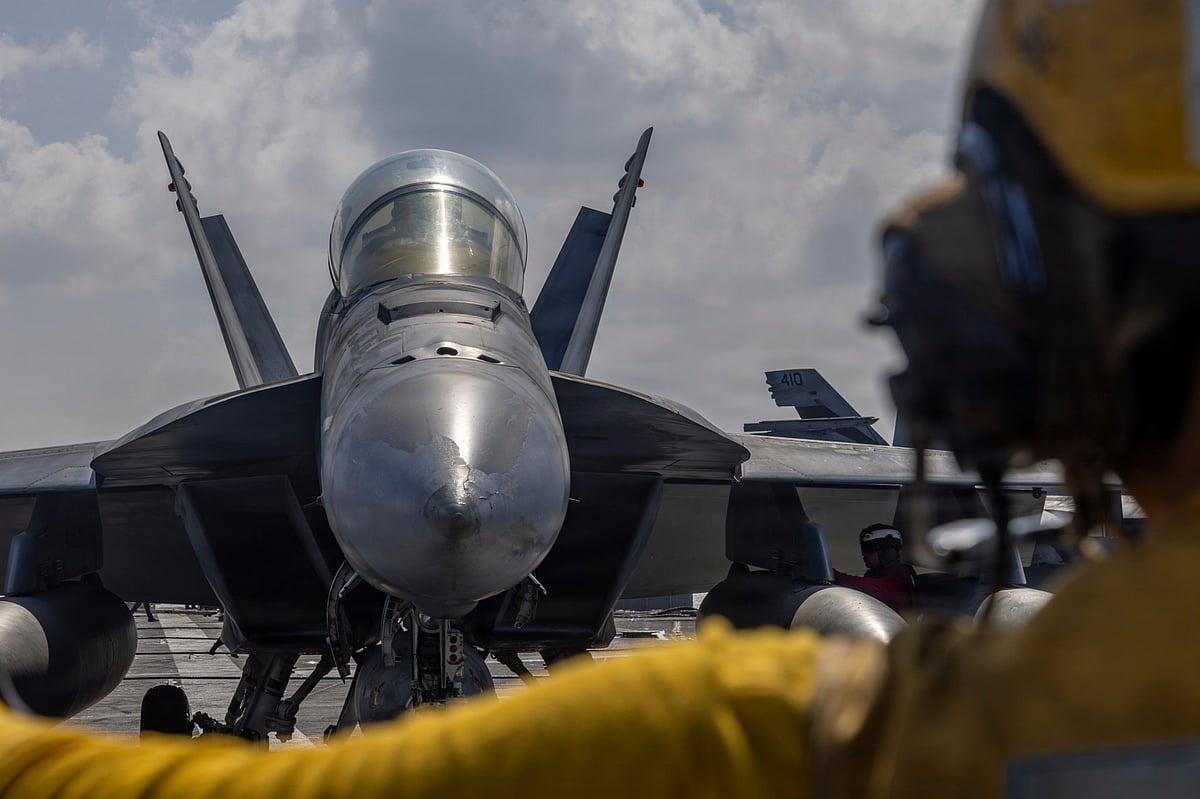
Aviation Boatswain's Mate 2nd Class Michael Cordova directing an F/A-18F Super Hornet on the flight deck of the Nimitz-class aircraft carrier USS Abraham Lincoln in the Indian Ocean on January 23, 2026
AP
Dubai: As US President Donald Trump signals that American forces could strike Iran following a deadly crackdown on nationwide protests, analysts say the consequences could range from limited military pressure to regional chaos with global repercussions.
A US aircraft carrier strike group has moved closer to Iran, while Trump has warned that a “massive armada” is ready to act if Tehran does not change course. Iran, in turn, vowed a “crushing response” to any attack.
Foes Washington and Tehran have exchanged sharp warnings since a protest wave in Iran led Trump to threaten military action over a violent crackdown, while the Islamic republic blamed the United States for fuelling what it deemed “riots”.
The face-off has sent diplomatic shock waves across the region, with calls for negotiations to defuse tensions drawing in key regional actors.
But while potential US targets — including Iran’s Islamic Revolutionary Guard Corps (IRGC), missile sites and nuclear facilities — are largely predictable, what happens next is far from clear.
Experts quoted by the BBC and the Atlantic Council say no scenario offers an easy or stable outcome.
‘Quick, surgical’ strikes — but no guaranteed transition
Jason Brodsky, a member of the Atlantic Council’s Iran Strategy Project, said Trump has historically favoured “quick, surgical, targeted, dramatic, and decisive military operations,” pointing to US airstrikes in Syria during his first term.
He said any US intervention could involve leadership decapitation alongside attacks on Iran’s military and security infrastructure.
However, Brodsky cautioned that Iran’s political system is designed to survive even major leadership losses.
“The Islamic Republic is bigger than any one individual,” he said, noting that institutions and succession mechanisms exist to fill any vacuum — even if the removal of Supreme Leader Ayatollah Ali Khamenei could be temporarily destabilising.
BBC analysis similarly warns that Western military interventions in Iraq and Libya ended authoritarian rule but plunged both countries into prolonged instability rather than smooth democratic transitions.
Regime change or hardened resistance?
Some in Washington hope military pressure could force Tehran to moderate its behaviour — scaling back its nuclear ambitions, missile programme and regional proxy network.
This would resemble what analysts call the “Venezuelan model,” where US pressure weakened but did not dismantle the government.
Yet experts say Iran’s leadership has spent nearly five decades resisting outside pressure and is unlikely to shift course now.
Danny Citrinowicz, a former Israeli intelligence official now with the Atlantic Council, warned that military strikes could actually strengthen hardliners.
“A US attack would more likely consolidate elite cohesion around the regime, marginalise protesters and reinforce Tehran’s narrative of external siege,” he said.
A takeover by Iran’s powerful military?
One of the most likely scenarios, according to both BBC analysis and Atlantic Council experts, is a shift toward overt military rule.
If Iran’s current leadership weakens but does not collapse, power could move fully into the hands of the IRGC — a force that already dominates Iran’s security network and large parts of its economy.
Brodsky said an IRGC figure such as parliamentary speaker Mohammad Bagher Ghalibaf could emerge as a central authority.
Rather than bringing reform, such a transition could entrench a more hardline system.
Retaliation across the region
Iran has made clear it would respond forcefully to any US strike.
The BBC notes Tehran could use its arsenal of ballistic missiles and drones to hit US bases as well as target infrastructure in countries it sees as complicit.
Iran could also disrupt global energy flows by laying sea mines in the Strait of Hormuz, a vital shipping route through which around a fifth of the world’s oil and gas exports pass.
Such a move would likely send energy prices soaring and impact global markets.
Could Iran hit US naval forces?
While considered unlikely, analysts warn Iran has trained extensively for “swarm attacks” using drones and fast boats designed to overwhelm US naval defences.
A successful strike on a US warship would represent a major escalation and a symbolic blow to Washington’s military dominance in the region.
The danger of collapse and chaos
Perhaps the gravest risk, experts say, is the collapse of central authority.
BBC analysis highlights the possibility of civil war, ethnic unrest involving Kurds and Baluchis, and a humanitarian crisis in a country of more than 90 million people.
Atlantic Council analysts warn that regime failure without an organised opposition could produce instability rather than democracy.
“Iran lacks a credible, organised opposition capable of governing the country,” Citrinowicz said, adding that externally imposed regime change could lead to chaos or even tighter hardline control.
Iran prepares and turns to the UN
Iran’s Revolutionary Guard says its forces are fully prepared for all military scenarios, accusing the US of psychological warfare.
Tehran has also written repeatedly to the UN Security Council, calling Trump’s warnings a violation of the UN Charter and reaffirming its right to self-defence.
No easy outcome
While some experts advocate intensified sanctions, diplomatic isolation and cyber pressure instead of direct strikes, others argue limited military action could weaken Iran’s repressive apparatus.
Yet both camps agree on one thing: Any US military move carries enormous uncertainty.
As the BBC puts it, the greatest danger may be that a powerful military buildup leaves Washington feeling it must act — triggering a conflict with no clear end-state and potentially far-reaching consequences.

A Senior Associate Editor with more than 30 years in the media, Stephen N.R. curates, edits and publishes impactful stories for Gulf News — both in print and online — focusing on Middle East politics, student issues and explainers on global topics. Stephen has spent most of his career in journalism, working behind the scenes — shaping headlines, editing copy and putting together newspaper pages with precision. For the past many years, he has brought that same dedication to the Gulf News digital team, where he curates stories, crafts explainers and helps keep both the web and print editions sharp and engaging.
Sign up for the Daily Briefing
Get the latest news and updates straight to your inbox
Network Links
GN StoreAbout Gulf NewsTerms & ConditionsReach by GNSitemapContact usPrivacy PolicyGN FocusHave your sayWork with usAdvertise with usGulf News epaperPrinting Services
Download our app
© Al Nisr Publishing LLC 2026. All rights reserved.