In recent interviews, Shaath has been blunt about the scale of destruction Gaza faces.
EXPLAINER
Gaza enters phase two of ceasefire: Who will govern, what happens to Hamas, what’s next
A US-backed plan shifts focus to governance, demilitarisation and rebuilding Gaza
Last updated:
4 MIN READ
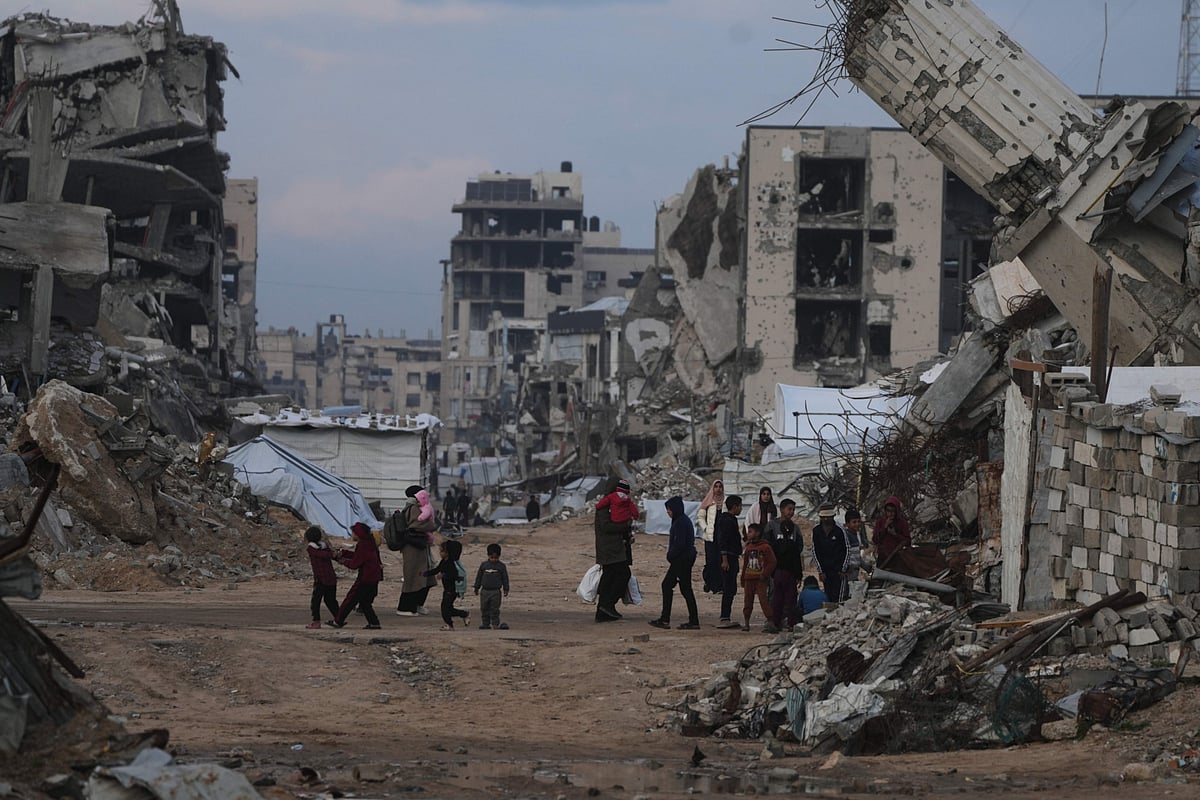
Buildings destroyed by Israeli air and ground operations in the Zeitoun neighborhood of Gaza City. More than $50 billion is required to rebuild Gaza, according to estimates.
AP
Dubai: After more than two years of devastating war, Gaza is moving into a critical and uncertain new chapter.
The United States says the ceasefire plan brokered under President Donald Trump is entering phase two — a stage that goes beyond silencing the guns and aims to dismantle Hamas’ rule, rebuild Gaza from the ground up and hand daily governance to a Palestinian technocratic body under international supervision.
The shift marks the most ambitious attempt yet to reshape Gaza’s future since Hamas seized control of the enclave in 2007. But it also opens a phase riddled with political, security and humanitarian risks that could still derail the plan.
What is phase two of the Gaza ceasefire?
According to US envoy Steve Witkoff, phase two moves Gaza “from ceasefire to demilitarisation, technocratic governance and reconstruction.”
The first phase, launched in October, halted most fighting, enabled a hostage-prisoner exchange, allowed a partial Israeli withdrawal and opened the door to increased humanitarian aid.
Phase 2 goes much further. It is designed to:
End Hamas’ 18-year rule of Gaza
Begin the disarmament of armed groups, starting with Hamas
Establish a Palestinian technocratic committee to run Gaza’s daily affairs
Launch a massive reconstruction effort estimated by the UN to cost more than $50 billion
Witkoff warned that Hamas must meet its obligations under the deal — including returning the final Israeli hostage, Ran Gvili — saying failure to do so would bring “serious consequences.”
Who will govern Gaza now?
Under the plan, Gaza will be administered by a 15-member Palestinian technocratic committee made up of non-partisan experts. The body will operate under the oversight of a US-led “Board of Peace,” to be chaired by Trump himself and led on the ground by former UN Middle East envoy Nickolay Mladenov.
Mediators Egypt, Turkey and Qatar announced that the committee will be headed by Ali Shaath, a Gaza-born civil engineer and former deputy minister in the Palestinian Authority.
Palestinian factions — including Hamas, Islamic Jihad and President Mahmud Abbas’ Fatah movement — have all publicly backed the committee, an unusual moment of consensus in deeply divided Palestinian politics.
Who is Ali Shaath?
Ali Shaath, 67, is a low-profile technocrat rather than a political heavyweight.
Born in Khan Yunis in southern Gaza in 1958, he studied engineering in Cairo and later served in senior roles within the Palestinian Authority, including as deputy minister of planning and international cooperation and undersecretary at the transport ministry.
In recent interviews, Shaath has been blunt about the scale of destruction Gaza faces.
“We are not talking about reconstruction, but construction anew,” he said, noting that nearly all of Gaza’s 2.2 million residents have been displaced at least once during the war.
He outlined priorities including emergency shelter, water purification, well rehabilitation and restoring basic services such as hospitals and schools. He even floated controversial ideas such as pushing rubble into the Mediterranean to reclaim land.
Shaath has stressed that his body will not act as a security force.
“The commission is not an army,” he said. “It is brains more than weapons.”
What happens to Hamas?
Hamas has said it does not seek a role in governing Gaza and would limit itself to monitoring the transition. It has also welcomed the formation of the technocratic committee.
But the hardest question remains unresolved: Disarmament.
Witkoff said phase two aims for the “full demilitarisation of Gaza,” including the disarmament of all unauthorised armed personnel. Hamas has long resisted giving up its weapons, and no clear mechanism has been outlined for enforcing this without sparking renewed conflict.
Israel, meanwhile, has said it will not fully move forward with phase two until the remains of Ran Gvili — the last Israeli hostage — are returned.
What are the biggest challenges ahead?
Even supporters of the plan acknowledge daunting obstacles:
Security: Who enforces disarmament, and how, without reigniting war?
Governance: How quickly can a new body replace Hamas’ control after nearly two decades?
Funding: With reconstruction costs topping $50 billion, donor commitments remain scarce.
Trust: Israelis, Palestinians and regional players remain deeply sceptical after repeated past failures.
The technocratic committee is due to meet for the first time in Cairo, with members travelling out of Gaza via the Rafah crossing — a symbolic first step in what could be a long, fragile transition.
Why this phase matters
If phase two succeeds, it could fundamentally reshape Gaza’s political and security landscape for the first time in a generation.
If it fails, Gaza risks slipping back into chaos — or worse, a renewed war.
For now, the guns are mostly silent. What comes next will determine whether that silence holds — and whether Gaza can finally begin to rebuild a future beyond war.
Phase two shifts the focus from stopping the fighting to reshaping Gaza’s future — moving toward demilitarisation, governance reform and long-term recovery.
A 15-member Palestinian technocratic committee, led by engineer Ali Shaath, will take over day-to-day administration, ending Hamas’ 18-year rule of Gaza.
Disarmament of armed groups
The plan calls for the demilitarisation of Gaza, including the disarmament of Hamas and other unauthorised fighters — the most sensitive and uncertain element.

A Senior Associate Editor with more than 30 years in the media, Stephen N.R. curates, edits and publishes impactful stories for Gulf News — both in print and online — focusing on Middle East politics, student issues and explainers on global topics. Stephen has spent most of his career in journalism, working behind the scenes — shaping headlines, editing copy and putting together newspaper pages with precision. For the past many years, he has brought that same dedication to the Gulf News digital team, where he curates stories, crafts explainers and helps keep both the web and print editions sharp and engaging.
Sign up for the Daily Briefing
Get the latest news and updates straight to your inbox
Network Links
GN StoreAbout Gulf NewsTerms & ConditionsReach by GNSitemapContact usPrivacy PolicyGN FocusHave your sayWork with usAdvertise with usGulf News epaperPrinting Services
Download our app
© Al Nisr Publishing LLC 2026. All rights reserved.