A bride and group couple rides in a military jeep arriving for a public mass wedding ceremony at Imam Hossein Square in Tehran on May 18, 2026.
Diplomacy and defiance: Why Iran is seeking a deal — without backing down
Tehran pursuing diplomacy as hardliners insist country will not surrender leverage
Last updated:
3 MIN READ
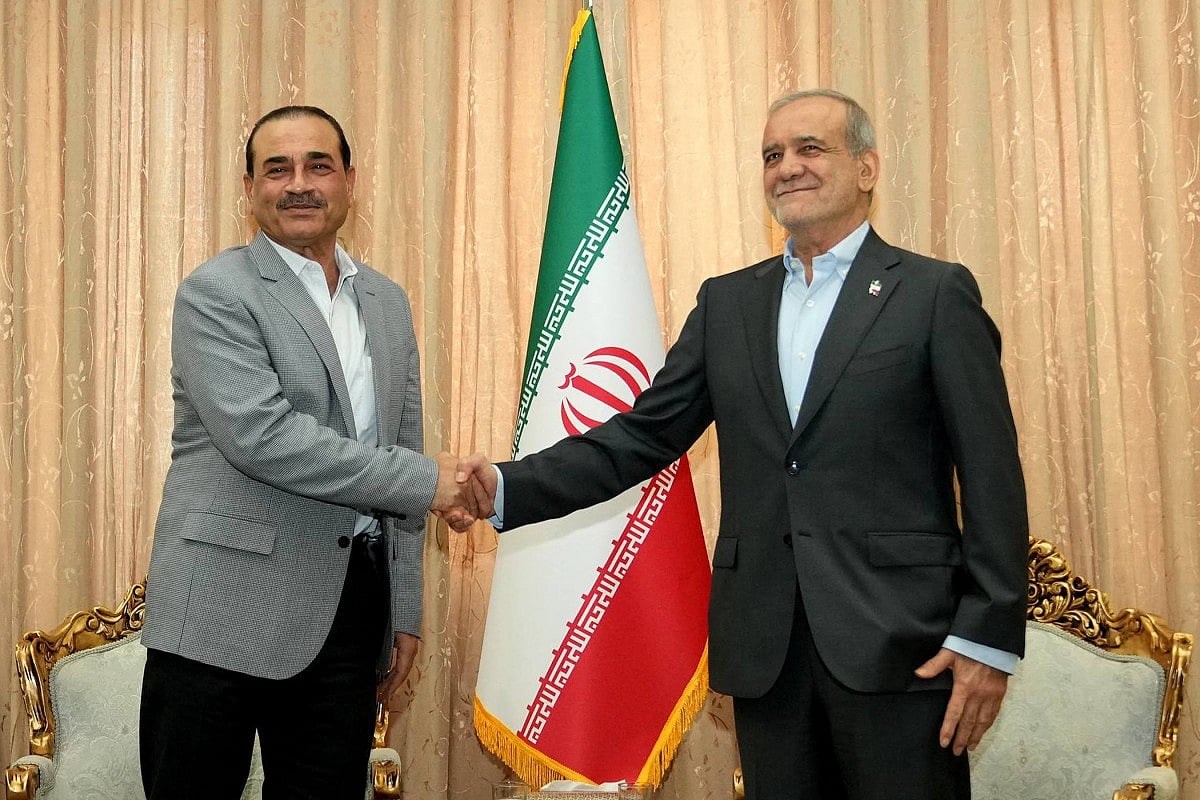
Iran's President Masoud Pezeshkian (right) during his meeting with Pakistan’s Defence Forces Chief Field Marshal Asim Munir in Tehran on May 23, 2026.
AFP
Dubai: Even as negotiations over a possible US-Iran agreement gathered momentum this weekend, Tehran projected two sharply different messages: Diplomacy abroad and defiance at home.
While Iranian officials worked through regional mediators to advance a proposed framework aimed at reopening the Strait of Hormuz and easing the risk of renewed US strikes, military commanders and state media continued issuing threats and preparing the public for the possibility of another war.
According to The New York Times, three senior Iranian officials said Tehran had agreed in principle to a memorandum of understanding that would halt fighting on multiple fronts, reopen the Strait of Hormuz without tolls or fees, lift the US naval blockade on Iran, and release billions of dollars in frozen Iranian assets.
US President Donald Trump said Saturday that a peace agreement with Iran had been “largely negotiated”, though he stressed that final details were still being worked out.
But even as diplomacy advanced, Iran’s leadership appeared determined to show that it was not negotiating from weakness.
According to the report, Iranian military commanders publicly threatened to target infrastructure in Gulf countries if Washington resumed attacks on Iran’s critical facilities. State media aired footage of volunteer fighters — including women and teenagers — undergoing firearms training at mosques across the country.
At a public mass wedding ceremony in Tehran, newly married couples rode military vehicles decorated with flowers and reportedly declared that drones would form part of the brides’ dowries — imagery that underscored how deeply the war narrative has penetrated public messaging inside Iran.
Analysts say the contrasting signals reflect Tehran’s attempt to balance two urgent priorities: Avoiding another devastating round of conflict while preserving the image of resistance central to the Islamic republic’s political identity.
Ghalibaf is the one in control
“The Iranians have shown that Trump can achieve less through threats and coercion than through diplomacy,” Omid Memarian, a senior analyst at DAWN, a Washington-based think tank, told the newspaper. “For both sides, negotiations are becoming unavoidable because of the enormous costs of continuing the war.”
The proposed framework would reportedly create a temporary truce lasting between 30 and 60 days, during which negotiations would continue over the most contentious issues — including Iran’s uranium stockpile, sanctions relief and the future of its nuclear programme.
Those issues remain unresolved.
Iranian officials quoted by the newspaper said the draft proposal leaves nuclear questions for later negotiations and does not immediately commit Tehran to major concessions on enrichment.
At the same time, Iran’s military establishment appears to be using the ceasefire period to regroup.
“We will make the enemy regret any renewed aggression against Iran,” Mohammad Bagher Ghalibaf, Iran’s parliament speaker and one of the country’s key wartime figures, said in an audio message cited by the report, adding that Iranian forces had used the ceasefire period to rebuild capabilities.
The report also said Iran’s new Supreme Leader, Mojtaba Khamenei, who has remained largely out of public view since succeeding his father following the February strikes, had authorised Ghalibaf to make decisions regarding the negotiations.
That detail could prove significant because many analysts believe wartime decision-making in Iran has increasingly shifted toward military and security figures, particularly the Islamic Revolutionary Guard Corps (IRGC).
That raises one of the biggest unanswered questions surrounding any potential agreement: Whether Iran’s hardline security establishment will ultimately support compromises that could reduce Tehran’s strategic leverage over Hormuz and its nuclear programme.
For ordinary Iranians, however, the immediate concern is simpler — avoiding another round of war.
The country continues to grapple with severe economic strain, including inflation, shortages and infrastructure damage caused during months of fighting and sanctions pressure.
Many Iranians had reportedly feared that US strikes could resume within days.
“We were trying to figure out if we should leave Tehran if bombs fall again,” a Tehran resident told the newspaper. “I gave a big sigh of relief.”

A Senior Associate Editor with more than 30 years in the media, Stephen N.R. curates, edits and publishes impactful stories for Gulf News — both in print and online — focusing on Middle East politics, student issues and explainers on global topics. Stephen has spent most of his career in journalism, working behind the scenes — shaping headlines, editing copy and putting together newspaper pages with precision. For the past many years, he has brought that same dedication to the Gulf News digital team, where he curates stories, crafts explainers and helps keep both the web and print editions sharp and engaging.
Sign up for the Daily Briefing
Get the latest news and updates straight to your inbox
Network Links
GN StoreAbout Gulf NewsTerms & ConditionsReach by GNSitemapContact usPrivacy PolicyGN FocusHave your sayWork with usAdvertise with usGulf News epaperPrinting Services
Download our app
© Al Nisr Publishing LLC 2026. All rights reserved.