Bab Al Mandab strait.
After Hormuz, are Iran and its allies eyeing Bab Al Mandab?
Warnings of 'new fronts' raise fears another vital route could be drawn into conflict
Last updated:
4 MIN READ
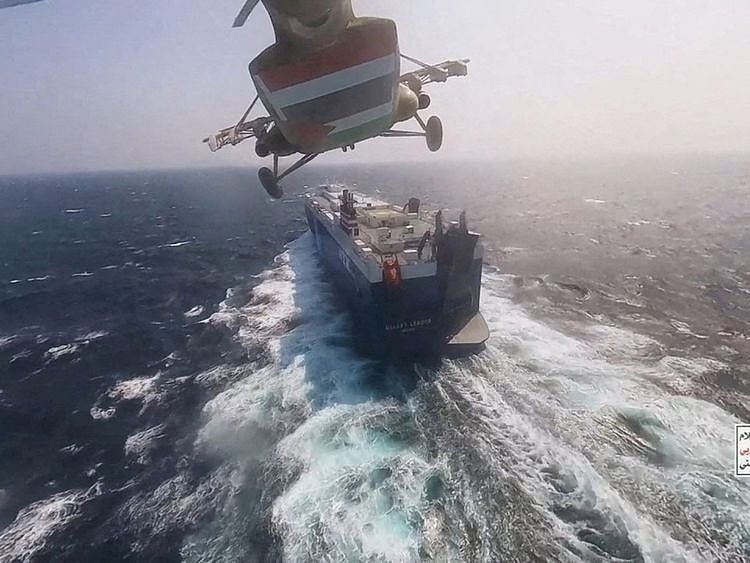
A Houthi military helicopter flies over the Galaxy Leader cargo ship in the Red Sea in November 2023. Houthi attacks on commercial shipping previously disrupted traffic through the Bab Al Mandab Strait, one of the world's most important maritime chokepoints.
AFP
Dubai: As negotiations between Iran and the United States falter and fighting in Lebanon escalates, attention is turning to another strategic waterway that could become the next flashpoint in the Middle East conflict: the Bab Al Mandab Strait.
According to a report by CNN, Iranian media reported on Monday that Tehran and its allies were considering the “activation of other fronts”, including the Bab Al Mandab Strait at the southern entrance to the Red Sea, following Israel’s expanding military operations in Lebanon.
The reports emerged shortly after Iran announced it was suspending indirect peace talks with the United States, citing Israel’s offensive in Lebanon and demanding a halt to military operations there before negotiations could resume.
While Iranian officials have not formally announced plans to disrupt shipping in the Bab Al Mandab, the mere suggestion rattled markets already on edge over the future of the Strait of Hormuz, through which roughly a fifth of the world’s oil and liquefied natural gas supplies normally pass.
Another vital global trade artery
Oil prices jumped sharply on Monday as investors weighed the possibility that the conflict could spread beyond Hormuz and threaten another vital global trade artery.
The concerns were amplified by earlier warnings from Tehran. Iran’s Revolutionary Guards said last month that any renewed conflict would spread “far beyond the region”, while senior Iranian officials have spoken of opening “new fronts” and using “new tools” should diplomacy fail.
Bab Al Mandab at a glance
Located between Yemen and the Horn of Africa
Connects the Red Sea to the Gulf of Aden
Gateway to the Suez Canal
Around 29km wide at its narrowest point
Carries nearly 15% of global maritime trade
Key route for oil, LNG and container shipping
Houthi attacks disrupted shipping between 2023 and 2025
Many vessels were forced to sail around Africa
Disruptions added billions of dollars in costs to global trade
One of the world’s most strategically important maritime chokepoints
The Bab Al Mandab, located between Yemen and the Horn of Africa, serves as a gateway to the Red Sea and the Suez Canal. It is one of the world’s most important maritime chokepoints, carrying energy supplies and commercial goods between Asia, Europe and the Middle East.
The waterway has already played a major role in recent regional tensions.
Beginning in late 2023, Yemen’s Iran-backed Houthi movement launched attacks on commercial vessels transiting the strait and nearby waters, saying the campaign was aimed at supporting Palestinians during the Gaza war.
The Bab Al Mandab Strait links the Red Sea to the Gulf of Aden and is one of the world's busiest shipping routes.
Shipping and insurance costs
The attacks forced many shipping companies to reroute vessels around the southern tip of Africa, adding thousands of kilometres to voyages, increasing fuel costs and disrupting global supply chains.
Industry estimates cited by CNN suggest the disruption cost the global economy billions of dollars annually while driving up shipping and insurance costs.
Despite the current regional conflict, the Bab Al Mandab has remained largely navigable, preserving a critical export route for Gulf energy producers and maintaining access to the Suez Canal.
Analysts say Iran’s strongest leverage lies not in conventional military power but in its ability to disrupt global energy flows and key trade routes.
Parallel disruption
After US and Israeli strikes on Iran earlier this year, Tehran effectively shut down most commercial activity through the Strait of Hormuz, demonstrating its willingness to use strategic waterways as pressure points during periods of heightened confrontation.
A parallel disruption at the Bab Al Mandab would significantly increase economic pressure on countries far beyond the Middle East and could further strain already fragile supply chains.
The latest reports come as Israel expands military operations against Hezbollah in Lebanon and as indirect negotiations aimed at ending the war remain deadlocked.
Israeli Prime Minister Benjamin Netanyahu has vowed to intensify pressure on Hezbollah, while Tehran insists that any broader peace agreement must include a halt to Israeli operations in Lebanon.
For now, there is no indication that the Bab Al Mandab faces an imminent closure.
However, the prospect alone highlights how quickly a conflict centred on Iran, Israel and Lebanon could spill into some of the world’s most important maritime corridors.
With Hormuz already heavily disrupted, any threat to the Bab Al Mandab would raise the stakes for global trade, energy markets and regional security, potentially opening a second maritime front in a conflict that diplomats are struggling to contain.

A Senior Associate Editor with more than 30 years in the media, Stephen N.R. curates, edits and publishes impactful stories for Gulf News — both in print and online — focusing on Middle East politics, student issues and explainers on global topics. Stephen has spent most of his career in journalism, working behind the scenes — shaping headlines, editing copy and putting together newspaper pages with precision. For the past many years, he has brought that same dedication to the Gulf News digital team, where he curates stories, crafts explainers and helps keep both the web and print editions sharp and engaging.
Sign up for the Daily Briefing
Get the latest news and updates straight to your inbox
Network Links
GN StoreAbout Gulf NewsTerms & ConditionsReach by GNSitemapContact usPrivacy PolicyGN FocusHave your sayWork with usAdvertise with usGulf News epaperPrinting Services
Download our app
© Al Nisr Publishing LLC 2026. All rights reserved.