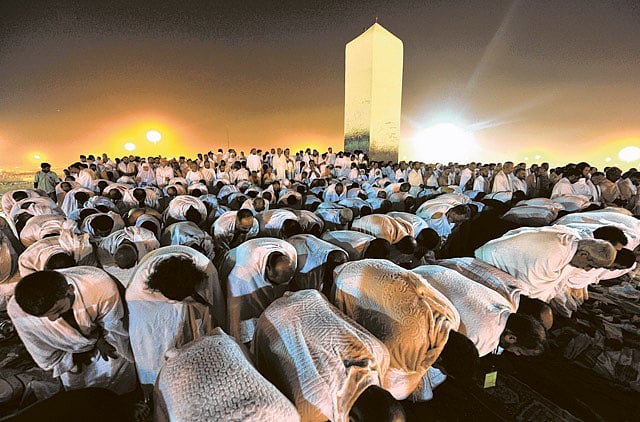
Mount Arafat, Saudi Arabia: Saudi Arabia's top Islamic cleric yesterday condemned Western occupations of foreign lands during a key sermon to millions of Muslims performing the annual Haj pilgrimage.
"Islam forbids the occupation of a country, and the unlawful shedding of civilian blood, and the destruction of crops and cattle," Grand Mufti of Saudi Arabia Shaikh Abdul Aziz Al Shaikh said.
"The rights of people in third world nations is not as it is in other countries, and it is unacceptable that nations occupy these lands and rape them of their riches," the mufti told a crowd of some three million people from around the world who crowded on top of Mount Arafat yesterday on the last day of Haj, chanting "Oh God, here we come, answering your call".
"But violence cannot be cured with violence and neither can terrorism be cured with force, but by lifting injustices levied on oppressed peoples," he told the pilgrims.
Those who did manage to jostle their way through the heaving crowds to the top of the hill, which is also known as Jabal Al Rahma, or the Mount of Mercy, sat on the rocky edges reciting Quranic verses and praying.
Al Shaikh stressed that Islam is a religion of "great mercy" and that it preached equality.
Terror
Saudi Arabia has recently warned that the pilgrimage could be targeted by terrorist attacks. One group, Al Qaida in the Arabian Peninsula, has denied it had any such plans.
Some used their mobile phones to take pictures. Others lay down on straw mats spread over the rocks. "My feeling cannot be described," said Syrian pilgrim Mossa'ad Mheymeed standing at the top of Mount Arafat. "I feel it is already judgment day."
The granite hill, rising some 60 metres from the plain and no more than 200 metres in length and of similar width, is topped with a four-metre pillar, said to represent the spot where the Prophet Mohammad (PBUH) delivered his final Haj sermon.
Pilgrims vied to touch the white cement structure, some crying.
Down below, movement on the plain came to a virtual standstill due to the sheer size of the crowd. Buses stood in four lanes as they fought for use of the road with pedestrians, who crammed the thin spaces between the idling vehicles in a bid to keep moving.
The edges of Arafat plain were marked by women in wheelchairs and children in strollers trying to escape being run over by jostling pilgrims heading in all directions.
Sign up for the Daily Briefing
Get the latest news and updates straight to your inbox
Network Links
GN StoreDownload our app
© Al Nisr Publishing LLC 2026. All rights reserved.