FILE PHOTO: A worker cleans up an oil spill at the beach as demonstrators take part in a protest outside Repsol's La Pampilla refinery against the recent oil spill that has caused an ecological disaster on the coasts of Lima, in Ventanilla, Peru January 29, 2022.
From satellites to robot 'dolphins' to AI: Inside the race to stop oil spills
Modern technology enhances cleanup and safeguards marine ecosystems from oil spills
Last updated:
4 MIN READ
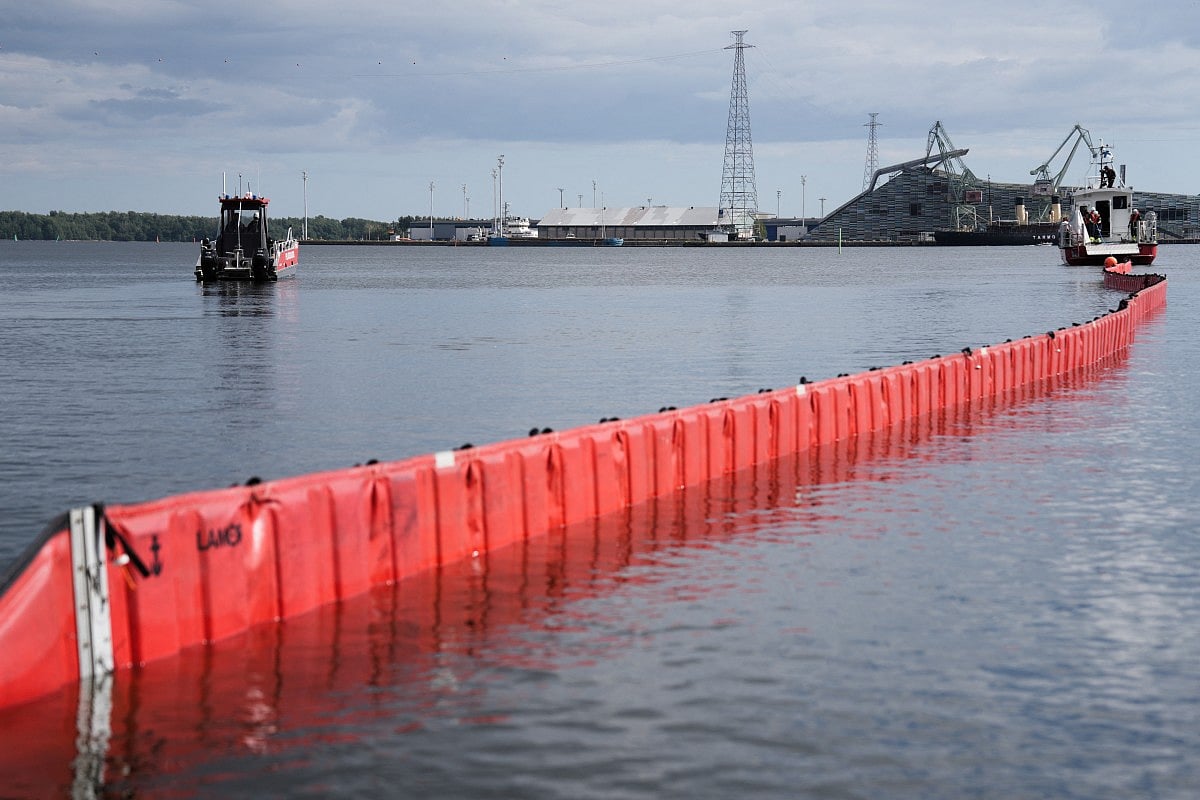
Members of the Finnish Rescue Service take part in a demonstration of the latest system to control oil spilling organised in cooperation with the John Nurminen Foundation on August 26, 2026 in Kotka, Finland.
AFP
When oil spills into the sea, responders face a race against wind, waves, and time.
Now modern satellite and AI tools can help detect spills faster.
Cleanup sequence
Cleanup, however, is not simply “removing oil”.
It is a sequence of containment, recovery, dispersal, burning, and shoreline protection — each with trade-offs.
Booms and skimmers can recover only part of a slick, while dispersants and in-situ burning may reduce oil at sea but create ecological risks.
The central challenge remains: protecting coastlines, wildlife, and livelihoods before the oil reaches them.
How cleanup works
Responders typically follow this order: stop the source, contain the slick, recover the oil, then clean the shore.
Booms and skimmers: Booms limit spread, deflect oil from sensitive areas and concentrate it for recovery. Skimmers then pump it into storage vessels. The limits are real: skimming efficiency depends on oil thickness and sea state, and on large spills skimmers are unlikely to recover more than a small percentage.
Dispersants: These are used early, when weather or resources limit other techniques and before weathering makes them ineffective. Researchers caution they carry ecological trade-offs.
In-situ burning: Oil is corralled with booms and ignited, and an industry response plan says it can burn off 80% to 98% of the oil it targets. It can leave residue that coats coasts or sinks onto seabed life.
Shoreline cleanup: Assessment teams set cleanup endpoints and choose among manual removal, low-pressure flushing or natural recovery based on habitat sensitivity.
In an aerial view, a boom contains oil contaminated water (BOTTOM) in the area of the Talbert Marsh wetlands after a 126,000-gallon oil spill from an offshore oil platform on October 4, 2021 in Huntington Beach, California.
Protecting marine life
Protection starts before oil lands. Responders deploy protection booms and physical barriers or deflect oil from sensitive shorelines.
Oiled wildlife response can take place at sea, on shorelines and in specialised facilities, mixing natural recovery with active rehabilitation.
The method matters too.
Aggressive shoreline cleanup can itself harm habitats, which is why endpoints are tied to habitat sensitivity and sometimes the best choice is to let nature recover.
Workers in protective suits clean oil in the area of the Talbert Marsh wetlands after a 126,000-gallon oil spill from an offshore oil platform on October 4, 2021 in Huntington Beach, California.
Latest cleanup technology
Satellite and AI detection: Modern surveillance leans on synthetic aperture radar satellites, with deep learning to tell real oil films from false targets. AI-enhanced multi-drone systems are also being developed for detection, as per Science Direct.
Robotic skimmers: RMIT’s “Electronic Dolphin” prototype uses a water-repellent, oil-absorbing filter inspired by sea urchins and recovered oil at about 2 mL/min with over 95% purity in tests. It runs about 15 minutes per charge, so it’s early-stage.
Autonomous swarms: A review describes AI-driven robot swarms for real-time response, though the full system is largely a proposed framework, according to Science Direct.
The 10 biggest oil spills (marine): A timeline
Estimates vary widely by source, so treat volumes as ranges. I’ve limited the list to marine spills and ranked them by mid-range estimate.
| Date | Spill | Location | Volume (est) | Rank |
|---|---|---|---|---|
| Mar 1978 | Amoco Cadiz | English Channel, France | ~69M gallons | 8 |
| Jun 1979–Mar 1980 | Ixtoc I | Gulf of Mexico | ~140M gallons | 3 |
| Jul 1979 | Atlantic Empress | Off Tobago | ~90M gallons; 26 crew killed | 4 |
| Feb 1983 | Nowruz platform | Persian Gulf | ~80M gallons | 5 |
| Aug 1983 | Castillo de Bellver | Off Cape Town | ~78M gallons | 6 |
| Nov 1988 | Odyssey | North Atlantic | ~41M gallons | 10 |
| Jan 1991 | Gulf War spill | Persian Gulf | 252–336M gallons | 1 |
| Apr 1991 | Haven | Off Genoa, Italy | ~45M gallons | 9 |
| May 1991 | ABT Summer | Off Angola | 51–81M gallons | 7 |
| Apr–Jul 2010 | Deepwater Horizon | Gulf of Mexico | ~168–210M gallons | 2 |
Source: LiveScience
How countries respond
Most countries use a polluter-pays, preparedness-first model. Liability can be steep. After the Exxon Valdez, Exxon agreed to pay $900 million in civil payments and $125 million in fines and restitution, and said it had spent more than $2 billion on cleanup.
Agencies such as NOAA also run trajectory models like to predict where oil will go.
In Australia, for example, regulator requires the responsible petroleum company to identify a suite of response strategies for different spill scenarios, and companies can form cooperative arrangements to share spill-response equipment.
In Canada, in-situ burning at sea needs government approval from Environment and Climate Change Canada.
Pre-approved dispersant plans, booming strategies and wildlife rehabilitation capabilities substantially reduce harm and shorten response times.
And size isn’t impact: The Gulf War spill was the only one on the list caused intentionally, and Deepwater Horizon is the largest accidental marine spill.
The Exxon Valdez released only about 10.8 million gallons, yet it carries the largest animal death toll because it hit ecologically rich waters.
What happens next: the Hormuz risk
The biggest present worry is the Gulf.
The International Maritime Organisation (IMO) counted 65 confirmed incidents involving ships in the Strait of Hormuz and the wider Middle East between March and mid-August.
Reuters-verified satellite imagery showed slicks off Qeshm and Sirri islands, and a grounded tanker, the Caroline Bezengi, leaked crude off Oman into a protected marine area, creating a slick some estimates put at 2,000 square km.
The Qeshm slick appeared off a breeding ground for endangered hawksbill turtles.
Maritime data firm Kpler counted 1,514 “dark crossings” in and out of the Gulf since March 1, which reduces transparency and adds environmental risk.
Greenpeace Germany warns the Gulf’s coral reefs, mangroves and seagrass meadows are at risk if trapped tankers are hit.
This week’s claimed tanker attacks add to the concern. The IRGC claims four tankers were hit and caught fire, though that couldn’t be independently verified. There are no confirmed reports of new slicks from those incidents yet.
Expect more satellite-and-AI monitoring and further trials of autonomous cleanup robots.
Still, no tech can match prevention, and cleanup in a war zone is far harder, as in the case of the delayed response due to the Iran-Iraq war in the 1980s.
Network Links
GN StoreAbout Gulf NewsTerms & ConditionsReach by GNSitemapContact usPrivacy PolicyGN FocusHave your sayWork with usAdvertise with usGulf News epaperPrinting Services
Download our app
© Al Nisr Publishing LLC 2026. All rights reserved.