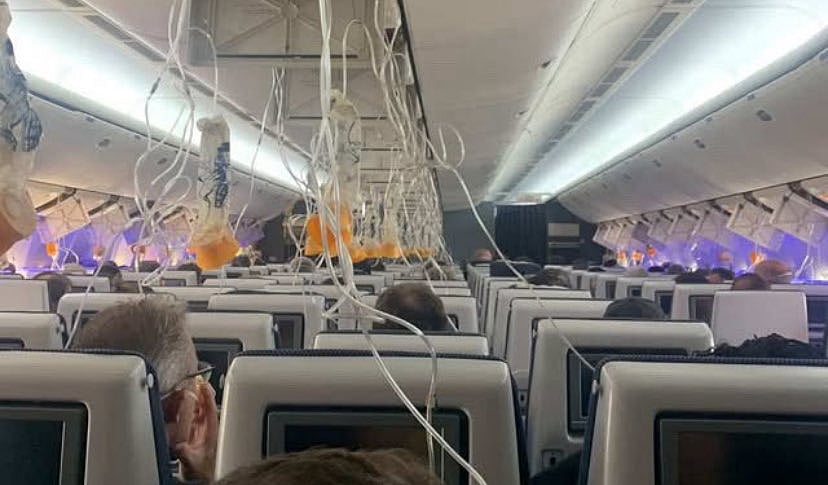
Passengers safe after technical fault forces emergency landing in London
Passengers on a British Airways flight from London to Chicago were forced to use oxygen masks after the aircraft experienced a pressurisation issue over Ireland, prompting pilots to make a rapid emergency descent and turn back to Heathrow.
British Airways flight BA295, operated by a Boeing 777-200ER, was travelling from London Heathrow to Chicago O’Hare on October 5 when the aircraft descended from around 37,000 feet to 9,000 feet within minutes.
Get updated faster and for FREE: Download the Gulf News app now - simply click here.
Flight tracking data showed the crew squawking 7700, the international transponder code used to signal a general emergency.
The aircraft later returned safely to Heathrow. British Airways said the pilots had returned to London following a technical issue and that passengers disembarked normally.
What caused the cabin pressure problem?
Aircraft flying at high altitude rely on cabin pressurisation to maintain an environment where passengers and crew can breathe normally.
At cruising altitude, the air outside the aircraft is too thin to provide enough oxygen at a pressure suitable for the human body. The aircraft therefore uses air supplied from the engines, which is compressed and fed into the cabin.
A controlled valve allows air to leave the aircraft at a regulated rate, maintaining the required cabin pressure.
If the system cannot maintain the pressure at cruising altitude, the aircraft must descend rapidly to a lower altitude where the surrounding air is dense enough to support breathing.
That appears to have been the reason for BA295’s sudden descent, although the exact technical fault has not been confirmed.
What happened on BA295?
The aircraft had reached a cruising altitude of about 37,000 feet when it encountered the problem over Irish airspace.
The oxygen masks deployed in the cabin as the aircraft began its emergency descent. Tracking data showed the Boeing 777 dropping about 28,000 feet to 9,000 feet in less than 10 minutes.
The crew then turned the aircraft back towards London and maintained an altitude of around 9,000 feet while preparing to land.
No injuries have been reported.
Why did the plane fly in circles before landing?
After an aircraft turns back shortly after take-off or during a long-haul flight, pilots may need to manage the aircraft’s weight before landing.
Long-distance flights carry large quantities of fuel, and an aircraft may still be too heavy to land within its normal landing weight shortly after departure.
In such cases, pilots can remain airborne while burning fuel. An aircraft can also use its landing gear or other procedures to increase drag when appropriate.
Emergency situations can allow an aircraft to land above its normal maximum landing weight, but where circumstances permit, reducing weight before landing can help return the aircraft within normal operating parameters.
BA295 remained at about 9,000 feet while making its way back towards Heathrow.
What does squawk 7700 mean?
7700 is the international transponder code for a general emergency.
When pilots select 7700, air traffic controllers are alerted that the aircraft requires priority attention. The code does not identify a specific problem; it can be used for a range of emergencies, including technical failures, medical incidents or other situations requiring immediate assistance.
Flight tracking service Flightradar24 confirmed that BA295 was squawking 7700 and had descended to 9,000 feet over Ireland.
How does aircraft pressurisation work?
A passenger aircraft does not simply pump oxygen into the cabin.
Instead, air taken from the engines is compressed and processed through the aircraft’s air-conditioning system before being delivered into the cabin. The pressure is then regulated by an outflow valve, which controls how quickly air leaves the aircraft.
This system allows the cabin to maintain a pressure equivalent to a much lower altitude than the aircraft’s actual cruising altitude.
A pressurisation problem can occur if components such as the air-conditioning packs, valves or associated systems fail to operate correctly.
Why did BA295 return to Heathrow?
With the aircraft already heading back towards the UK after the emergency descent, the pilots returned the Boeing 777 to its departure airport rather than continuing towards Chicago.
British Airways said: “The safety of our customers and crew is always our top priority, and the aircraft landed safely after our highly trained pilots returned to Heathrow following a technical issue.”
The airline added that passengers disembarked normally and its teams were working to arrange onward travel.
The exact cause of the technical issue has not been disclosed.
Oxygen masks deployed as aircraft descended
The oxygen masks provided supplemental oxygen while the aircraft descended to a safer altitude. Once the aircraft reached around 9,000 feet and the cabin pressure situation was under control, passengers no longer needed the masks.
The aircraft subsequently landed safely at Heathrow, with passengers leaving the aircraft normally.
British Airways has not disclosed the number of passengers on board.
What we know about BA295
Flight: British Airways BA295
Route: London Heathrow to Chicago O’Hare
Aircraft: Boeing 777-200ER
Incident: Pressurisation-related technical issue
Location: Over Ireland
Cruising altitude: About 37,000 feet
Emergency descent: To around 9,000 feet
Transponder: Squawk 7700
Outcome: Aircraft returned safely to Heathrow
Injuries: None reported
Cause: Exact technical fault not confirmed
Network Links
GN StoreAbout Gulf NewsTerms & ConditionsReach by GNSitemapContact usPrivacy PolicyGN FocusHave your sayWork with usAdvertise with usGulf News epaperPrinting Services
Download our app
© Al Nisr Publishing LLC 2026. All rights reserved.