Amazon, Microsoft rose after founder scandals—can Nvidia bounce back?
Nvidia is down a third from its peak. Earnings could show whether the dip is worth buying.
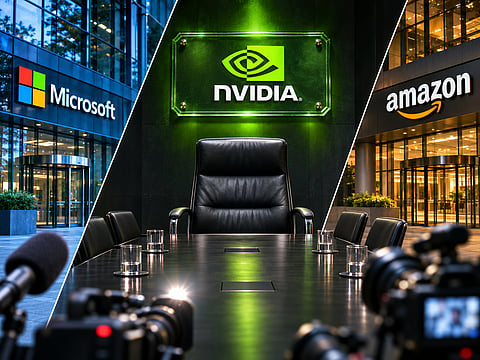
Dubai: Amazon and Microsoft shares more than doubled in the years after scrutiny of their founders’ personal lives. Now Nvidia, down about a third from its October record, faces a more immediate test. Can the company sustain its earnings growth after the abrupt departure of Jensen Huang?
Nvidia closed Friday at $162.85, down nearly 13% for the week. It opened 13.1% lower on Thursday after the company announced Huang’s resignation, recovered much of that loss to close 4.3% lower, then fell another 2% on Friday. Chief Financial Officer Colette Kress took over as interim CEO while the board looks for a permanent successor.
Get updated faster and for FREE: Download the Gulf News app now - simply click here.
Huang acknowledged infidelity in an email to staff that Nvidia made public. The board opened an independent investigation into national security concerns raised in news reports about a woman US intelligence reportedly suspected of gathering information for Beijing. China denied the espionage allegation.
How Amazon, Microsoft fared
Jeff Bezos was still running Amazon when the National Enquirer reported his relationship with Lauren Sánchez on January 9, 2019, the day he announced his separation from MacKenzie Bezos. He remained CEO in the immediate aftermath. Amazon shares went from a split-adjusted $82.97 that day to $267.44 on the day Nvidia announced Huang’s exit, a gain of about 222% over nearly eight years.
Microsoft shares fell about 1.2% on May 17, 2021, after Bill Gates acknowledged through a spokesperson that he had had an affair with a Microsoft employee. Gates had already left the board by then. From that day’s close to November 12, 2026, Microsoft gained about 113% over five and a half years, before dividends.
Google offers another example. In August 2013, media reports linked co-founder Sergey Brin to a Google Glass marketing manager, and a spokesperson confirmed Brin and his wife were living apart. The corresponding Alphabet Class A shares were worth roughly 14 times their split-adjusted late-August 2013 price by November 12, 2026. These three gains played out over years and say little about how quickly Nvidia might recover.
What happens when CEO leaves?
McDonald’s shares fell 2.7% in the first session after it fired Steve Easterbrook in November 2019 over a relationship with an employee that breached company policy. The stock recovered its initial loss by mid-December, according to a company court filing. A year after that first session, it was up about 14% from the post-announcement close.
Two technology companies had a tougher year. Intel shares fell about 2.4% when Brian Krzanich’s resignation became public in 2018, after the company found that a past relationship with an employee breached its policy. They were about 9% below that day’s close a year later. Hewlett-Packard fell 8% in its first session after Mark Hurd resigned in 2010 following an investigation that found breaches of its business conduct standards. The stock was about 26% below that first close a year later.
Is Nvidia cheap enough to buy?
On Thursday, Nvidia traded at about 12 times expected earnings, its lowest valuation on that measure since 2012, Reuters reported. At that price, investors were paying about $12 for every $1 of forecast profit per share. That gives buyers a lower entry price if earnings forecasts hold. If analysts cut those forecasts, the shares become more expensive relative to expected profits even if the price stays where it is.
The latest reported figures show why some investors may see an opportunity. Nvidia’s revenue more than doubled to $96.2 billion in the quarter ended July 26, with data centre sales rising 117% to $89 billion. Data centres accounted for more than 90% of revenue. That dependence also explains why concerns about a slowdown in AI infrastructure spending were weighing on the shares before Huang left.
Nvidia reports results on November 17 in the US. Investors can check whether quarterly sales met the company’s forecast of about $108 billion, then look at what Kress expects for sales and margins in the next quarter. If that outlook supports existing profit forecasts, the sell-off may offer a buying opportunity. If it points to weaker demand or thinner margins, Nvidia’s shares could look less cheap even at Friday’s price.