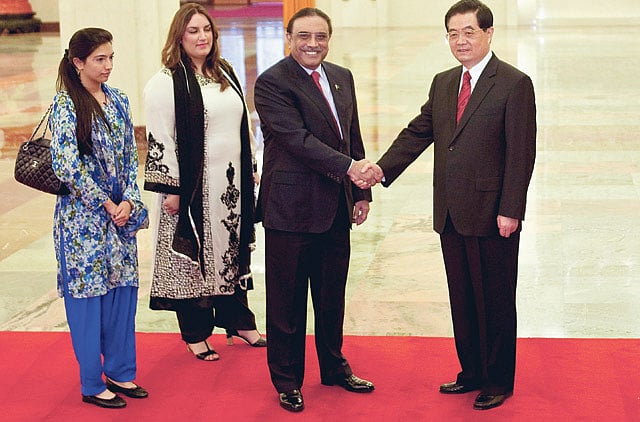
Beijing: Pakistani President Asif Ali Zardari urged Chinese companies to invest in his country, telling them Wednesday that his government was looking to nuclear, hydro and alternative sources to meet an acute thirst for power.
Zardari made the remarks on the second day of a six-day visit to China that has underscored the strategic bond between the two neighbours who both look warily at India.
His remarks, reported by the Associated Press of Pakistan, the country's official news service, did not touch on a nuclear energy deal with China that has prompted questions from New Delhi, Washington and other capitals.
But Zadari made clear his country was looking to China to help shore up Pakistan's economy and expand an energy sector that has struggled to keep up with a growing population.
Zardari also met Chinese President Hu Jintao. They vowed to jointly fight the "three forces" of extremism, separatism and terrorism", China's Xinhua news agency reported.
Hydro and wind projects
Zardari told the Chinese business chiefs in Beijing that "Pakistan was facing acute power shortage and intended to add tens of thousands of megawatts of power to its national grid in the next 25 years through combined hydro, coal, gas, nuclear and renewable energy sources", said the APP report, citing the Pakistani President's spokesman, Farhatullah Babar.
An executive of China's Three Gorges Corporation, which runs the huge hydro power dam in southwest China, said his company agreed to look to hydro and wind power projects in Pakistan, the report said.
The Chinese companies present included NORINCO, one of the country's biggest sellers of conventional arms. The report did not mention any Chinese nuclear companies.
Beijing and Islamabad appear unlikely to use Zardari's visit to trumpet their nuclear power deal, which has unsettled some other governments, worried that it could erode non-proliferation rules.
Regional rivals Pakistan and India both have nuclear weapons, and refuse to join the Nuclear Non-Proliferation Treaty (NPT), which would oblige them to scrap those weapons.
The United States sealed a nuclear energy deal with India in 2008, despite the objections of critics who said it eroded the integrity of non-proliferation rules.
China has said it has the right to pursue nuclear power projects with Pakistan. Chinese nuclear companies have built one reactor unit at the Chashma atomic complex in Pakistan's Punjab province, and they are building another one likely to be finished in 2011 or 2012.
Chinese companies have also unveiled plans to build another two bigger reactors at Chashma in coming years.
The NPT rules say that if countries not authorised to possess nuclear weapons want to receive nuclear materials from countries adhering to the Treaty, such as China or the US, they should accept comprehensive nuclear safeguard agreements.
Sign up for the Daily Briefing
Get the latest news and updates straight to your inbox
Network Links
GN StoreDownload our app
© Al Nisr Publishing LLC 2026. All rights reserved.