FILE - Nirmal Purja, one of the team member of the all-Nepalese mountaineering team that became the first to scale Mount K2 in winter, gestures as the team arrives at Tribhuwan International airport in Kathmandu, Nepal, Jan. 26, 2021. (AP Photo/Niranjan Shrestha, File)
World-famous climber Nirmal Purja among 10 missing after Broad Peak avalanche in Pakistan: ‘Space for hope is narrow’ as rescue launched
Helicopters, ground teams mobilized as search hampered by harsh weather
Last updated:
4 MIN READ
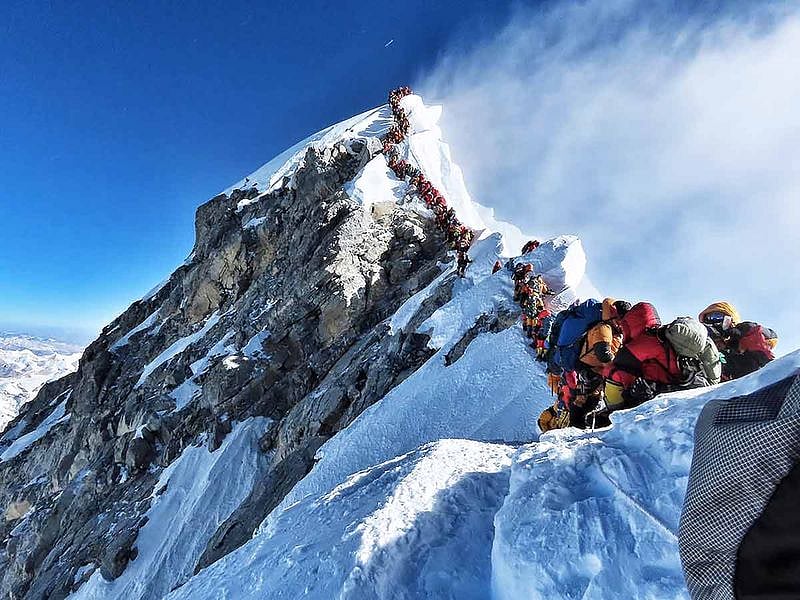
In this file handout photo taken on May 22, 2019 and released by climber Nirmal Purja's Project Possible expedition shows heavy traffic of mountain climbers lining up to stand at the summit of Mount Everest.
AFP/Project Possible
Renowned Nepali mountaineer Nirmal Purja is among 10 missing after an avalanche in northern Pakistan where they were on a climbing expedition, the country's alpine club said.
"The Alpine Club of Pakistan (ACP) has received deeply concerning reports of an avalanche that struck a team of climbers on Broad Peak (8,047m) in the Karakoram mountain range," the club said late on Thursday, adding the team was led by Purja and could not be reached since the incident.
Get it: Fast, verified news for FREE ... download the Gulf News app — simply click here
Expedition
The club said the expedition comprises 10 people -- including five Nepalese, a Pakistani, an Omani, an American, a climber from China, and one other foreigner.
"The entire team has reportedly been out of communication since the avalanche," the club said.
It added: "Every possible effort is being made to ensure that helicopter support and all available rescue resources are mobilised at the earliest opportunity, subject to weather and operational conditions."
Purja, 43, who served with Britain's Brigade of Gurkhas before joining the Special Boat Squadron of the Royal Marines, has broken multiple climbing records since becoming a full-time mountaineer and tour guide.
He climbed all 14 "eight-thousanders" (peaks above 8,000 metres or 26,000 feet) in six months and six days between April and October 2019 -- then a record.
In 2021, along with a team of nine other Nepalese climbers, Purja completed the first winter ascent of K2.
Who is Nirmal Purja?
Renowned Nepali mountaineer Nirmal Nims Dai Purja is among 10 climbers "missing" after a massive avalanche struck an expedition on Pakistan's Broad Peak, triggering an international rescue operation involving Pakistani military helicopters and climbers descending from nearby peaks.
Purja is one of the world's best-known high-altitude mountaineers.
The Nepali-British climber became globally famous after completing all 14 of the world's 8,000-meter peaks in just six months and six days, a record that dramatically compressed a feat that had traditionally taken climbers years.
He is also known for his successful ascent of K2 in winter as part of the historic first winter summit of the mountain.
Purja's presence on Broad Peak has therefore drawn international attention to the rescue effort.
2 bodies found as rescue operation intensifies
Pakistan's Alpine Club said two army rescue helicopters carrying personnel and specialised equipment had been dispatched to the mountain.
The helicopters are supporting ground teams operating in an extremely difficult, high-altitude environment where weather, thin air, steep terrain and unstable snow can severely restrict rescue operations.
Nepal's Mountaineering Association is coordinating with the Alpine Club of Pakistan, while Nepali climbers already in the K2 and K3 areas have begun descending to assist with the search.
Some Sherpa climbers based around K2 were also heading toward Broad Peak, according to Nepali officials.
There were reports of possible movement detected by a tracking device associated with Purja, but the data reportedly reflected movement recorded earlier and has not been confirmed as evidence that he is alive.
Who are the 10 missing climbers?
The Alpine Club of Pakistan identified the missing climbers as:
Nadhira Ahmed Abdullah Al Harthy — Oman
Sohail Sakhi — Pakistan
Wang Zhong — China
Mallory Geis — United States
Nirmal “Nims Dai” Purja — Nepal
Pur Bahadur Gurung “Yukta” — Nepal
Kili Pemba Sherpa “Kilu” — Nepal
Nima Sherpa — Nepal
Nawang Thindu Sherpa — Nepal
Gyalu Sherpa — Nepal
The group comprises guides and foreign clients climbing under three Nepali expedition operators: Elite Exped, Seven Summit Treks and Imagine Nepal.
‘The space for hope has become very narrow’
Thaneshwar Guragain, general manager of Seven Summit Treks, told Kantipur that identification of the two bodies was underway.
Asked about the chances of finding other climbers alive, Guragain reportedly said they were "slim," adding that "the space for hope has become very narrow."
That assessment underscores the urgency of the operation. Avalanche survival depends heavily on how quickly buried climbers can be located and dug out, while conditions at more than 6,000 meters make prolonged rescue efforts extraordinarily difficult.
But officials have continued searching.
Climbers from K2 and K3 join the search
The rescue effort is not being conducted solely by military personnel.
Climbers operating on K2 and K3, nearby peaks in the Karakoram range, have reportedly been mobilized to descend and assist at Broad Peak.
Mingma Gyabu Sherpa, a Nepali lawmaker and business associate of Purja, said climbers from the area were moving to help. Members of Imagine Nepal were also assisting.
The involvement of experienced high-altitude climbers is particularly important because rescue operations at extreme altitude require specialized knowledge and can themselves expose rescuers to serious danger.
Why Broad Peak is so dangerous
Broad Peak's 8,047-meter summit places it firmly in the so-called "death zone," where atmospheric oxygen is only a fraction of that at sea level.
At those elevations, the human body deteriorates rapidly even when climbers are acclimatized. Rescue becomes vastly more difficult because helicopters have limited operating capabilities at extreme altitude and weather can change quickly.
The avalanche itself creates additional hazards: unstable snow can trigger secondary slides, while buried climbers may be difficult to locate beneath deep snow and debris.
Recent climbing incidents in Pakistan have demonstrated the dangers. In 2024, Pakistani climber Murad Sadpara died after being injured while climbing Broad Peak, with poor weather delaying rescue efforts.
Network Links
GN StoreAbout Gulf NewsTerms & ConditionsReach by GNSitemapContact usPrivacy PolicyGN FocusHave your sayWork with usAdvertise with usGulf News epaperPrinting Services
Download our app
© Al Nisr Publishing LLC 2026. All rights reserved.