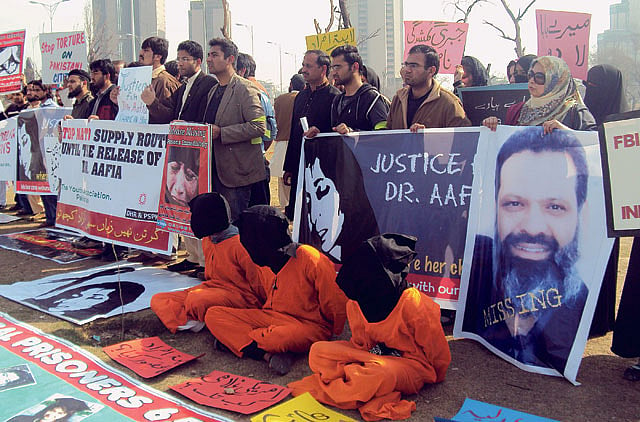
Islamabad: Amina has been on a roller-coaster of hopes raised, hopes dashed and hopes raised again since 2006 when her husband Masood Janjua went missing and the Pakistan Supreme Court took up the issue.
Musharraf-era Minister of Interior Aftab Sherpao had admitted on April 18, 2007, that the government had arrested 4,000 while handed over 2,000 to foreign agencies.
In his biography, General Musharraf admitted receiving money for arresting and handing 689 persons over to other countries. Some of the missing later emerged as far as Guantanamo Bay prison in Cuba.
Today, Amina Masood Janjua along with hundreds other families awaits action from the Judicial Commission on Missing Persons, comprising three retired but well-reputed judges Kamal Mansoor Alam, Fazulur Rehman and Nasira Iqbal.
Untill the fateful evening of July 30, 2005, Amina served as a traditional household woman for 16 years. Her prime responsibility was to serve her ageing parents-in-law and raise her three children Mohammad, aged 20, Ali, aged 18, and Aishah, aged 14.
Over the past five years, time has changed her role from an amateur painter and housewife to a campaigner, businesswoman and public figure.
Besides managing the home, Amina not only runs her husband's business but also spearheads campaigns for Pakistanis picked up by the intelligence agencies and police without a charge.
"When leading human rights figures ignored my pleas, I did not wait for their slumber to finish," recalls Amina, who now chairs the Defence of Human Rights.
She brought activism for human rights out of seminar rooms of five-star hotels to the streets and doorsteps of the sacred and the powerful.
This housewife led a sit-in on the main gate of Inter-Service Intelligence but also attempted to literally to knock the doors of Pakistan Army General Headquarters.
The next morning, newspapers embarrassed Musharraf with Amina's elder son, Mohammad, being shoved into a police van without his trousers.
Using Facebook, Twitter and her website, she is surrounded by thousands of loyal activists.
"We are happy to stand for the cause of the weak. Can you imagine every week, five to six citizens are reported to missing under mysterious circumstances," she says.
Alongside journalists, lawyers and students, Amina firmly stood against Musharraf's imposition of November 3 emergency and for restoration of judiciary.
Ever since the independent-minded judges have returned to their chambers with dignity, there has been no respite in the hardships of missing persons families.
While the Supreme Court takes on the Zardari government unequivocal terms for corruption and abuse of power, it simply could not press the intelligence agencies with similar rulings.
"Even if the commission is set up and the SC bench supervises it, without examining the role of the intelligence agencies that are central in this whole issue, it could all end up as an exercise in futility, with the culture of impunity enjoyed by the intelligence agencies intact, alive and kicking," Daily Times newspaper wrote in a recent editorial.
While Amina's struggle and judicial intervention could facilitate the release of 250-odd persons, ironically her very own husband remains in illegal detention.
Interior Minister Rehaman Malek's recent promises are proving false, she says, and the DHR is gearing up for protest campaign yet again.
"Sooner or later, the tyranny and injustice has to end and courage is all that we are left with now," she says in an uncompromising tone.
Sign up for the Daily Briefing
Get the latest news and updates straight to your inbox
Network Links
GN StoreDownload our app
© Al Nisr Publishing LLC 2026. All rights reserved.